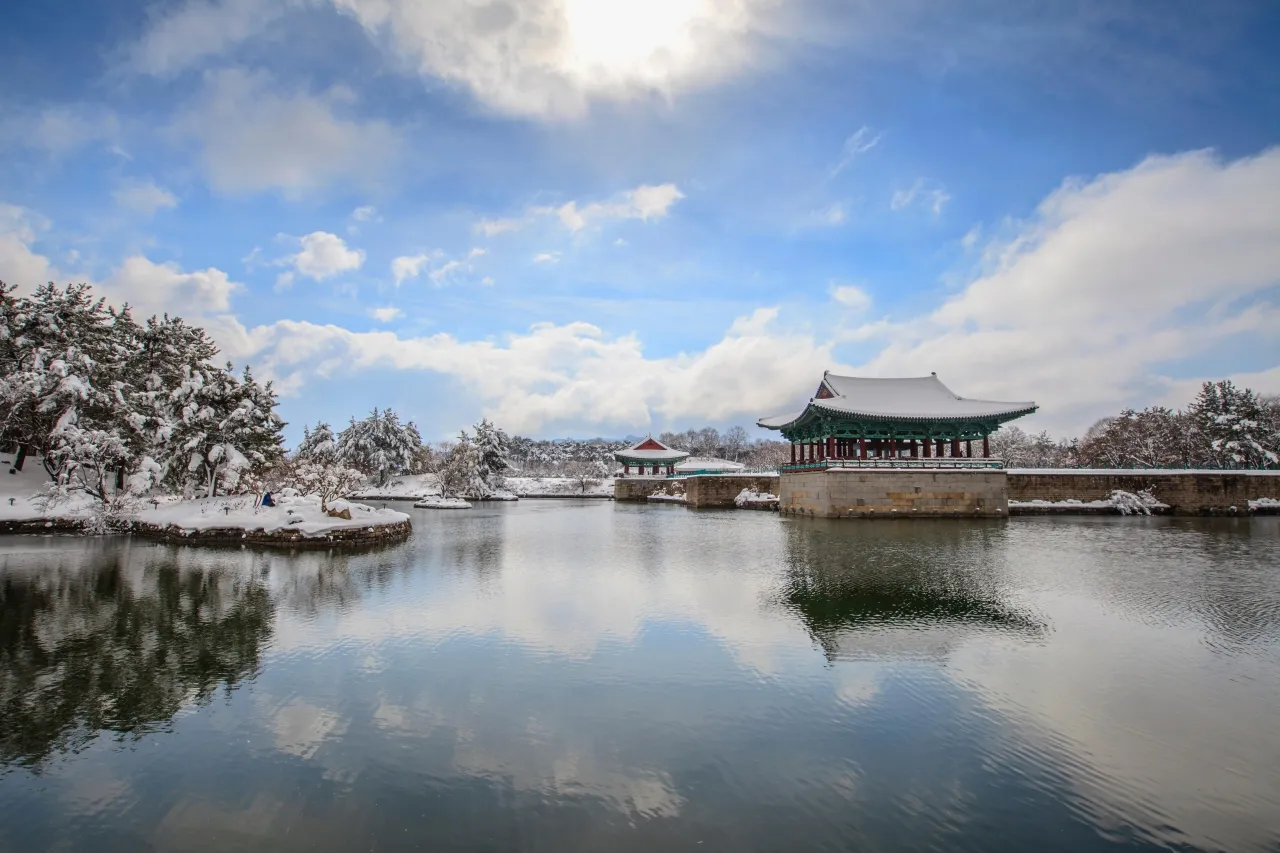
Gyeongju in winter is a daylight problem more than a cold problem. The temples close their gates early, while the lit sites in the old town stay open into the evening.
Plan the day in that order and the trip works, with or without snow.
Quick answer
| Question | Short answer |
|---|---|
| Worth it in winter? | Yes, for quiet heritage sites and lit evenings. Not for promised snow scenery |
| Snow? | Possible, never promised. The city is cold and often bare |
| Cold? | Winter averages 1.7 °C, with a mean low of -3.5 °C. Bring real layers |
| From Seoul? | KTX to Gyeongju Station, about 2 hours. The station is outside the old town |
| From Busan? | Train or intercity bus. Compare both, because the KTX station is far from the center |
| Bulguksa hours? | Last entry 17:00 from November to January, per the temple |
| Seokguram? | Same 17:00 last entry. It is a separate trip uphill, not a short walk |
| Night sights? | Woljeonggyo, Donggung and Wolji, and Cheomseongdae, all outdoors after dark |
| 1 day or 2? | One day is tight. Two days with one night is comfortable |
Is Gyeongju worth visiting in winter?
Yes, if you want Silla heritage without the summer crowds and heat. Winter is quiet, the air is clear, and the lit sites in the old town suit long evenings.
It is a weaker choice if:
- You need deep snow on a set date, which Gyeongju cannot promise
- You dislike cold evenings outdoors, because the best night views are open air
- You only have a few hours, since the temples and the old town sit in different clusters
- You plan to add Seokguram on a day with snow or ice warnings
Gyeongju is a heritage trip, not a snow trip. For the year-round overview of every site, see the Gyeongju travel guide.
For the same trip in another season, see the Gyeongju autumn guide.
Winter weather and snow reality
The figures below are 1991 to 2020 climate normals for the Gyeongju weather station, as published by Gyeongju City. They are seasonal averages for the city, not forecasts and not monthly values.
| Measure | Winter | Summer |
|---|---|---|
| Mean temperature | 1.7 °C | 24.4 °C |
| Average high | 7.6 °C | 29.9 °C |
| Average low | -3.5 °C | 20.1 °C |
| Precipitation | 82.9 mm | 482.6 mm |
Daytime highs sit above freezing on average, and nights fall below it. Winter is also the driest season in the table, which is why a snow day is a bonus and not a plan.
Snow can fall, and a snowy morning can look striking over the tomb mounds and the palace pond. I give no snow depth and no count of snow days, because the source does not publish them.
Check the Korea Meteorological Administration forecast a few days before you go. A snow warning is also a reason to drop the Seokguram climb.
Seoul to Gyeongju in winter
By KTX. The usual rail time from Seoul is about 2 hours. Some trains leave from Seoul Station and others from a different Seoul-area station, so read the departure station on your ticket.
Book through the Korail+ app or the official KORAIL channel, and reserve ahead for weekends. I do not give a timetable or a train frequency here, because they change with the schedule.
| Item | What to know |
|---|---|
| Operator | KORAIL |
| Arrival | Gyeongju Station (the KTX station) |
| Time | About 2 hours. Individual trains differ |
| Booking | Korail+ app or the official KORAIL channel |
| Fare | Check the official site for your date |
For payment steps, see the KTX ticket guide. For the full route and the station transfer, see Seoul to Gyeongju by train. If this is your only long rail trip, compare a single ticket with a pass in the KORAIL Pass guide.
Busan to Gyeongju in winter
Busan is the closer base, and the Busan guide describes Gyeongju as about an hour away by local train or bus. Do not assume the KTX wins from Busan.
The reason is the station. The KTX stops outside the old town, while intercity buses serve the city side, so a slower seat can save a transfer.
| KTX or fast train | Intercity bus | |
|---|---|---|
| Best for | Travelers already on a rail pass or with luggage | Reaching the city side without a station transfer |
| Arrival | Gyeongju Station, outside the old town | A bus terminal in the city. Confirm which one on your ticket |
| Watch for | A taxi or bus after arrival | Winter road delays after snow |
| Booking | Korail+ or the official KORAIL channel | Express or intercity bus booking pages |
I do not give a Busan travel time as a fixed number or a departure frequency. Compare the rail and bus timetables for your exact date before you pick one.
For the Busan side of the trip, see the Busan winter itinerary and the Busan travel guide.
Gyeongju Station is not the old downtown station
This is the most common planning mistake. The current KTX stop is Gyeongju Station, and it is outside the historic center.
It was called Singyeongju Station until it was renamed Gyeongju Station on 28 December 2023. The old downtown Gyeongju Station closed on 28 December 2021.
| Name you may see | What it means |
|---|---|
| Gyeongju Station | The current KTX station, outside the old town |
| Singyeongju Station | The former name of that same KTX station, still on older maps and blogs |
| Old downtown station | Closed in 2021. Do not plan around it |
The renamed station did not move. Arriving there does not put you next to Daereungwon, Hwangnidan-gil, or Bulguksa.
Check the map pin and the address, not just the label, before you book a taxi or a hotel pickup.
One day or two days
This is the main decision.
| One day | Two days, one night | |
|---|---|---|
| Best for | Busan day trips, or a tight Seoul schedule | Seoul visitors who want temple and night views |
| Bulguksa | Possible in daylight | Comfortable in daylight |
| Night views | Possible only if the return train is late | Realistic |
| Seokguram | Usually skip it | Possible on day 2 |
| Buffer | Small. Book the return first | Larger |
| Skip if | You need Seokguram and the night route together | You only have one free day |
Winter makes the gap bigger. The daylight is short, and the temples shut before the best night views begin.
Walkable cluster or bus and taxi
Gyeongju is not one walkable town. It is two clusters and a long gap.
| Cluster | Sites | How to move |
|---|---|---|
| Old town | Daereungwon, Hwangnidan-gil, Cheomseongdae, Woljeonggyo, Donggung and Wolji | Walkable in sections, with a short taxi when it is cold or dark |
| Bulguksa side | Bulguksa, then Seokguram uphill | Bus or taxi from the old town |
| KTX station | Gyeongju Station | Bus or taxi into town |
A taxi is the calmer choice in cold wind, after dark, or with luggage. A T-money card works on city buses, and the Korea transportation guide covers bus and taxi basics.
The historic center in winter
Daereungwon, Hwangnidan-gil, and Cheomseongdae sit close together in the old town. They make the easiest walking loop, and it works in the cold if you keep the stops short.
Warm stops matter more here than in other seasons. Plan a cafe or a meal between outdoor sections, instead of walking the whole loop without a break.
Daereungwon
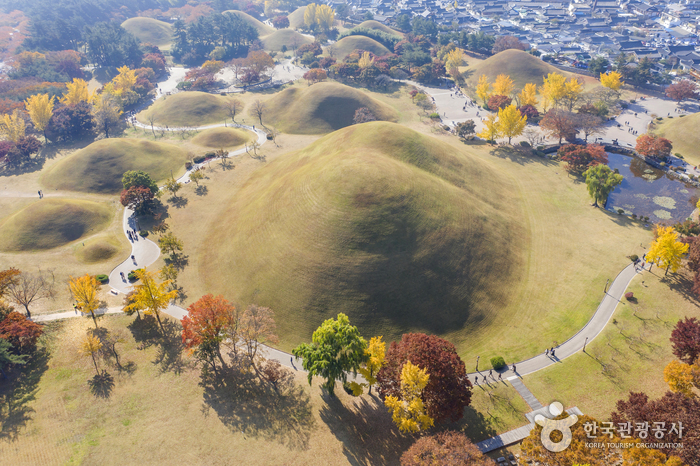
Daereungwon is the royal tomb park, a set of grassy mounds beside Hwangnidan-gil. Visit Korea currently lists the grounds as free, open about 09:00 to 22:00, with a separate fee to enter the Cheonmachong tomb interior.
You do not need the tomb interior for the winter walk. The mounds themselves are the landscape, and a light frost or snow cover changes how they look. Confirm hours and fees at the gate.
Hwangnidan-gil
Hwangnidan-gil is the cafe and restaurant street along the tomb park wall. Use it for a meal, a warm cafe, and a short evening stroll, not as a heritage site.
I do not rank shops, and menus and hours change. Pick a place with a posted menu.
Dietary note. Gyeongju bread and many street snacks use wheat and sweet red bean. Many rice sets include meat or fish. This guide cannot confirm halal, vegetarian, or allergy-safe status for any shop, so ask before you order.
Cheomseongdae
Cheomseongdae is the seventh-century stone observatory, a short walk from the tomb park toward Wolji. The tower is visible from outside, and the grounds are open air.
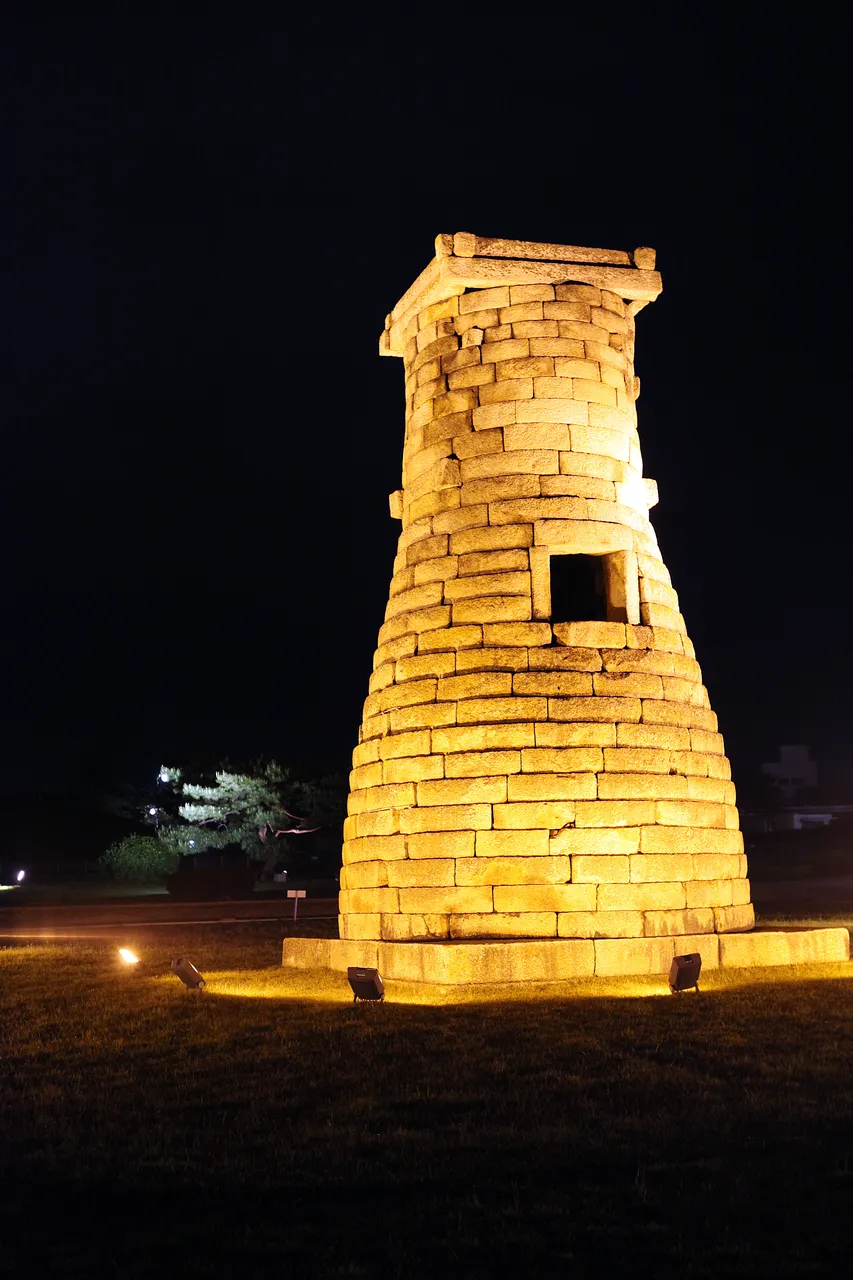
I found no official lighting schedule, so do not plan around a set start or end time for the evening lights. Confirm any viewing-area fee on the city page.
Woljeonggyo
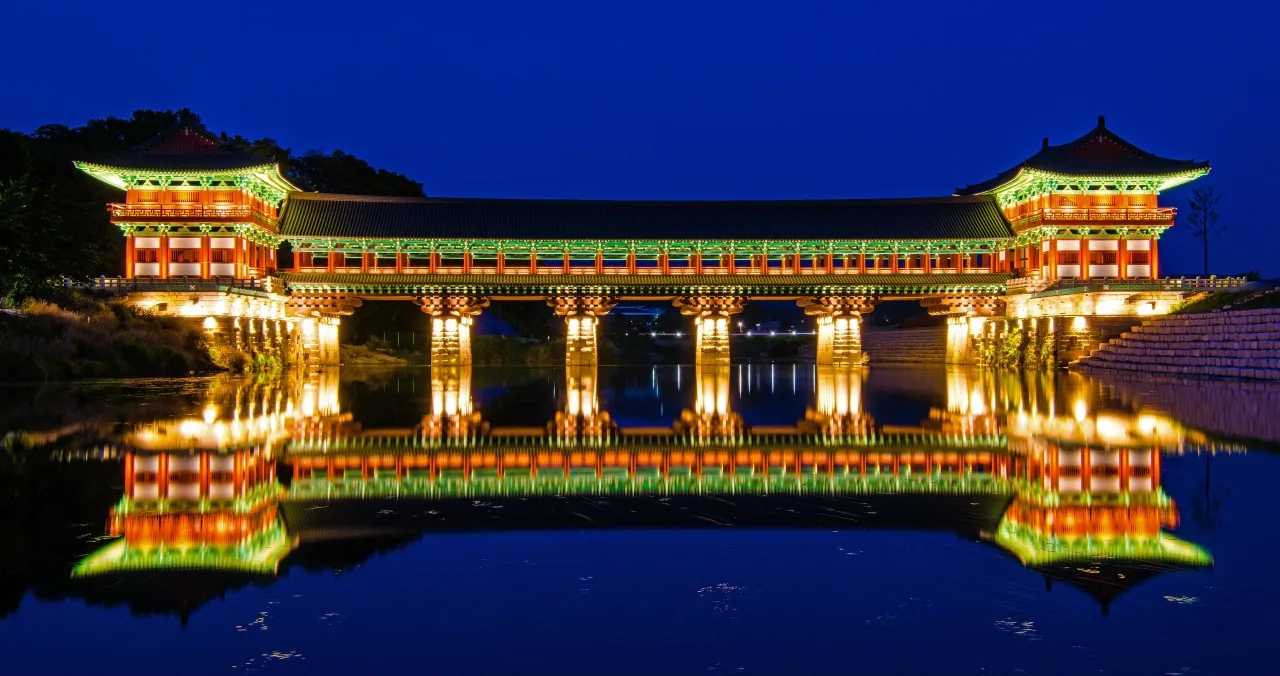
Woljeonggyo is the restored Silla-era wooden bridge over the Namcheon river. Visit Korea currently lists it as free, open about 09:00 to 22:00.
The lights and the river reflection are the draw. The upper corridor can close earlier than the outdoor view, and the bridge is exposed to wind off the water, so confirm on the day.
Donggung and Wolji at night
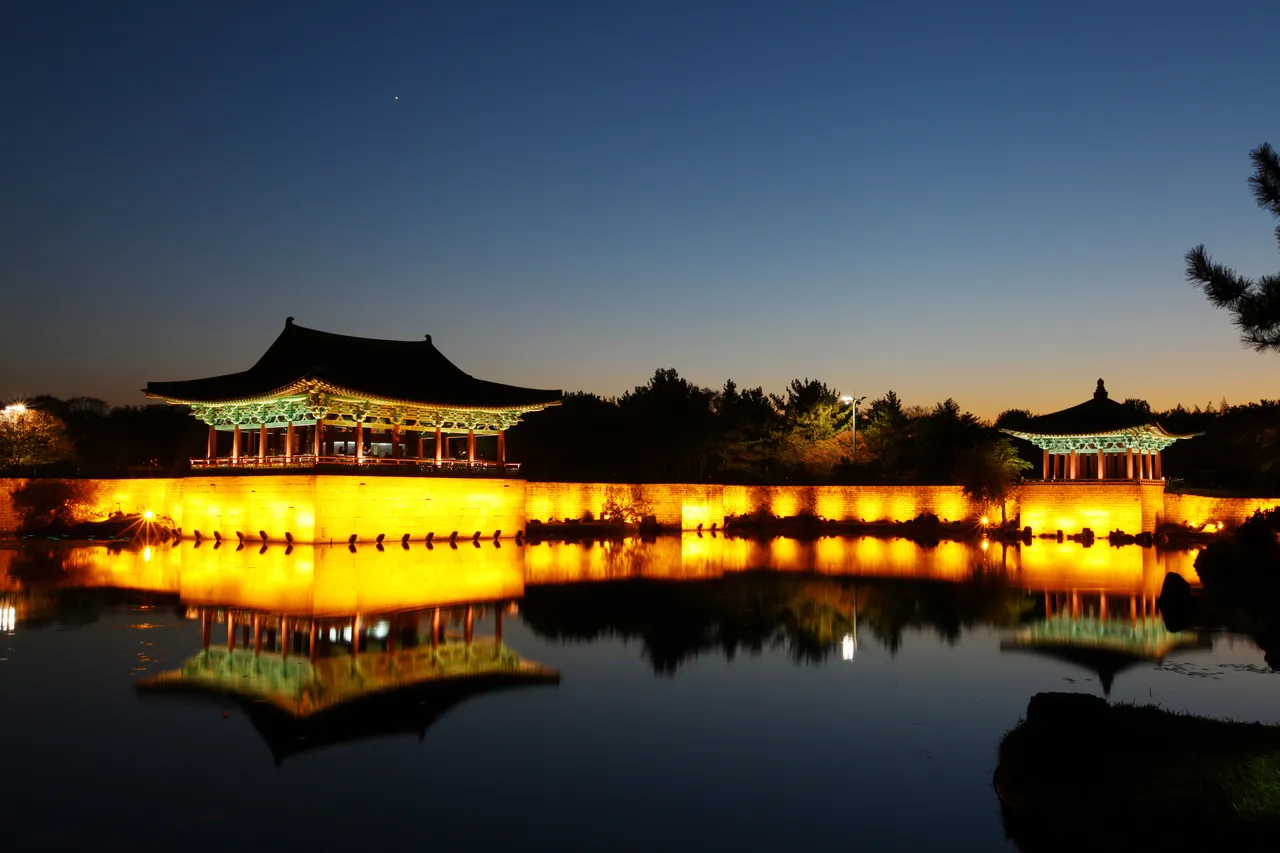
Donggung and Wolji is the Silla secondary palace and its pond, with an older name, Anapji, still on some maps. Visit Korea currently lists it as open about 09:00 to 22:00, with last admission around 21:30 and an adult ticket of ₩3,000. Confirm before you go.
Go after dusk if you only visit once. Arrive with a buffer before last entry, because the pond walk takes time.
I found no official lighting schedule, so I give no start or end time for the lights. A few lit pavilions and a still pond are the reason to come, and wind and cold are the cost.
Bulguksa in winter
Bulguksa is a Silla-era temple on the slopes of Tohamsan, with stone terraces, stairs, and paired pagodas. UNESCO lists Seokguram Grotto and Bulguksa Temple together as one World Heritage property, inscribed in 1995.
The temple's own page lists admission as free since May 2023, with last entry at 17:00 from November to January. It is 17:30 in February and October, and 18:00 from March to September. Pets are not allowed, and parking is charged separately.
Visit Korea lists later hours than the temple does, so use the temple's own times for winter and confirm on the day.
Give the courtyards 90 minutes to 2 hours. The stairs are stone and can be slick in frost, so wear shoes with grip.
Because the sun sets in the late afternoon, Bulguksa belongs to the morning or early afternoon. Do not leave it for the end of the day.
Getting to Bulguksa
Bulguksa is a separate eastern cluster, not next to the tombs. The temple's directions page lists city buses 10 and 11, and it also mentions the bus terminal.
That page still names the old Gyeongju Station, so treat the numbers as a lead and confirm the live route in a Korean map app. A taxi from the old town or the KTX station is the fixed alternative.
Seokguram in winter
Seokguram Grotto is the paired UNESCO grotto, further uphill from Bulguksa. The official page lists free admission and the same last entry as the temple, 17:00 from November to January.
The Buddha is viewed through glass, which protects the grotto's climate, so it is not a broken exhibit. The official page also says heavy snow, rain, and typhoon advisories can restrict entry for visitor safety.
Do not imply a short walk from Bulguksa. Visit Korea gives the distance as about 3 km by trail, and longer by road. In snow or ice, the trail is a walk to plan, not a stroll.
| Option | What to know |
|---|---|
| Local bus | A local bus links the two sites. Confirm the number and the times before you plan around it |
| Taxi | The fixed alternative, and the calmer choice in cold or icy weather |
| Walking the trail | About 3 km per Visit Korea. Skip it in snow, ice, or short daylight |
Do not copy an old hourly shuttle timetable from a blog. Seokguram is optional. Put it on day 2 morning, or skip it if the weather, your legs, or your return train are tight.
What to wear
Cold air and wind at the open-air sites matter more than the temperature number.
- A warm base layer and a mid layer
- A windproof outer jacket
- Warm socks and shoes with grip for stone stairs
- Gloves and a hat for the evening walks
- A warm drink break planned between outdoor sections
Night views at Woljeonggyo and Wolji are exposed, and you stand still to look. Bring a warmer layer than you think you need.
For a fuller packing list, see what to wear in Korea in winter.
Winter daylight and last entries
Winter days are short, and the temples' last entries are at 17:00 from November to January. That sets the whole day.
I do not give a single sunset time. Check the Korea Astronomy and Space Science Institute (KASI) sunrise and sunset table for your date, then work backward from your return train.
| Time of day | Best use |
|---|---|
| Morning to early afternoon | Bulguksa, and Seokguram if you add it |
| Late afternoon | Old town walking, a warm cafe stop |
| After dark | Woljeonggyo, then Donggung and Wolji |
Itinerary: one day
One day works best from Busan, or from Seoul with an early KTX. Book the return train first and build the day around it.
| Time block | Stop | Why this order |
|---|---|---|
| Morning | Arrive at Gyeongju Station or the bus terminal | Check which one your ticket uses |
| Late morning | Bus or taxi to Bulguksa | Use the daylight while the gates are open |
| Early afternoon | Old town: Daereungwon and a warm lunch | Move into the walkable cluster |
| Late afternoon | Cheomseongdae | A short walk toward the pond |
| Evening | Woljeonggyo, then Donggung and Wolji | Lit sites after dark, with a buffer before last entry |
| Night | Taxi to the station or terminal | Keep a margin before your return |
Skip Seokguram on this day. Two sites done well beat four done in a rush.
Itinerary: two days and one night
Two days lets you keep the temple in daylight and the lit sites for the evening.
| Day | Plan |
|---|---|
| Day 1 | Arrive, drop bags in the old town, then Bulguksa in daylight. Return to Daereungwon and Hwangnidan-gil for a warm dinner, then Woljeonggyo and Donggung and Wolji after dark |
| Day 2, Seokguram option | Seokguram by bus or taxi in the morning, then back to the old town for a slow lunch before your return |
| Day 2, slower option | Gyeongju National Museum and Cheomseongdae, then a warm cafe, then your return |
Choose one Day 2 option, not both. Do not zigzag between Bulguksa, Seokguram, the old town, and Bomun in one day.
Where to stay
Choose by what you value, not by hotel name.
| Area | Good for | Trade-off |
|---|---|---|
| Old town, near Daereungwon and Hwangnidan-gil | Walking to the night sights and warm cafes | A bus or taxi to Bulguksa |
| Bomun Lake area | A quieter resort base | Not walkable to the old town. Extra transfers both days |
| Near Gyeongju Station | A very early or late KTX | Far from every site |
Without a car, stay in the old town. If you consider a hanok stay, ask about winter heating and the bathroom setup. Check availability yourself, because I do not recommend specific hotels.
Bad-weather alternative
Rain, snow, or wind change the plan, not the whole trip. Most Gyeongju sites are outdoors, so a rainy day needs a backup.
| If | Try |
|---|---|
| Snow or ice warnings | Skip Seokguram and the trail. Visit Bulguksa only if the roads are open |
| Hard rain or wind | The museum galleries, then a cafe on Hwangnidan-gil |
| Early dark | Reach Donggung and Wolji before last entry. Do not add Seokguram |
Gyeongju National Museum is the indoor backup. Gyeongju City currently lists its permanent galleries as free. The galleries are indoors, but the grounds are outdoors, so confirm hours and any closed days.
Daereungwon, Cheomseongdae, Woljeonggyo, and Donggung and Wolji are all outdoor sites. Do not treat them as indoor options.
Combining Gyeongju and Busan
The two cities pair well, and the Busan guide describes Gyeongju as about an hour away. Gyeongju suits a calmer heritage day, while Busan suits sea views and food.
A sensible shape is one night in Gyeongju between a Busan stay and your next stop. A day trip from Busan also works, with the return train or bus booked first.
I do not give a fixed time or frequency, so check the rail and bus timetables for your date. See the Busan winter itinerary for the Busan side.
Common mistakes
- Assuming the KTX arrives in the old town
- Planning around the old downtown station, which closed in 2021
- Arriving at Bulguksa too late, after the 17:00 last entry
- Treating Seokguram as a short walk from Bulguksa
- Counting on snow, or on a lighting schedule
- Treating an outdoor site as an indoor backup
- Skipping the last entry at Donggung and Wolji
FAQ
Is Gyeongju worth visiting in winter?
Yes, for quiet heritage sites and lit evenings. It is not the place for promised snow scenery.
Does Gyeongju get snow?
It can. Snow is never promised, and the city is often cold and bare. The climate data here is a seasonal average, not a snow count.
How cold is Gyeongju in winter?
The winter average is 1.7 °C, with a mean high of 7.6 °C and a mean low of -3.5 °C. Wind at the open-air sites makes it feel colder.
What should I wear?
Layers, a windproof jacket, warm socks, shoes with grip, gloves, and a hat for the evening walks.
How do I get from Seoul to Gyeongju?
Take the KTX to Gyeongju Station, about 2 hours. Check your departure station on the ticket.
How do I get from Busan to Gyeongju?
By train or intercity bus. Compare both, because the KTX station is outside the old town.
Which station is the KTX station?
Gyeongju Station, formerly called Singyeongju. It was renamed on 28 December 2023 and did not move.
Is the old downtown Gyeongju Station still open?
No. It closed on 28 December 2021. Do not plan around it.
Is one day enough?
It is tight, and it works best from Busan or with an early KTX. Two days is more comfortable.
Can I walk between all the sites?
No. The old town cluster is walkable in sections. Bulguksa and Seokguram need a bus or taxi.
Is Bulguksa open in winter?
Yes. The temple lists last entry at 17:00 from November to January. Confirm before you go.
Can I walk from Bulguksa to Seokguram?
Visit Korea gives about 3 km by trail and longer by road. Use a bus or taxi, and skip the trail in snow or ice.
What are the best night views?
Woljeonggyo, Donggung and Wolji, and Cheomseongdae, all outdoors. I found no official lighting schedule, so confirm on the day.
Is Hwangnidan-gil worth visiting in winter?
Yes, for a warm cafe or meal between outdoor sections. It is a cafe street, not a heritage site.
What if the weather is bad?
Use Gyeongju National Museum, which is indoors. Treat the tomb park, bridge, and pond as outdoor only.
Check before you go
- KORAIL or bus timetable and your exact departure station
- KMA forecast and any snow or cold warnings
- KASI sunrise and sunset times for your date
- Bulguksa and Seokguram last-entry times on the official pages
- Opening hours and fees for the sites you add
Sources
- Gyeongju City: location and climate normals (1991 to 2020, Gyeongju weather station)Official government site
- Korea Astronomy and Space Science Institute: sunrise and sunset timesOfficial government site
- KORAILOfficial transport site
- Visit KoreaOfficial tourism site
- Gyeongju City culture and tourism (official)Official tourism site
- Bulguksa Temple (official)Official tourism site
- Seokguram Grotto (official): hours and admissionOfficial tourism site
- UNESCO World Heritage Centre: Seokguram Grotto and Bulguksa TempleOfficial government site
- KOBUS (Express Bus Integrated Reservation)Official transport site
Information is compiled from official sources. Details such as prices, hours, and schedules can change. Confirm time-sensitive facts before you travel.
Last verified on
Related guides
Gyeongju Travel Guide for First-Time Visitors
Gyeongju is Korea's open-air museum, the thousand-year capital of the Silla kingdom, where royal tomb mounds, a UNESCO temple, and an old observatory sit within easy reach. One full day covers the highlights; arrive by KTX to nearby Singyeongju station.
Seoul to Gyeongju by Train: KTX to Singyeongju and City Transfer
The KTX makes Seoul to Gyeongju an easy ride of a couple of hours, but the part first-timers miss is that the high-speed station sits outside Gyeongju's historic center, not in it, so you still have to plan the transfer into town. Below: booking the train, the recent station-name change, the ride from the KTX station to the walkable historic district, the separate and longer trip out to Bulguksa, and how many days the area really takes. Fares, times, and bus numbers change, so confirm the official and map-app details.