
Korea has among the better public transport systems for visitors anywhere, and you can do an entire trip without renting a car. The pattern is simple: take the train from the airport, use a transit card for subways and buses, take the KTX between cities, and grab taxis for the last mile.
This page is the overview. Use the focused guides when you need the full how-to.
Which guide do you need?
| Your question | Go here |
|---|---|
| How do I get from Incheon into Seoul? | Airport to Seoul |
| How do I buy and top up a transit card? | T-money card |
| How do I book KTX / high-speed trains? | Book KTX tickets |
| Is a rail pass worth it? | Korail Pass |
| Which apps for maps and transit? | Travel apps |
| Do I need a car on the mainland or Jeju? | Car rental · Jeju car rental |
Quick facts
- From the airport
- Airport Railroad (AREX)
- In the city
- Subway + bus with T-money
- Between cities
- KTX high-speed train
- Short hops
- Taxi (Kakao T)
- Pay with
- T-money card
From the airport
From Incheon, the Airport Railroad (AREX) runs into Seoul. The all-stop train is cheaper and takes longer; the express is faster to Seoul Station.
Limousine buses also serve many hotels.
Subways and buses
City subways are clean, signed in English, and easy to navigate with a map app. Buses cover the gaps.
Tap a T-money card on entry and exit, buses and the subway both require tapping out.

Between cities by train
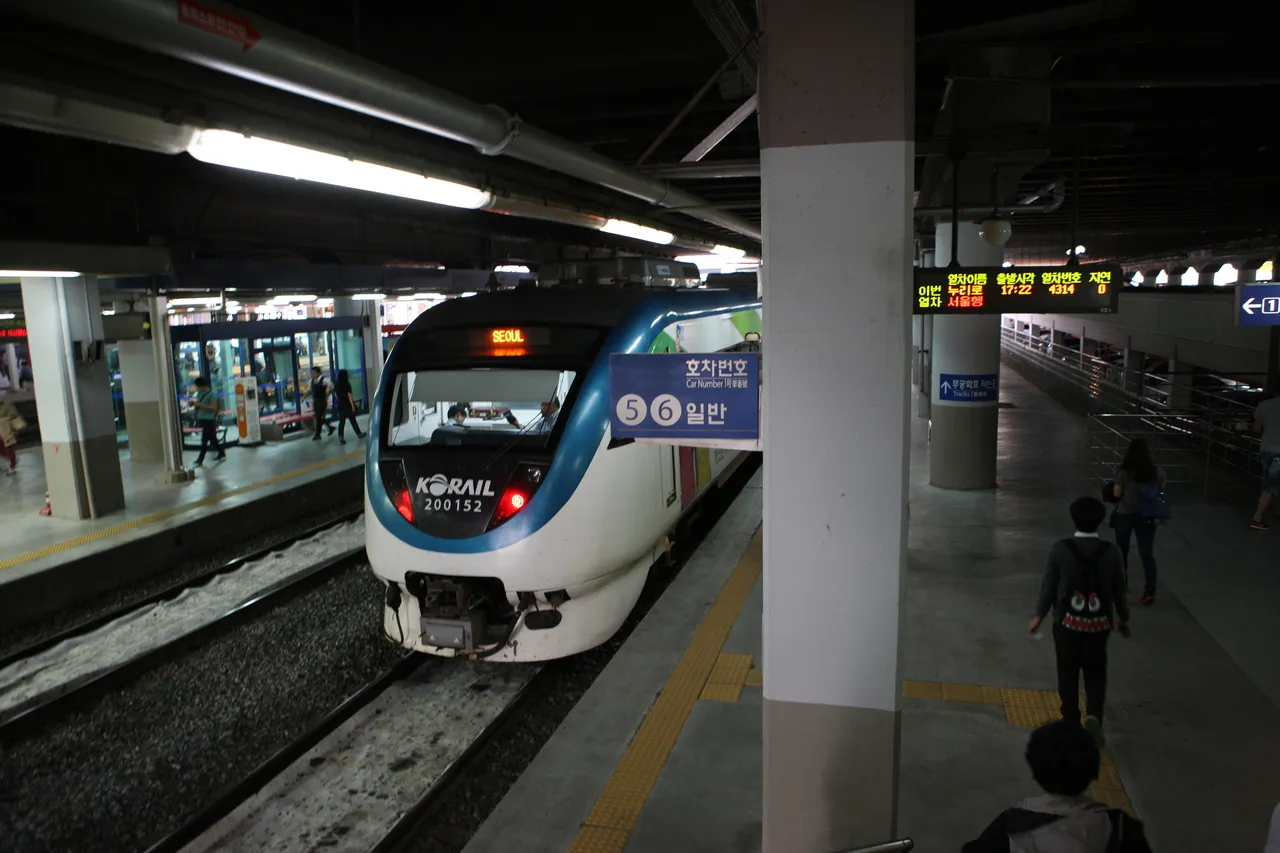
The KTX high-speed train links Seoul, Gyeongju, Busan, and more. Seoul to Busan is about two and a half hours. Book in the Korail+ app or at the station; reserve ahead on holidays.

Taxis
Taxis are reasonable for short trips or late nights. Use Kakao T to hail one and see the fare and route, which sidesteps the language barrier. Most accept cards or a T-money balance.
Useful phrases for getting around
A few polite phrases for taxis, subways, and buses.
Show the driver the address or a map pin as you say it.
Polite여기로 가 주세요
yeo-gi-ro ga ju-se-yo
Please take me here.
Korean audio isn't available on this device or browser. Use the romanization above to say it.
Use this to ask a taxi driver to pull over.
Polite세워 주세요
se-wo ju-se-yo
Please stop here.
Korean audio isn't available on this device or browser. Use the romanization above to say it.
Express buses (inter-city)
For cities the KTX does not reach directly, or where the express bus is cheaper and more convenient, Korea has an extensive inter-city bus network. The two main terminals in Seoul are Seoul Express Bus Terminal (Gangnam) and Dong Seoul Bus Terminal (Gangbyeon), both on the subway. Buses depart frequently to Gyeongju, Jeonju, Busan, Suwon, and many other cities.
Tickets can be bought at the terminal; some routes sell out on holiday weekends, so book ahead when possible.
Inter-city buses are often slower than KTX but cheaper, and they serve destinations that the rail network does not. Confirm whether your route is served by the express bus or the KTX, since travel times vary significantly.
Getting to Jeju Island
There is no train or road link to Jeju. You must fly or take a ferry. From Seoul's Gimpo Airport, flights to Jeju take about one hour.
Air connections also run from Incheon, Busan Gimhae, and other cities. The ferry from Mokpo on the southwest coast takes several hours and is mainly used for cargo and residents. For most visitors, the domestic flight is the practical route.
Book domestic flights through Korean carrier apps or booking platforms ahead of time, especially on holiday weekends when capacity is limited.
Renting a car
Cars are useful for rural areas, Jeju Island, and destinations without good rail links. You need an International Driving Permit (IDP) alongside your home license, and you must drive on the right. Jeju is the most common destination for car rental among foreign visitors, since the island has a limited bus network and scenic coastal routes are better driven at your own pace.
See the car rental guide for foreigners for IDP requirements, insurance, and what to watch for.
Getting between Incheon and Gimpo Airports
If you fly into Incheon but need to connect to a domestic flight from Gimpo (common for Jeju), the Airport Railroad AREX connects both airports. The journey takes about 30 minutes. A T-money card or single-journey ticket covers the fare.
Alternatively, the airport limousine bus stops at Gimpo Airport en route from Incheon to central Seoul.
Maps make it work
Use Naver Map or KakaoMap for routing, Google Maps transit is unreliable in Korea. Search the place name, pick transit, and follow the car numbers and exit numbers the app gives. Both apps have English versions.
Kakao T is the app for hailing taxis: it shows the fare in advance, lets you set the pickup point, and sidesteps the language barrier entirely.
Who should use public transport vs. rent a car?
| Situation | Public transport | Car rental |
|---|---|---|
| Seoul, Busan, major cities | ✓ Ideal | Unnecessary |
| Between Seoul and Busan/Gyeongju | ✓ KTX | Slower by car |
| Jeju Island | Possible but limited | ✓ Most flexible |
| Rural coastline or mountains | Limited | ✓ Useful |
| No international driving permit | ✓ | Not an option |
Common mistakes
- Using Google Maps for transit and getting no usable route or wrong times.
- Forgetting to tap out and getting charged a penalty fare.
- Leaving KTX booking to the last minute on a long weekend, trains sell out.
- Assuming a bus card (T-money) works without a top-up: load cash onto it before you travel.
- Arriving at Daejeon or Suwon instead of Seoul when the station is different from what you expected. Confirm the station name on your ticket before boarding.
- Taking a taxi from Incheon to Seoul: it is expensive compared to the AREX and shuttle bus.
A note on navigation apps
Google Maps cannot route Korean public transport reliably. Use Naver Map or KakaoMap instead for subway, bus, and walking directions. Both have English-language interfaces and handle transfers, exit numbers, and real-time arrival times.
See the Korea travel apps guide for setup instructions.
Frequently asked questions
How do I get from Incheon Airport to Seoul?
Take the Airport Railroad (AREX): the all-stop train is cheaper and takes about an hour to Seoul Station; the Express train is faster. Limousine buses also run directly to major hotels and areas. Avoid taxis from the airport.
They are expensive for this route.
Do I need to buy a separate subway card or ticket every time?
No. A single T-money card works on subways, city buses, and most taxis across Korea. Load cash onto it at any convenience store or machine and tap in and out. See the T-money card guide for how to buy and use one.
How do I book KTX tickets?
The Korail+ app (the update that replaced KorailTalk) is the most convenient for foreigners. You can also book at any KTX station ticket window or machine. For full booking steps see the KTX booking guide.
How long does the KTX take from Seoul to Busan?
About two hours and fifteen to thirty minutes on the fast service. The SRT (from Suseo Station) covers a similar route.
Do I need a car in Korea?
For most first-time trips focused on Seoul, Busan, and Gyeongju, no. The train and subway network is excellent. A car is most useful for Jeju Island and rural destinations, you need an International Driving Permit to rent one.
Sources
- KORAILOfficial transport site
- Airport Railroad (AREX)Official transport site
- Seoul Metropolitan Government Open DataOfficial government site
- Visit KoreaOfficial tourism site
Information is compiled from official sources. Details such as prices, hours, and schedules can change. Confirm time-sensitive facts before you travel.
Last verified on
Related guides

How to Book KTX Train Tickets in Korea: KORAIL, SRT, Korail Pass, and Foreigner Tips
Korea's high-speed booking rules change on 1 September 2026, when KTX and SRT stop being two companies with two apps. Which rules apply depends on the date your train runs: through 31 August the two are still booked separately, and from 1 September the integrated Korail+ app books both. Below: how to book on either side of that date, which Seoul station fits your trip, paying with an overseas card, and what the fare cut does and does not cover.
Korail Pass Guide for Foreigners: When It Saves Money and When It Does Not
The Korail Pass can be great value, or a waste of money, depending entirely on how much you ride. This guide is a buying-decision tool, not a sales pitch: it explains what the pass covers (KORAIL trains like KTX and ITX, not subways or Jeju), why former SRT coverage after 1 September 2026 is not yet published, who can buy it, how seat reservations still work, and a simple way to check whether it beats single tickets for your trip. Pass types, prices, and rules change, so confirm the current details on the official KORAIL site before you buy.