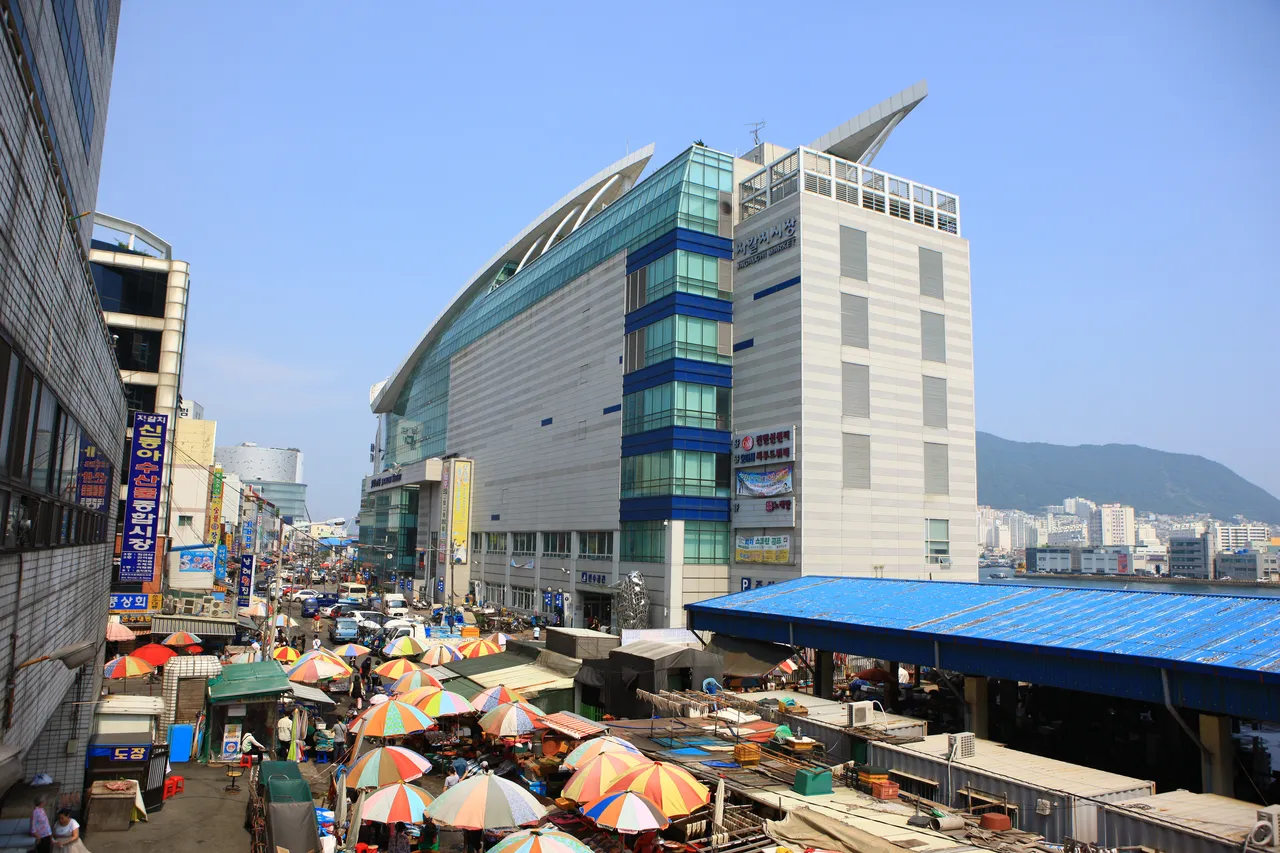
Go to Jagalchi if you want to see a working seafood market on the Busan waterfront and are willing to ask questions before you eat. Skip the sit-down meal if you will not ask for a price, because no source publishes one.
Plan on roughly one to two hours (my estimate). The market building and the street stalls outside run on different rules, so know which one you are standing in.
Quick answer
| Question | Short answer |
|---|---|
| What is it? | A seafood market on the Nampo waterfront. Visit Busan and VisitKorea both describe it as one of Korea's largest |
| Where? | 52 Jagalchihaean-ro, Jung-gu, Busan |
| Nearest station | Jagalchi Station Exit 10 or Nampo Station Exit 2, both Metro Line 1 (the operator and Visit Busan agree) |
| Hours | Sources disagree. See the hours section before you plan around a time |
| Closed days | The operator lists the 1st, 3rd and 5th Tuesdays. VisitKorea lists only the 1st and 3rd |
| Entry | No admission fee is listed |
| Prices | None published. Visit Busan says fees differ by store |
| Raw fish meal | Possible, but confirm weight, price, preparation and table charge first |
Is it worth the stop?
Visit Busan's tagline for the market is "Come, See, Buy": the visit is mostly about looking and shopping, with a meal as an option. If the meal is the whole point, read the ordering sections first.
| You are | Verdict |
|---|---|
| A first-time visitor curious about Busan's seafood culture | A good fit, as a look-around with an optional meal |
| Happy to point, ask and compare before you buy | Yes |
| Wanting a fixed-price set meal with an English menu | Possible elsewhere in Nampo. I found no published English menu for the market |
| Allergic to fish or shellfish | Poor fit. Raw and live seafood is the whole market |
| Vegetarian | Poor fit. See the dietary section |
| Short on time | Walk the market building and the stalls, and skip the meal |
| Using a wheelchair or stroller | The building lists an elevator and accessible facilities. The outdoor stalls are not covered by that listing |
What "Jagalchi" actually means
People use one name for four different things. Keeping them apart avoids most confusion on the day.
| Part | What it is | What the sources say |
|---|---|---|
| The Jagalchi Modernized Market building | The curved-roof building by the water | Run by the Busan Infrastructure Corporation, with the tenant cooperative handling the market floors. It opened in December 2006 per the operator's FAQ |
| The outdoor street stalls | Stalls and parasols around the building | The operator says street shops run like an ordinary traditional market |
| Shin Dong-A Fish Market | A neighboring market | Separate from the building. Visit Busan's bus note names it alongside Jagalchi |
| Jagalchi Ajimae Market | A new sales building | Listed by the operator, with shop placement lotteries still being held in October 2026. I could not confirm that it is open |
Visit Busan traces the name to the pebbles (jagal) on the shore. It says street fish stalls began under Japanese rule and grew after the Korean War, when refugees settled around the area.
That history is why the street and the building feel different. The street is the older market, and the building is the 2006 modernization.
Hours and closed days
I found two answers for opening hours and two for closed days. I publish both rather than pick one.
| Source (checked 2026-10-18) | Hours | Closed days |
|---|---|---|
| Visit Busan | Every day except days off, 05:00 to 22:00 | 1st, 3rd and 5th Tuesdays |
| VisitKorea | 05:00 to 22:00 | 1st and 3rd Tuesdays |
| Operator FAQ (posted 2013) | First-floor seafood market about 5 a.m. to 9 p.m., second-floor raw-fish center about 9 a.m. to 9 p.m. | 1st, 3rd and 5th Tuesdays, plus the day of Seollal or Chuseok and the day after |
| Outdoor stalls | No fixed hours listed. The operator says they run like an ordinary traditional market | No rule listed |
Treat this as a conflict, not a schedule. The operator's FAQ is the only source that separates the floors, but it is more than a decade old.
If you need a restaurant, plan to arrive well before 21:00 and not on a Tuesday near the start of a month. The operator's cooperative office lists the phone number 051-245-2594 for details, but I could not confirm that staff answer in English.
The building is lit after sunset until 22:00 per an operator FAQ posted in 2020. Local events can extend that.
Inside the market building
The operator's floor guide describes a building that runs from the second basement to the seventh floor. The market floors are at the bottom.
| Floor | What the operator lists | What it means for you |
|---|---|---|
| B2 and B1 | Parking | A parking garage exists. I am not giving fees or capacity, because the posted figures are old |
| 1F | Seafood market | Live and fresh seafood in tanks and trays. This is the shopping floor |
| 2F | Raw-fish center and dried fish | The sit-down floor for raw fish and other seafood dishes |
| 3F and above | A youth center, offices and other uses | Not part of the seafood visit |
Floors and tenants are in flux. The operator's site lists tenant bids for 2026, so a shop you read about may have moved or closed. Use floor names as a rough map and read the signs.
The outdoor stalls
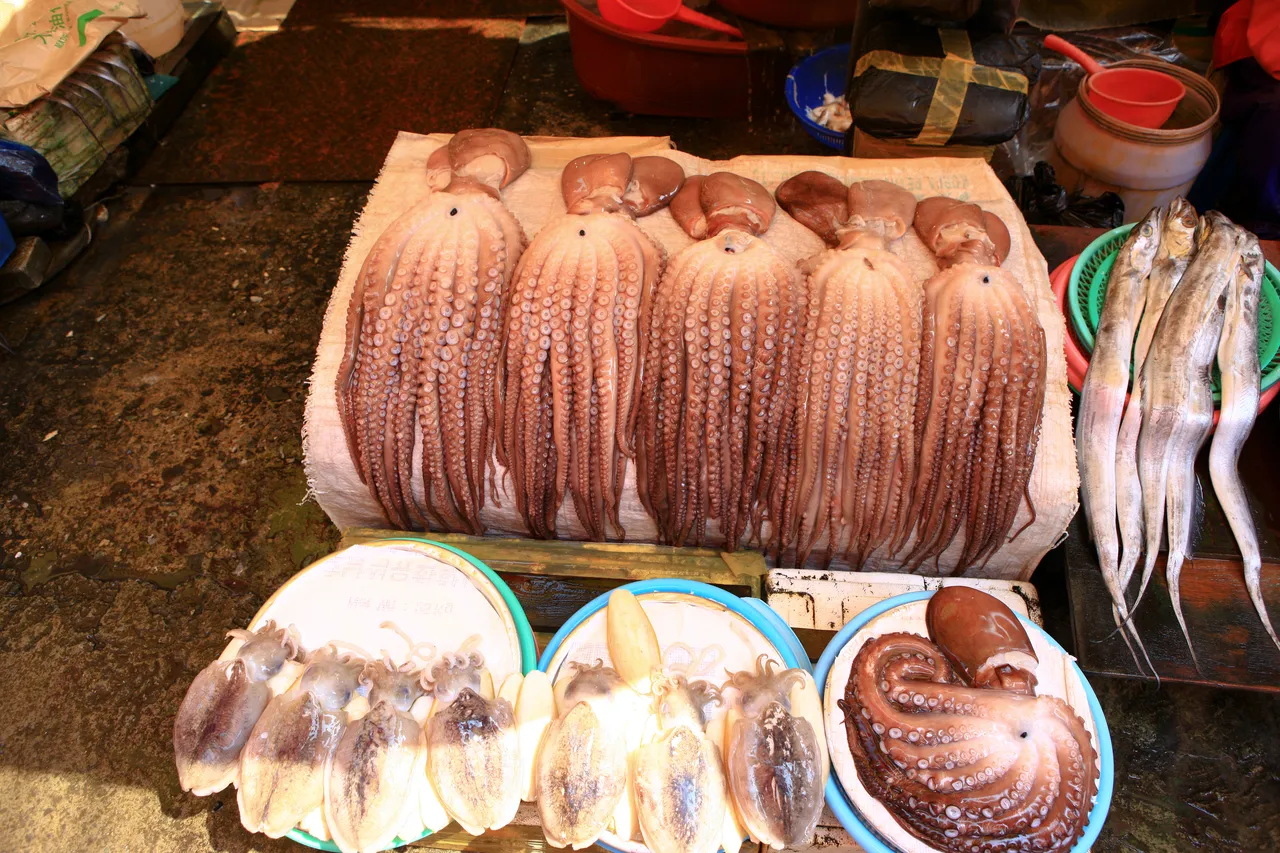
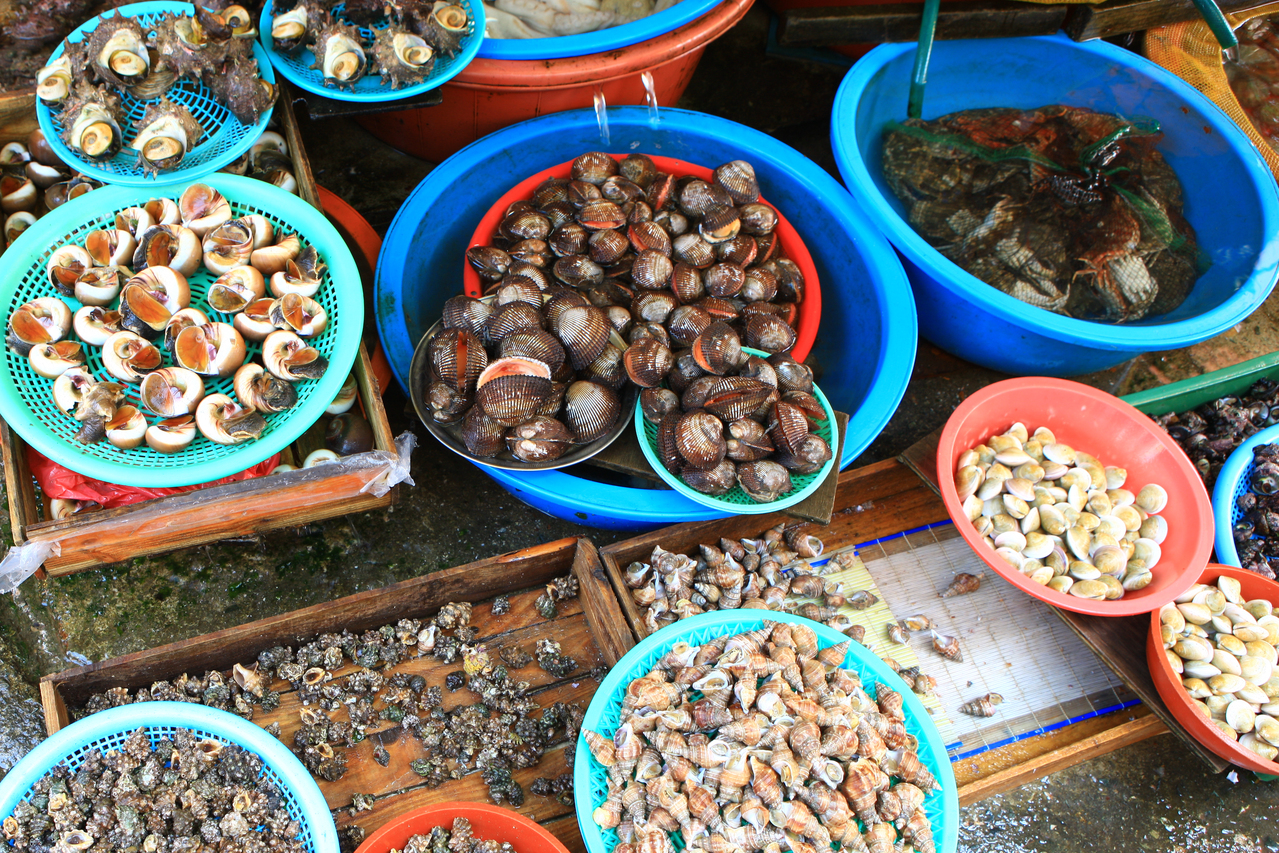
Visit Busan describes colorful parasols and seafood on stalls along narrow alleys, with live octopus in basins. It also says the outdoor market is livelier in the early morning.
I am not turning that into a visiting plan. Market life follows the sea and the season, and I found no official source for a busy hour or a quiet one.
Stall holders sell by the piece or by weight and often prepare nothing on the spot. If you want something cooked or sliced, you will usually need to take it to a restaurant, which the next section covers.
How to eat seafood at Jagalchi
The operator confirms the floor roles: seafood on 1F and a raw-fish center on 2F. The exact buy-then-eat flow is not described by any official page I found, so the steps below are what travelers commonly report. Treat them as a checklist of questions, not a fixed procedure.
- Decide whether you want to eat or only to look. If you only want to look, you can skip the rest.
- Choose where to sit. The second-floor raw-fish center is the building's own dining floor. Street-side and nearby restaurants also exist.
- Look at what is for sale. Live fish and shellfish sit in tanks and trays, and the selection changes with the season.
- Ask before you buy. Ask for the weight, the price and the total for what you point at.
- Ask who prepares it and where. Some restaurants slice or cook what you pick, sometimes for a separate charge, and some set menus include everything.
- Confirm the table charge and the sides. Visit Busan lists service fees as differing by store, so ask what the table or setting charge is and what comes with it.
- Say the total back to them. Repeat the number, or show it on a phone calculator, so both sides agree.
- Pay at the end by a method they accept. Do not assume your card will work everywhere.
Say this while pointing at what you want, before anything is weighed or cut.
Polite가격이랑 무게 먼저 알려 주세요
ga-gyeok-i-rang mu-ge meon-jeo al-lyeo ju-se-yo
Please tell me the price and the weight first.
Korean audio isn't available on this device or browser. Use the romanization above to say it.
What you will see and what to eat
Visit Busan lists live fish, shellfish, octopus and dried seafood, and says restaurants serve raw fish, grilled fish and spicy stew. What is actually available depends on the day.
| Item | Plain English | What to know |
|---|---|---|
| Hoe | Raw sliced fish | The main reason people sit down. The fish depends on the season and the stall |
| Assorted raw fish | A mixed plate of raw fish | Ask what is on it and what the plate costs in total |
| Grilled fish | Fish cooked over heat | A cooked option if you do not want raw |
| Maeun-tang | Spicy fish stew | Often made with fish parts, and usually spicy. Ask |
| Shellfish and octopus | Clams, abalone, octopus and similar | On display at many stalls. Ask whether it is eaten raw or cooked |
| Dried seafood | Dried and salted products | The operator lists dried fish on the second floor |
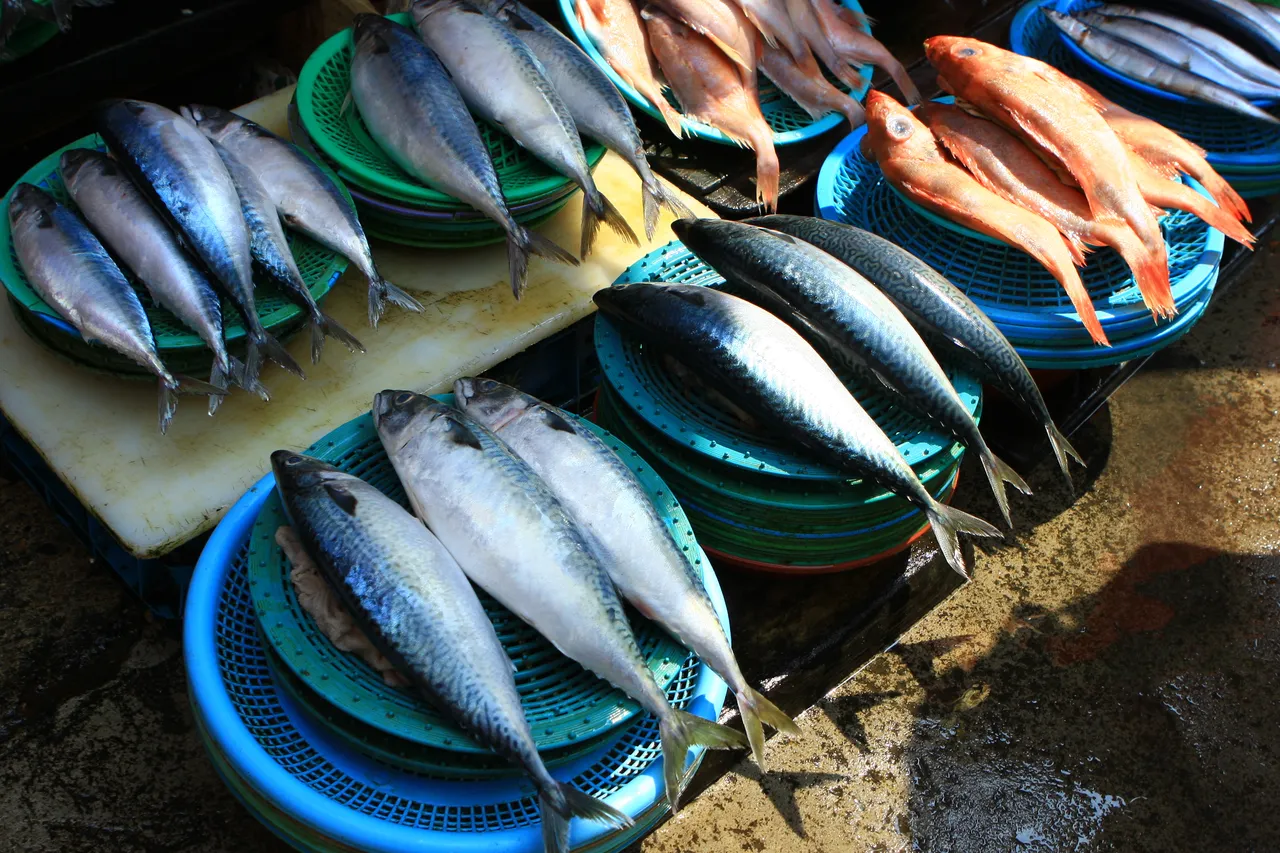
I would not promise any of these on a given day, and I did not verify any single restaurant or dish. A menu is the vendor's, not the market's.
Hoe in plain English
Hoe is raw fish sliced and served fresh. It is usually eaten with side dishes and dipping sauces, often wrapped in a leaf, and the exact set depends on the restaurant.
If you have not eaten raw fish in Korea before, start with a small plate and a restaurant that shows the price. Raw fish is a normal meal here and not a dare, but you can ask for it cooked.
Prices and fees: what to confirm
I am not printing a single seafood price, a table fee or a "typical meal" figure. The operator says prices depend on the season and the item and tells visitors to ask the merchants' association. Visit Busan lists fees as differing by store.
Old blog numbers circulate for this market. Treat any figure you did not see on a menu or a scale that day as out of date.
Before you agree to a plate, confirm these:
- The item and the weight. What exactly is being weighed?
- The price. Per kilogram, per piece or per plate?
- The preparation. Raw, grilled or in stew, and who does it.
- The table or setting charge. Is there one, and per person or per table?
- The sides. What is included, and what is extra?
- The total. Say it back, and ask for it before you eat.
For foreign travelers
Language. I found no official statement that stalls or restaurants offer English service, so plan to point, use a translation app and use numbers on a phone screen. The operator's own pages are in Korean.
Payment. An operator FAQ posted in 2020 says traditional market vouchers, credit cards and the Busan local currency card Dongbaek-jeon are accepted. That is a general statement and each merchant decides, so I would not assume your foreign card works at a given stall. Carry some cash for small stalls and ask before you order.
Eating alone. I found no published solo set menu or portion rule. Ask whether a smaller plate is possible and what the minimum order is. A restaurant may have one.
Allergies. The market sells fish, shellfish and other seafood, and shared tanks, boards and knives are normal. If you have a fish or shellfish allergy, I would not eat raw seafood here.
Raw seafood. Raw fish and shellfish carry the usual food-safety risks of any raw seafood. If you are pregnant, have a weakened immune system, or have a medical reason to avoid raw food, choose cooked dishes or skip the meal. This is general guidance, not a claim about any particular stall.
Halal. I found no halal certification for the market or for its restaurants. Seafood alone does not settle the question, because sauces, side dishes, alcohol and shared preparation surfaces are outside what I could verify. For a wider view see the Korean food guide for Muslim travelers and ask each restaurant directly.
Vegetarian. The market is almost entirely seafood, and stews and sides often use fish-based stock or seasoning. I found no vegetarian-labeled option. Eat elsewhere in Nampo and use the market as a place to look.
Add the food (for example 조개, shellfish) and show it written down.
Polite알레르기가 있어요
al-le-reu-gi-ga i-sseo-yo
I have an allergy.
Korean audio isn't available on this device or browser. Use the romanization above to say it.
Getting there
The market is on the waterfront, a short walk from two Metro Line 1 stations. I am giving no walking times, because the sources disagree: Visit Busan says 6 minutes from the exits and the operator's FAQ says within 3.
| Starting point | What the sources say |
|---|---|
| Jagalchi Station (Line 1) | Exit 10, per the operator and Visit Busan |
| Nampo Station (Line 1) | Exit 2, per the operator and Visit Busan |
| Busan Station | The operator's FAQ says take Line 1 toward Sinpyeong and exit at Nampo or Jagalchi. It lists about 10 minutes, but the FAQ is not dated |
| Haeundae | The operator's FAQ says take Line 2 to Seomyeon, transfer to Line 1, and exit at Nampo or Jagalchi. It also names an express bus, but I am not giving a number |
| Bus | Busan has been changing city bus routes since July 2025. Visit Busan and the operator both list bus numbers, and I am not repeating them. Use a live map |
| Car | A garage is listed in the building, but I am not giving fees or capacity |
Exit numbers can change, so follow the signs on the day. If you use a transit card, the T-money guide explains what to buy.
If you are staying nearby, the Nampo and Jagalchi stay guide covers the area as a base.
What is nearby
The operator's nearby-tourism page lists Gukje Market, BIFF Square and Yeongdo Bridge at about 5 minutes on foot, and Yongdusan Park at about 10. Those are the operator's own estimates and I did not time them. It lists Taejongdae by bus.
- Gukje Market and BIFF Square. Separate places with their own hours. I have no dedicated guide for either yet, so check them before you add them.
- Gamcheon Culture Village. Jagalchi Station is one of the two Line 1 gateways the village lists. The Gamcheon guide covers its 09:00 to 18:00 visitor rule and the village buses.
- Huinnyeoul Culture Village. A cliff-edge lane neighborhood on Yeongdo island, reached by city bus. The Huinnyeoul guide covers the bus options and the walkway and tunnel closures.
- Yongdusan Park. The operator lists it as a longer walk than the others, and it is a different kind of stop.
- Yeongdo Bridge. An operator FAQ says the lift can be seen from the waterfront in front of the market or from a west-side deck on the fifth floor, every Saturday at 2 p.m. for 15 minutes. The FAQ is undated, so confirm the current schedule.
- Jagalchi observation deck. The operator says a seagull-shaped mailbox there collects postcards and sends them in a batch after six months.
For a longer day in the city, see the Busan guide and the 2-day Busan itinerary. For wider planning only, the Haedong Yonggungsa guide covers a separate trip out to the coast.
Common mistakes
- Treating the whole district as one place. The building, the street stalls and the neighboring market run on different rules.
- Going on a closed Tuesday. The operator lists the 1st, 3rd and 5th Tuesdays. Check the week.
- Trusting one set of hours. The sources disagree, so give yourself a margin.
- Ordering without a total. Weight, price and preparation should all be agreed first.
- Assuming a table charge, or assuming there is none. Ask. It differs by store.
- Using an old blog price. Seafood prices follow the season.
- Assuming staff speak English. I found no official statement that they do.
- Assuming your foreign card works. Each merchant decides.
- Picking a fish you cannot identify. If you cannot tell what it is, ask or choose something else.
- Eating raw seafood with a known allergy or a medical reason to avoid it. Choose cooked dishes or skip it.
- Taking "halal" or "vegetarian" for granted. I found no certification and no vegetarian-labeled option.
- Using a bus number from an old page. Busan changed routes in July 2025, so use a live map.
- Expecting an auction show. I found no official source that gives tourists access to a wholesale auction, so do not plan around one.
FAQ
What are the opening hours?
Visit Busan and VisitKorea list 05:00 to 22:00. The operator's FAQ is older and lists about 5 a.m. to 9 p.m. for the first floor and about 9 a.m. to 9 p.m. for the second floor. Treat it as a conflict and arrive early.
Which days is Jagalchi closed?
The operator and Visit Busan list the 1st, 3rd and 5th Tuesdays. VisitKorea lists only the 1st and 3rd. The operator also lists the day of Seollal or Chuseok and the day after.
Is it free to enter?
No admission fee is listed. Anything you buy or order is separate.
Is there one price for a raw fish meal?
No. I found no published price and I am not giving one. Visit Busan lists fees as differing by store.
Do restaurants charge a table fee?
Some travelers report one, but I found no official rule. Ask before you sit down and ask for the total.
Can I buy fish downstairs and eat it upstairs?
The operator confirms a seafood market on the first floor and a raw-fish center on the second. The exact buy-and-prepare flow is not described by any official page I found, so ask the restaurant how it works.
Can I eat on my own?
I found no published solo set or portion rule. Ask whether a smaller plate is possible and what the minimum order is.
Do vendors speak English?
I found no official statement that they do. Use a translation app, point at what you want and show numbers on a phone.
Can I pay by foreign credit card?
An operator FAQ posted in 2020 lists credit cards as accepted, but that is general and each merchant decides. Carry some cash and ask before you order.
Is raw seafood safe to eat?
It carries the usual food-safety risks of any raw seafood. I cannot guarantee any stall. Choose cooked dishes if you are pregnant, have a weakened immune system or have a medical reason to avoid raw food.
Is Jagalchi halal-friendly?
I found no halal certification for the market or its restaurants. Ask each restaurant, and read the Korean food guide for Muslim travelers.
Is there anything vegetarian?
I found no vegetarian-labeled option. The market is nearly all seafood, and stews and sides often use fish-based seasoning.
How do I get there by subway?
Take Metro Line 1 to Jagalchi Station Exit 10 or Nampo Station Exit 2. Follow the signs, because exit numbers can change.
How do I get there from Haeundae?
The operator's FAQ says take Line 2 to Seomyeon, transfer to Line 1, and get off at Nampo or Jagalchi. Use a live map for buses.
How long should I plan?
About 1 to 2 hours for a walk and a look (my estimate). Add time if you sit down for a meal.
Which floor has the raw-fish restaurants?
The operator lists the raw-fish center on the second floor and the seafood market on the first. Tenants change, so read the signs.
Is the outdoor market the same as the building?
No. The operator says street shops run like an ordinary traditional market, separate from the building's hours.
Is the new Ajimae Market open?
I could not confirm it. The operator was still running shop placement lotteries in October 2026, so check before you plan around it.
Can I see the fish auction?
I found no official source that gives tourists access to a wholesale auction. Do not plan a visit around one.
Is it good for a rainy day?
Partly. The building is indoors, and the street stalls are mostly open to the weather.
Is there a wheelchair or stroller route?
Visit Busan lists an elevator, an accessible bathroom and accessible parking for the market. I did not check the outdoor stalls or how crowded the aisles get.
Can I combine it with Gukje Market and BIFF Square?
Yes. The operator lists both at about 5 minutes on foot, which I did not time, and each place has its own hours.
The bottom line
Go for the look, ask for the total, and give the hours some margin. Jagalchi is a real working market, and the meal is the part where the details matter most: weight, price, preparation, table charge and total.
Sources
- Visit Busan: Jagalchi Market (official Busan tourism listing)Official tourism site
- VISITKOREA: Jagalchi Market (Korea Tourism Organization)Official tourism site
- Busan Infrastructure Corporation: Jagalchi Market official siteOfficial government site
- Busan Infrastructure Corporation: Jagalchi Modernized Market floor guideOfficial government site
- Busan Infrastructure Corporation Jagalchi FAQ: operating hours (posted 2013)Official government site
- Busan Infrastructure Corporation Jagalchi FAQ: closed daysOfficial government site
- Busan Infrastructure Corporation Jagalchi FAQ: payment (posted 2020)Official government site
- Busan Infrastructure Corporation Jagalchi FAQ: public transport directionsOfficial government site
- Busan Infrastructure Corporation Jagalchi FAQ: who to ask about seasonal items and pricesOfficial government site
- Busan Infrastructure Corporation Jagalchi FAQ: Yeongdo Bridge lifting viewOfficial government site
- Busan Infrastructure Corporation: sights near Jagalchi MarketOfficial government site
- Busan Infrastructure Corporation: Jagalchi Ajimae Market facility guideOfficial government site
- Busan Infrastructure Corporation notice 2026-334: Jagalchi Ajimae Market shop placement additional lottery (Oct 14, 2026)Official government site
- Busan Infrastructure Corporation Jagalchi FAQ: market building parkingOfficial government site
- Busan Infrastructure Corporation Jagalchi FAQ: building night lighting (posted 2020)Official government site
- Busan Infrastructure Corporation Jagalchi FAQ: seagull mailbox on the observation deckOfficial government site
Information is compiled from official sources. Details such as prices, hours, and schedules can change. Confirm time-sensitive facts before you travel.
Last verified on
Related guides
Busan Travel Guide for First-Time Visitors
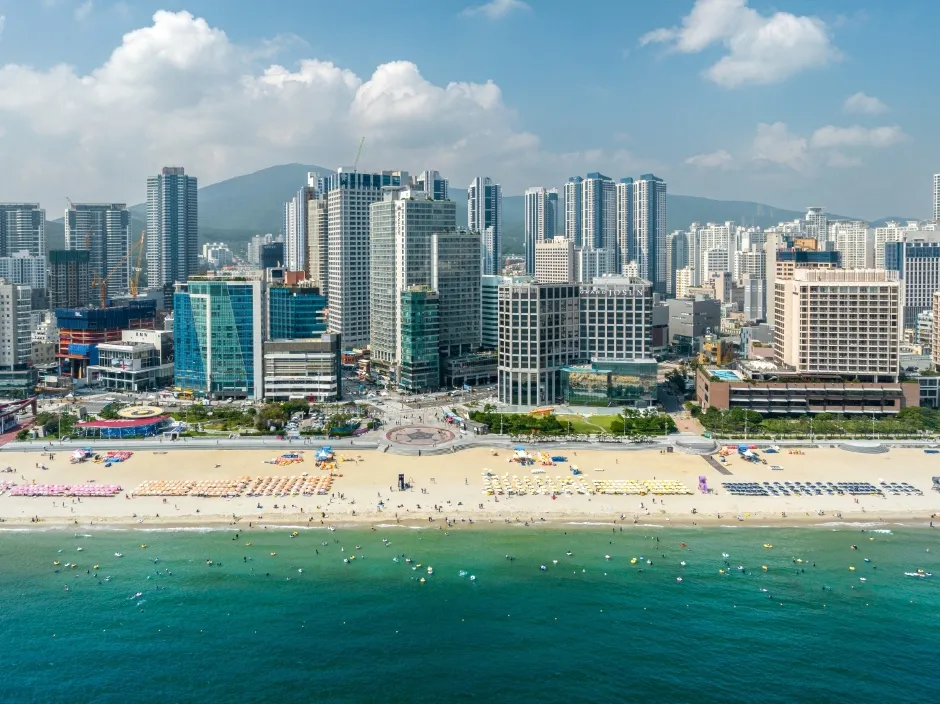
Busan is Korea's second city and its biggest beach destination, a relaxed coastal counterpoint to Seoul. Two to three days covers its beaches, fish markets, and cliffside temple. Most visitors arrive by KTX in about two and a half hours from Seoul.
What to Eat in Busan: A First-Timer's Food Guide
Busan's food is a seaport-and-refugee story: hearty pork-bone soup, wheat-flour cold noodles, and the country's biggest fish market all trace back to the Korean War years. The dishes to try follow (dwaeji gukbap, milmyeon, Jagalchi seafood, Busan eomuk, ssiat hotteok, grilled shellfish, and market snacks), each with where to find it and how to search by name.