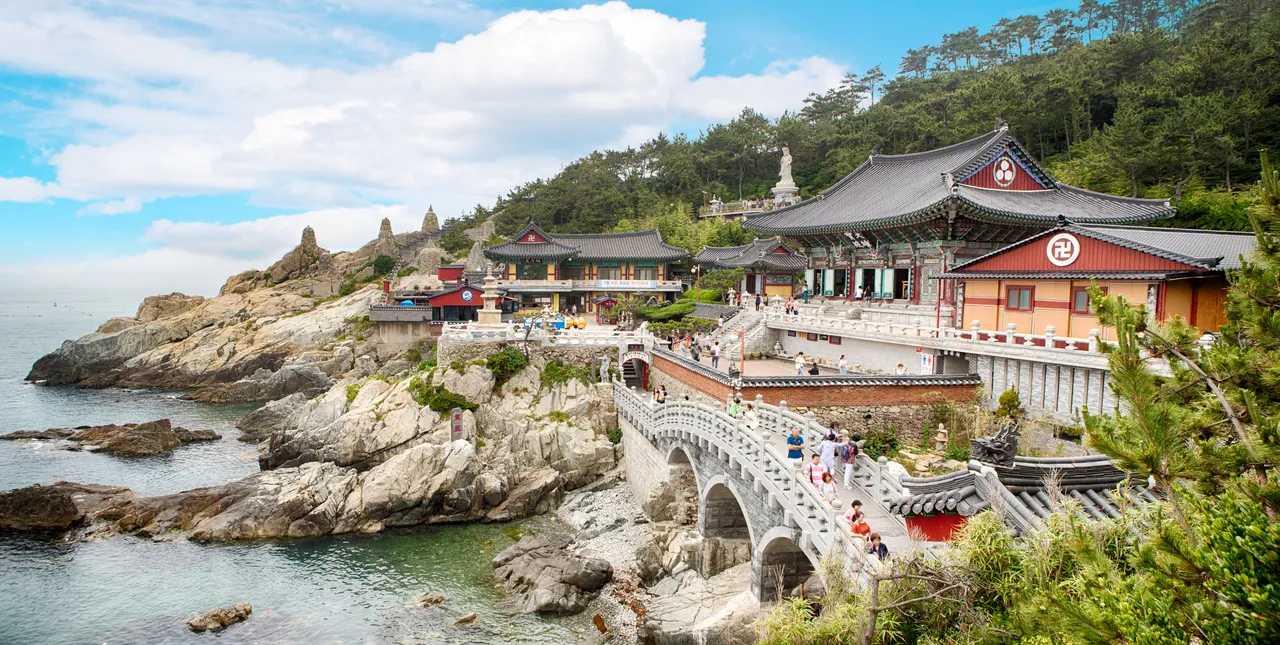
Go if you want a working Buddhist temple with the sea in every frame, and skip it if you only have an hour and no plan for the trip out. It is a coastal stop in Gijang, not a metro stop in the city.
Entry is free. Parking is charged, and the temple's own page and the tourism listings do not agree on when the gates close.
Is it worth the trip?
It suits visitors who like temples, coastline and early mornings. It is a poor fit if stairs are a problem or you want a tight, transit-only plan.
| You are | Verdict |
|---|---|
| A first-time visitor with a free half day in Busan | A good fit if you accept the bus or taxi leg |
| Interested in a temple set on the water | Yes, this is the reason to come |
| Short on time | Possible, but the trip out takes more time than the visit itself |
| Using a wheelchair or stroller | Not recommended as a plan. The route has stairs and no published step-free path |
| Hoping for a sunrise | Possible if you reach it before dawn, but sunrise times change by date |
| Wanting a quieter visit | Go early in the day, and keep your voice low inside |
Hours, admission and parking
The official sources disagree, so I am not giving one closing time as fact.
| Source (checked 2026-10-18) | What it says |
|---|---|
| VisitKorea and Visit Busan | Open every day, 04:30 to 19:20, last entry 18:50, free |
| The temple's own visiting page | Entry from 4:30 a.m., exit at 8:30 p.m., free, open all year |
The safe reading is to treat 04:30 as the earliest and 18:50 as the latest you should arrive. Neither source gives a holiday closure, and both describe it as open all year.
To confirm on the day, call the temple at +82-51-722-7744. Another option is the 1330 Korea Travel Helpline, which VisitKorea lists for visitors.
Parking is separate from the temple. Visit Busan lists the temple parking lot as charged, and the temple's own page says parking fees are unrelated to the temple and lists amounts by vehicle size. Those amounts look like old figures and I am not repeating them, so read the sign at the lot.
What you will see
Visit Busan describes the approach as a walk past a row of twelve zodiac animal figures, through the Iljumun Gate, and down a set of 108 stairs through a pine grove to the temple. The temple's own visiting page lists the main hall (Daeungbojeon), a Budai statue (Podaehwasang), a dragon shrine (Yonggungdan), the Seaside Avalokitesvara statue (Haesu Gwaneum Daebul), the Yaksajeon hall and a Jijang Bodhisattva shrine at the release site by the water.
Visitors throw coins from the stone bridge, which Visit Busan names Yongmungyo Bridge, and make a wish. Visit Busan says the stairs beside the main hall lead to the statue and a sea view.
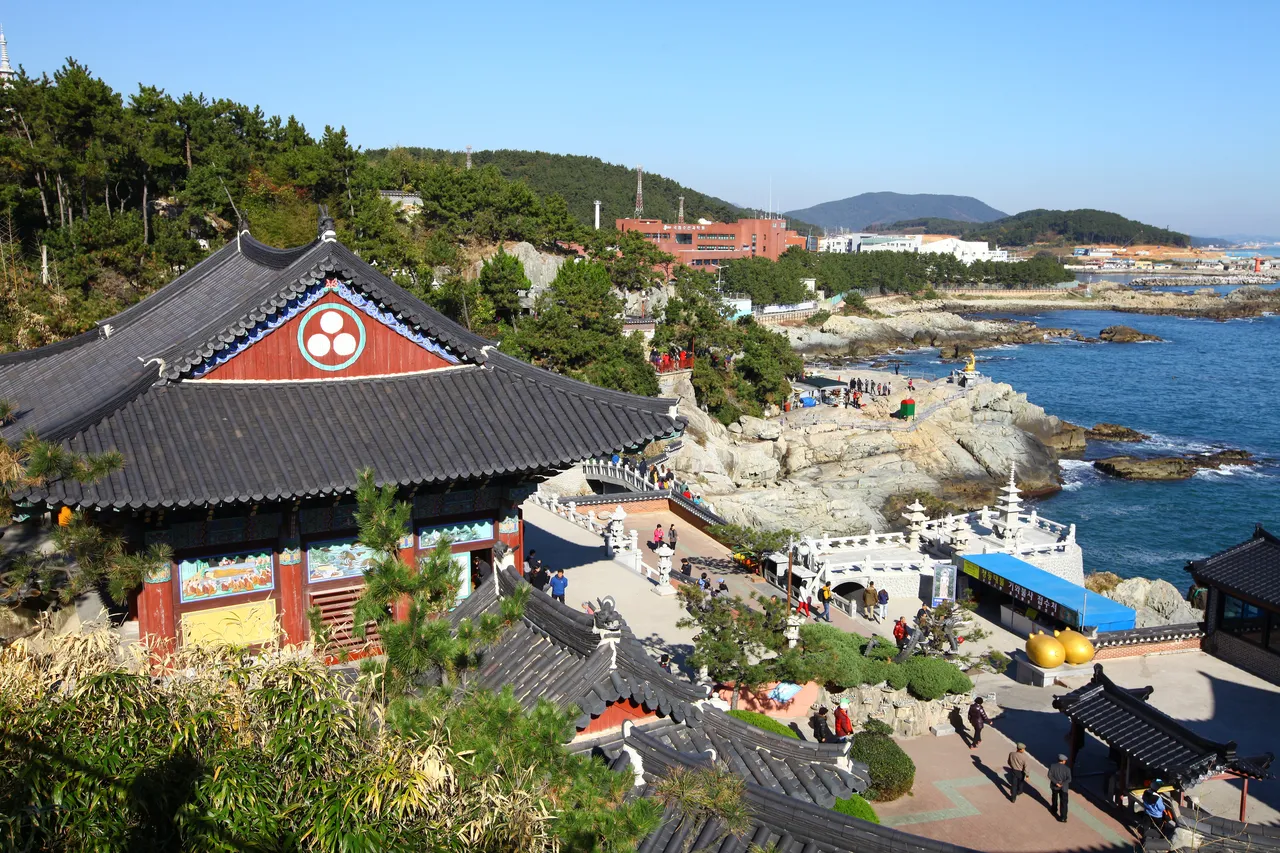
Past the halls, a coastal trail leads along the rocks. Visit Busan places it on Haeparang Trail Route 1 and highlights a sunrise rock, but it does not say how long the trail is, so I am not giving a distance.
The 108 stairs and how hard the walk is
The 108 stairs are named by both Visit Busan and the temple's own scenic-views page. I use the number as the name the sources give, and I did not count the steps myself.
Treat the visit as a walk with many steps. Wear shoes with grip, because stone can be slippery after rain or sea spray.
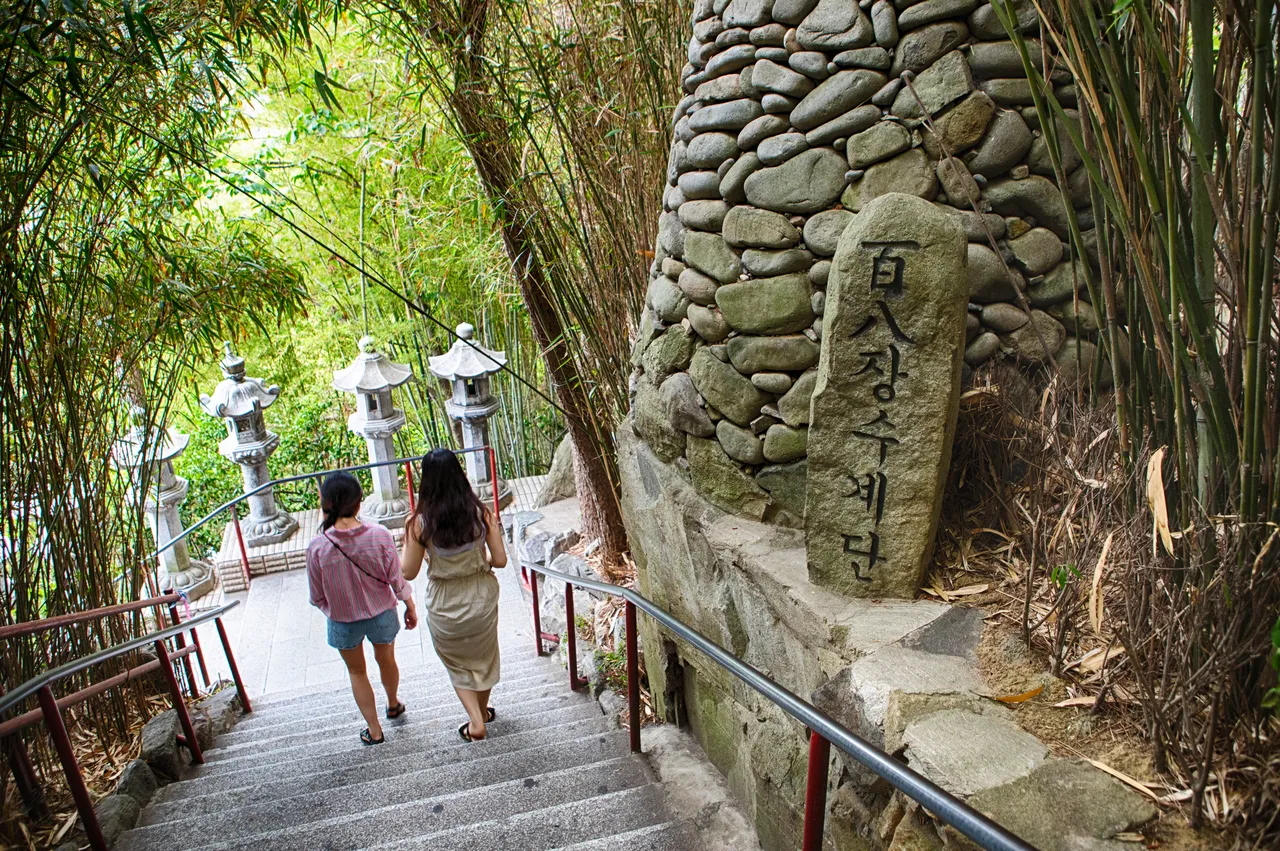
I found no official figure for the walking distance or the time from the gate to the halls. For planning, I allow 1 to 2 hours on site, and that is my own estimate.
Accessibility
Visit Busan lists an accessible restroom and says companion animals are allowed in a carrier or with a muzzle. That is the only accessibility information I found from an official source.
The temple route is built around stairs. I found no published step-free path and no stated wheelchair or stroller access. If you need level access, call the temple or the 1330 helpline before you travel.
History: what is documented and what is tradition
The temple's own history page says Haedong Yonggungsa was founded in 1376, in the Goryeo period, by the monk Naong. VisitKorea gives the same founding year and the same founder.
The temple's page and VisitKorea agree that the buildings were lost in the Imjin War and rebuilt in the early 1930s by the monk Ungang of Tongdosa. The temple's page adds that it was then called Bomunsa.
The rename comes from a dream. The temple's page says that in the early 1970s the monk Jeongam, who vowed to restore the temple as a Gwaneum site, saw the White-Robed Avalokitesvara rise on a dragon, and afterward renamed the mountain Botasan and the temple Haedong Yonggungsa. "Yonggungsa" means Dragon Palace Temple.
VisitKorea dates Jeongam's arrival to 1974, while the temple says only the early 1970s, so I use "early 1970s". The dream is a religious tradition told by the temple, not a documented event, and the temple also describes Naong building a hut here as something handed down.
Why it is called a seaside temple
Most Korean temples sit in the mountains. This one stands on rock at the waterline, which is why VisitKorea calls it a rare find among Korean temples.
The temple's own history page counts itself among Korea's three major Gwaneum (Avalokitesvara) sites, alongside Naksansa in Yangyang and Boriam in Namhae. That is the temple's own claim, and both of the others are also on the coast, so I do not call this the only seaside temple in Korea.
Etiquette and dress
Visit Busan lists three points. Lower your voice inside the temple, use only the side doors to enter and leave the sanctuary because the front door is for monks, and organize your shoes.
I found no published dress code for visitors. As a courtesy and my own suggestion, not a rule from the temple, wear clothes you are comfortable in at a place of worship and shoes you can walk in on stairs.
Treat it as an active temple. Do not walk through a service or prayer, and follow any posted sign over this page.
Photography
I found no official photography policy beyond what signs at the site say. Do not point a camera at someone praying, and I found no drone rule, so check before flying one.
For sea views, Visit Busan points to the stairs next to the main hall. The shoreline is rocky, so keep behind rails and away from wet rocks, and do not climb for a shot.
Sunrise, the full moon and New Year
The temple's own scenic-views page praises the sunrise, a moonlit walk down the 108 stairs on a full-moon night, mist, the evening bell at sunset, waves, the Sirangdae viewpoint, spring cherry blossoms and Buddha's Birthday lanterns. These are the temple's own descriptions, not guarantees.
For sunrise, check the time for your date on the Korea Astronomy and Space Science Institute site, and arrive before it. The listed opening time of 04:30 is what makes this possible, but I did not verify any special night access.
The temple's annual calendar lists a New Year sunrise release prayer on solar January 1 and a lunar January 15 prayer. I found no official crowd or parking plan for those days, so I expect them to be busy and suggest you check ahead.
Buddha's Birthday
The temple's calendar marks Buddha's Birthday on the eighth day of the fourth lunar month, with a lantern-lighting event. The scenic-views page says the lanterns are best seen from the Yaksajeon hall.
The solar date changes every year, and I did not verify the current year's schedule or any crowd control. I expect the grounds to be much busier, so confirm the date and any program with the temple.
Getting there
Public transport routes here change. Busan reorganized its city bus network on July 5, 2025, with Gijang and Gangseo changed first, according to the city's own announcement.
I could not confirm which numbers stop at the temple today, so use the table as a starting point and check a live map.
| Starting point | Official listing, with my caution |
|---|---|
| Haeundae Station (Metro Line 2) | Visit Busan lists Exit 7, then bus 181, 100 or Haeundae 9. The temple's own page lists 181 and village bus 9 |
| Osiria Station (Donghae Line, not Metro Line 2) | Visit Busan lists Exit 1 and a bus, naming 139 on this page and 1001 or 139 on nearby listings, then a walk of about 15 minutes from the stop. The 2025 reorganization may have changed 139 |
| Busan Station | Visit Busan lists the City Tour Bus Red Line, then the Haeundae Beach Blue Line to the temple |
| Taxi | Show the driver 해동용궁사, Gijang-eup, Yonggung-gil 86. I am not giving a fare or a time |
| Car | Use the temple lot, which is charged |
The stop name on the Visit Busan listings is Yonggungsa and National Institute of Fisheries Science. Search for 용궁사 in Naver Map or KakaoMap, and select the bus option for the current route and the next arrival.
Busan's Tabara demand-response bus was a 2023 pilot around Osiria Station, and the city's 2025 announcement says demand-response service was being expanded in Osiria. I could not confirm whether it serves the temple now.
A T-money card works on buses, as covered in the T-money guide. Keep one ready, because the bus leg is the part you cannot do by metro alone.
Pairing it with nearby stops
The National Fisheries Science Museum is beside the temple, and the Osiria Coastal Walk is a short distance north. The temple's own page names Haeundae Beach and Songjeong Beach as nearby places, but I did not verify walking links.
Each of these is a separate site with its own hours and fees, so check them before you add them to the day. For where they fit in the wider city, see the Busan guide and the 2-day Busan itinerary.
If you are staying in Haeundae, start with the Haeundae stay guide and compare beach areas in Haeundae vs Gwangalli.
Religious terms in plain English
| Term | Meaning |
|---|---|
| Daeungjeon or Daeungbojeon | The main hall of a temple |
| Gwaneum | The Korean name for Avalokitesvara, the Bodhisattva of compassion |
| Bodhisattva | An enlightened being who helps others, in Mahayana Buddhism |
| Iljumun | The one-pillar gate at the entrance to temple grounds |
| Yaksajeon | A hall for the Medicine Buddha |
Food and facilities
I did not verify food stalls or restaurants at the temple, so I am not naming any. If you have Muslim, vegetarian or allergy needs, ask staff directly and do not rely on a menu description.
VisitKorea lists a restroom at the temple. Bring water and a layer, because the coast can be windy.
Common mistakes
- Using an old bus number as current. Busan changed its routes on July 5, 2025.
- Treating the metro as the whole trip. There is a bus or taxi leg after the station.
- Arriving at 19:15. The listings give 18:50 as last entry.
- Assuming the 108 stairs are the only stairs. I did not verify the full layout of the route.
- Calling it the only seaside temple in Korea. The temple's own list names two others.
- Wearing slippery shoes. Stone can be wet from rain and spray.
- Using the front door. Visit Busan says it is for monks, so use the side doors.
FAQ
Is Haedong Yonggungsa free?
Yes. VisitKorea, Visit Busan and the temple all list entry as free. Parking is charged separately.
What are the opening hours?
The tourism listings say 04:30 to 19:20 with last entry at 18:50, and the temple's own page says 4:30 a.m. to 8:30 p.m. Treat 18:50 as the safe last arrival and call to confirm.
How do I get there from Haeundae?
Visit Busan lists Metro Line 2 to Haeundae Station Exit 7, then a bus. Confirm the current number on a live map, because Busan changed routes in July 2025.
How do I get there from Busan Station?
Visit Busan lists the City Tour Bus Red Line followed by the Blue Line to the temple. The temple's page also describes metro to Haeundae and then a bus.
How many stairs are there?
Visit Busan and the temple name 108 stairs. I did not count them.
Is there a dress code?
I found no published dress code. The posted etiquette is to lower your voice, use the side doors and organize your shoes.
Can I see the sunrise?
The temple opens at 04:30, so arriving before sunrise should be possible. Check the sunrise time for your date and confirm access with the temple.
Is it good for wheelchairs or strollers?
I would not plan on it. The route has stairs and I found no published step-free path.
Is it the only seaside temple in Korea?
No. The temple counts itself among three major Gwaneum sites, and the other two are also on the coast.
Are pets allowed?
Visit Busan says pets can enter in a carrier or with a muzzle.
The bottom line
Go early, expect stairs and verify the bus on the day. The temple is free, but the closing time is disputed and the bus numbers online are the part most likely to be wrong.
Sources
- Visit Busan: Haedong Yonggungsa Temple in Gijang (hours, fees, etiquette, transport)Official tourism site
- VISITKOREA: Haedong Yonggungsa Temple (Busan)Official tourism site
- Haedong Yonggungsa (official temple site): visiting information, entry and parking noticeofficial_service_site
- Haedong Yonggungsa (official temple site): temple historyofficial_service_site
- Haedong Yonggungsa (official temple site): public transport guidanceofficial_service_site
- Haedong Yonggungsa (official temple site): annual prayer and ritual calendarofficial_service_site
- Haedong Yonggungsa (official temple site): the temple eight scenic viewsofficial_service_site
- Busan Metropolitan City: July 5, 2025 city bus route reorganization announcement (Gijang and Gangseo first)Official government site
- Busan City story report: Tabara demand-response bus pilot around Osiria Station (September 2023)Official government site
Information is compiled from official sources. Details such as prices, hours, and schedules can change. Confirm time-sensitive facts before you travel.
Last verified on
Related guides
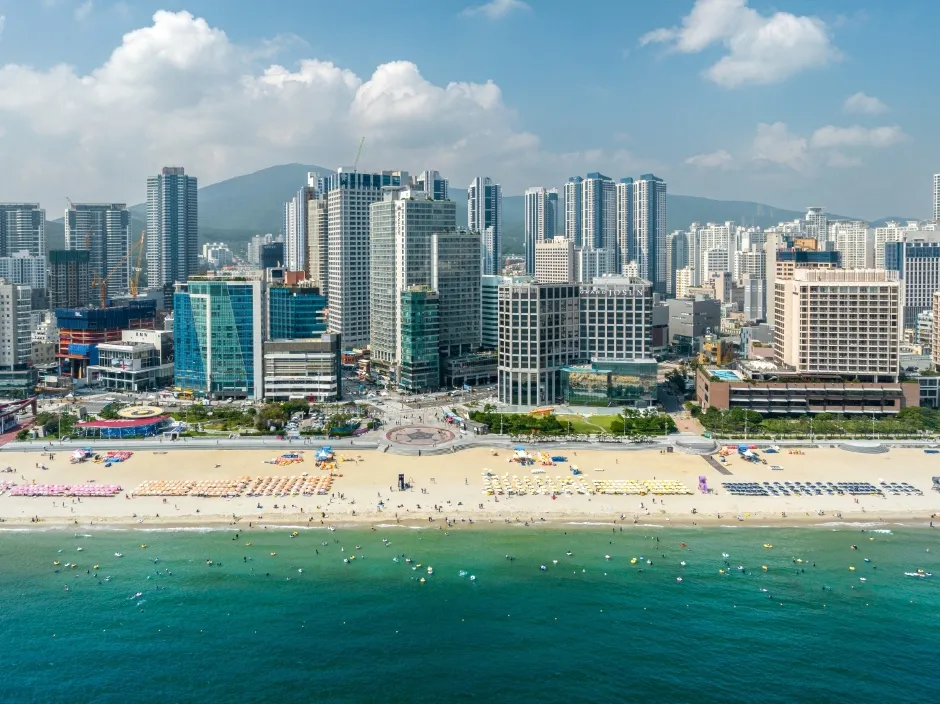
Busan Travel Guide for First-Time Visitors
Busan is Korea's second city and its biggest beach destination, a relaxed coastal counterpoint to Seoul. Two to three days covers its beaches, fish markets, and cliffside temple. Most visitors arrive by KTX in about two and a half hours from Seoul.

Busan 2-Day Itinerary for First-Time Visitors
Two days in Busan split by theme: the coast, beaches, and a cliffside temple on day one, then seafood markets and the Gamcheon culture village on day two. Built around the metro and a couple of short taxi hops.