
For eleven nights in September, the metal shell of Dongdaemun Design Plaza stops being a building and becomes a screen. Seoul Light DDP is free, outdoors, and needs no ticket.
The 2026 autumn edition runs September 3 to 13, nightly from 7:30 PM to 10:30 PM.
The decisions worth making in advance are small but real: which night, and what else you do in Dongdaemun while you are there.
What Seoul Light DDP actually is
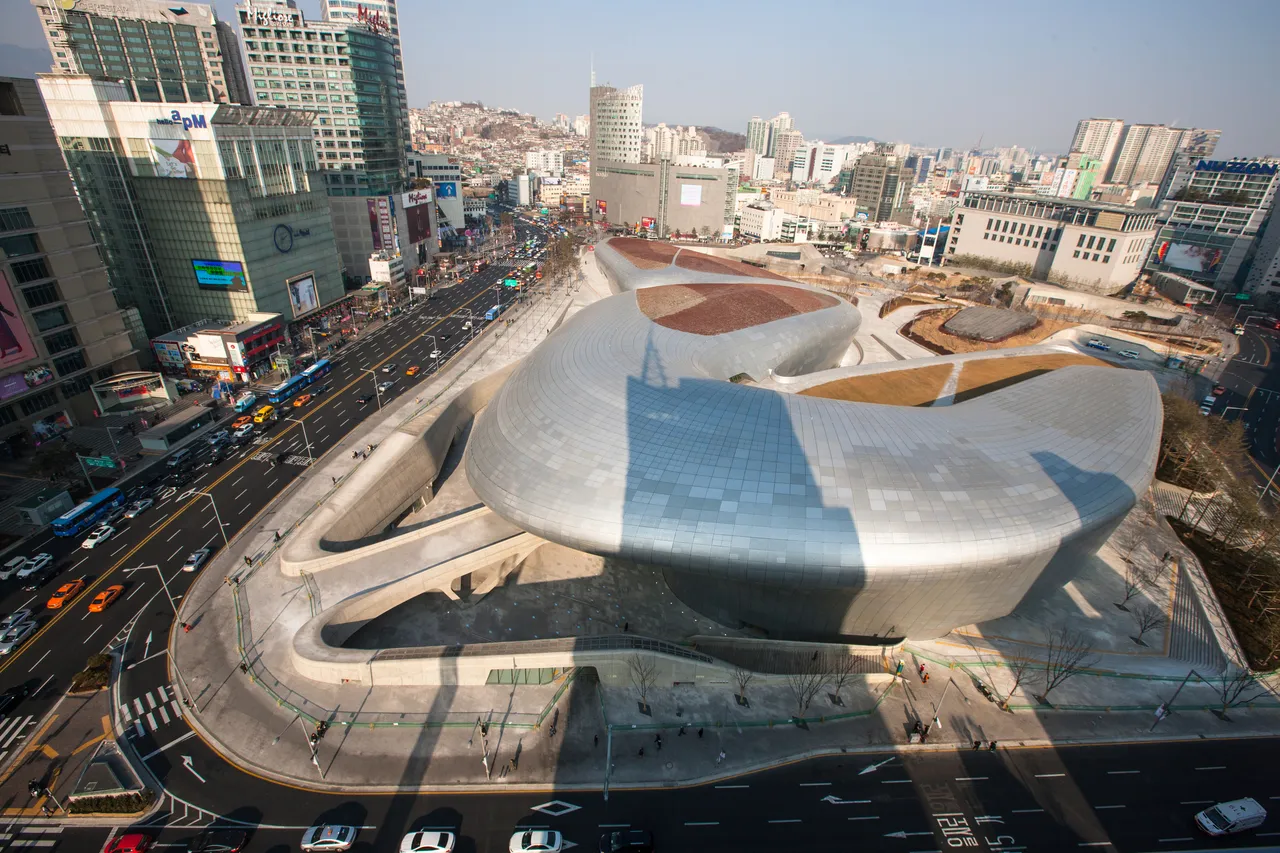
DDP's exterior is a continuous curved surface of aluminum panels, and the main facade runs about 222 meters. Seoul Light uses that whole length as a canvas for projection, light, video, sound, and laser work.

That is the part worth understanding before you go. This is not a gallery you walk through, and it is not a screen on a stage.
The artwork is wrapped around a building that curves in every direction, and the pieces are made for that shape rather than adapted to it.
On seven of the eleven nights, a musician performs live and the imagery responds to what they play.
When it runs in 2026
| Dates | September 3 to 13, 2026 (11 nights) |
| Nightly hours | 7:30 PM to 10:30 PM |
| Admission | Free |
| Venue | DDP main facade and the surrounding area |
| Annual theme | DAYBREAKER |
| Autumn edition theme | K-Original Light |
Seoul runs Seoul Light twice a year, in summer and autumn, under one annual theme. DAYBREAKER is the 2026 umbrella; K-Original Light is what the autumn edition does with it.
What the 2026 program is about
The autumn theme looks at Korean artists and cultural forms that changed how images, landscapes, and language were expressed, and rebuilds them at architectural scale.
That is a more specific idea than "Korean culture." Each of the four main works takes a body of existing work and asks what it becomes when it is 222 meters wide and moving.
Nam June Paik: The Break Point
Paik is the Korean-American artist widely credited with inventing video art in the 1960s, decades before screens were ordinary.
This piece is the one built for live performance. A musician plays, and media imagery reacts to the sound in real time across the facade. It is the reason seven nights of this festival are different from the other four.
Yoo Youngkuk: Finding the Mountain Within Me
Yoo was a pioneer of Korean abstract painting who spent a career reducing mountains to blocks of color and simple geometry.
The work expands those mountain forms and his color language across DDP's curves, in collaboration with media artist Kwon Hayoun. Painted mountains were always flat; here they are wrapped around a surface that bends.
Cheonggu Yeongeon: The Night Words Shine
Cheonggu Yeongeon is an 18th-century anthology of Korean poems and songs, one of the earliest efforts to write down and preserve verse that had been sung rather than recorded.
The piece uses text from that collection, structured in three parts to echo the form of the poems themselves. If you are wondering why Korean characters are moving across the building, this is why. You do not need to read them to follow it.
Yoon Je-ho: Passing Through the Light of the Future
The fourth work is laser rather than projection, combining laser installation, electronic sound, traditional percussion, and AI-generated imagery.
It is the least like the others, and the most dependent on being there rather than seeing a photograph of it.
Which nights have live performances
Seven of the eleven nights have a live musical performance tied to The Break Point. The other four do not.
| Date | Live performance |
|---|---|
| Wed, September 3 | IDIOTAPE (opening night) |
| Thu, September 4 | SION |
| Fri, September 5 | SION |
| Sat, September 6 | HYPNOSIS THERAPY |
| Sep 7 to 10 | No live performance announced |
| Fri, September 11 | SOULSCAPE |
| Sat, September 12 | HYPNOSIS THERAPY |
| Sun, September 13 | SOULSCAPE |
Opening night on September 3 also carries a separate K-Original Light opening program at 7:30 PM, combining laser, electronic audio, AI video, and lighting with traditional performance and choreography.
Choosing a night
This part is our recommendation rather than official guidance.
- Want the music. Pick one of the seven performance nights. The Paik piece is designed around live sound, and on the other four nights you are seeing the visual half of it.
- Want the opening. September 3 has both the opening program and IDIOTAPE, and it is the night most likely to draw a crowd for that reason.
- Want to look at the artwork without an event around it. September 7 to 10 have no announced live performance. That may be easier than an opening or performance night, though nobody publishes attendance figures, so treat it as a reasonable guess rather than a promise.
Is it free?
Yes. Seoul lists the event as free, with no ticket and no published reservation requirement.
What that covers is the outdoor media-art event. DDP's indoor facilities are a separate matter: some exhibitions inside the building charge admission and keep their own hours.
Getting there
The station is Dongdaemun History & Culture Park (동대문역사문화공원역), served by Lines 2, 4, and 5.
DDP's own directions name two exits:
- Exit 1 is closest to the B2-level entrance, Oullim Square, DDP Market, Design Lab, and the museum.
- Exit 2 is closest to the first-floor Design Lab entrance and the Dongdaemun History and Culture Park entrance.
Because three lines meet there, the trip is short from most places a visitor stays. Line 4 connects it toward Myeongdong and Seoul Station, Line 2 toward Hongdae and Gangnam, and Line 5 runs east to west across the center. For fares and how the transit card works, see the Korea transportation guide and the T-money card guide.
What time to arrive
The program runs 7:30 PM to 10:30 PM. Seoul does not publish a playback rotation or a fixed running order, so we cannot tell you that a particular work starts at a particular minute.
What we would do, as a recommendation rather than an instruction: arrive around sunset, walk the building while there is still light, and be in position when the program starts at 7:30 PM.
DDP is worth ten minutes in daylight on its own terms. The Zaha Hadid Architects building opened in 2014 and it reads completely differently before and after dark, which is a small thing you get for free by arriving early.
Where to watch from
There is no seating and no designated viewing zone. Seoul describes the venue as the DDP main facade and the surrounding area, and in practice you move through the public plaza and paths around the building.
Two things trade off against each other, and this is our observation rather than official advice:
- Farther back you see more of the 222-meter surface at once and can tell what a piece is doing as a whole.
- Closer in you see the panel texture and detail, and lose the overall composition.
Walking between the two during the evening is easy, and probably better than picking one spot and staying in it.
Stay on the public paths and out of the way of people moving through. This is a working plaza next to a major intersection, not a closed venue.
How long to allow
45 to 90 minutes is our estimate for most visitors, not an official duration.
Under 45 minutes and you have seen fragments of a few works. Past about 90 minutes you are mostly re-watching, unless you came for a live performance, in which case build the evening around the music instead.
Build it into a Dongdaemun night
Do not cross Seoul for this alone. It is a good anchor for an evening in Dongdaemun, and a thin reason for a special trip.
A shape that works:
- Late afternoon. Arrive at Dongdaemun. Look at DDP in daylight.
- Sunset. Walk the plaza and the surrounding paths as the lighting comes up.
- 7:30 PM. The program starts. Give it an hour or so.
- Afterward. Dongdaemun's shopping district and night markets are right there, and Cheonggyecheon stream runs west from nearby.
The Namdaemun and Dongdaemun market guide covers which parts of Dongdaemun are worth your time and which are wholesale-only. Opening hours in that district vary a lot by building and by day, so check current hours for anywhere specific rather than assuming a market is open because it is late.
For a wider view of what else is on in Seoul after dark, see things to do in Seoul at night.
If it rains
Seoul's official listing states that the event operates in light rain, and that cancellation due to severe weather would be announced as an urgent notice.
So ordinary rain is not a reason to cancel your plan. Check the Seoul forecast the morning of your visit, bring compact rain protection if it looks likely, and check the official notice before setting out if the weather turns bad.
Photography
The subject is large, dark, and moving, which is a difficult combination for a phone.
- Tap the darkest part of the frame to lower exposure. Projection blows out badly on auto.
- Brace against something. Handheld shots at night are mostly blur.
- Take some wide frames that include the building's shape. A tight crop of light on metal could be anywhere.
- Video handles moving projection better than stills do.
If you use a tripod, do not set it up in a walking route. DDP does not publish tripod rules for Seoul Light, so treat it as a busy public plaza and behave accordingly.
What to bring
Not much. Comfortable shoes, a portable battery, and a light layer, since September evenings in Seoul cool down after dark. Compact rain protection if the forecast calls for it.
This is a walk-around event on a paved plaza, not a picnic. Leave the chairs and mats at home.
Is it worth going?
Yes if you are already spending an evening in Dongdaemun, you like design or contemporary art, you want something free after dark, or you photograph at night.
Probably not if projection art leaves you cold, if it means crossing the city for a short visit, or if you already have another major event that evening. Seoul in early September is busy, and this is not the thing to squeeze in at the cost of something you were looking forward to.
Common mistakes
- Going to Dongdaemun Station. DDP is at Dongdaemun History & Culture Park Station.
- Assuming every night has music. Four of the eleven have no announced performance.
- Planning to go inside at 9:00 PM. Indoor facilities generally close at 8:00 PM.
- Arriving in daylight and looking for the projection. It starts at 7:30 PM.
- Using last year's program. The works and performers change every edition.
- Standing too close the whole time. You lose the scale that makes it work.
- Building the evening around a Dongdaemun shop's opening hours you have not checked.
Frequently asked questions
When is Seoul Light DDP 2026 Autumn? September 3 to 13, 2026, for eleven consecutive nights.
What time does it start? 7:30 PM, running until 10:30 PM each night.
Is it free? Yes. Seoul's official listing shows the event as free, and no reservation requirement is published.
Where is it? Dongdaemun Design Plaza, 281 Eulji-ro, Jung-gu, Seoul. The event uses the main facade and the surrounding area.
Which subway station? Dongdaemun History & Culture Park Station on Lines 2, 4, and 5. Exit 1 or Exit 2 depending on which part of DDP you want.
Is it indoors or outdoors? Outdoors. The artwork is projected onto the building's exterior, and you watch from the plaza around it.
How long should I spend there? We would allow 45 to 90 minutes. That is our estimate, not an official running time.
Do I need a reservation? No reservation requirement is published for the outdoor event.
Which nights have live performances? September 3, 4, 5, 6, 11, 12, and 13. See the table above for who plays when.
What happens if it rains? Seoul states the event runs in light rain. Severe weather cancellation would be announced as an urgent notice, so check the official page before setting out in bad conditions.
Sources
- Seoul Metropolitan Government (english.seoul.go.kr)Official government site
- Seoul Metropolitan Government festival information (festival.seoul.go.kr)Official government site
- Dongdaemun Design Plaza (Seoul Design Foundation, official)Official tourism site
Information is compiled from official sources. Details such as prices, hours, and schedules can change. Confirm time-sensitive facts before you travel.
Last verified on
Related guides

Things to Do in Seoul at Night: Food, Cafés, PC Bangs, Markets, and Safe Routes
Seoul after dark isn't just a drinking scene. It's late-night food streets, 24-hour-feeling markets, gaming cafés, river walks, and skyline views, all reachable without ever ordering a drink. This guide is a planning hub, not a deep dive: it helps you pick one neighborhood, string together two or three activities, and, the part most visitors get wrong, actually check how you get home before you go out, since Seoul's last trains and buses don't run on one fixed schedule. For the specifics on any single activity, this guide links out to the dedicated pieces.
Seoul Events in August and September 2026: Festivals Foreign Visitors Can Join
Late summer and early autumn are one of Seoul's busiest event stretches: August brings Han River nights and outdoor programs, while September turns the city into an art capital around Frieze Seoul and Kiaf, plus media-art, street performance, and outdoor-library programs. This guide is about which events a foreign visitor can actually join: free versus paid, ticketed versus invitation-only, how English-friendly they are, and how to plan around August heat and the Chuseok holiday. Only confirmed events get firm dates here; everything else is flagged to check officially. Dates, venues, and tickets change constantly, so always confirm the official website before you go.