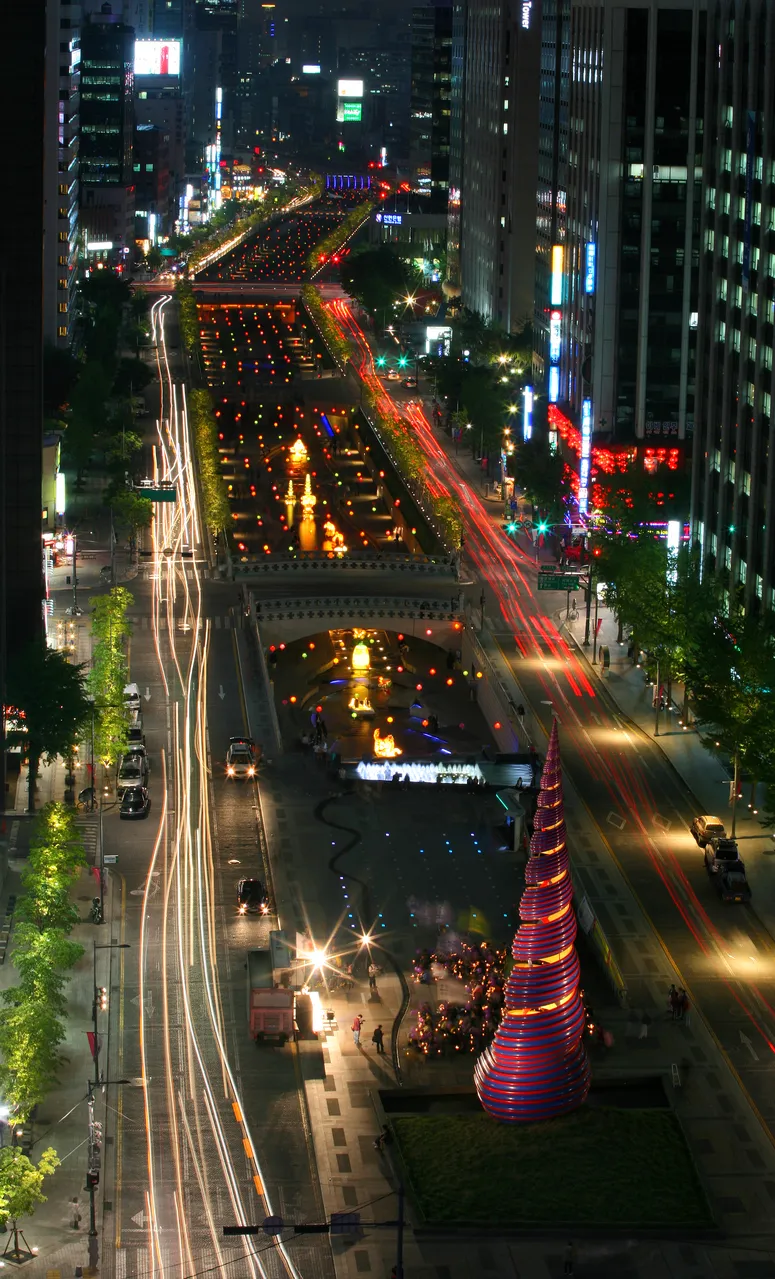
A highway once buried this stream. For about three decades, Cheonggyecheon flowed unseen beneath an elevated road through the middle of Seoul, until the city tore the road down and brought the water back to the surface in 2005.
Today it's among the easier, most rewarding things to do in central Seoul: a free, sunken walking corridor that runs below street level, so the traffic noise fades and you're suddenly walking beside water in the middle of the city. Studies have even reported it runs a few degrees cooler than the streets above.
The best part is how flexible it is. You can drop in for a 30-minute stroll or make a half-day of it with market food at the end.
What follows is the backstory, where to actually start (you don't walk the whole thing), four easy routes, the food areas nearby, and the practical details. One honest caveat up front: the walkway is open around the clock but can close in heavy rain, and festival dates change yearly, so check current official information before you go.
Quick answer
| Question | Short answer |
|---|---|
| Is it free? | Yes: free to walk, anytime |
| Where do I start? | Cheonggye Plaza (near City Hall / Gwanghwamun) |
| How far should I walk? | The popular stretch is about 2 km, not the full 11 |
| Is it open at night? | Yes, 24/7: but it can close in heavy rain |
| Is it near Gwangjang Market? | Yes: an easy walk east to market food |
| How long does it take? | 30 minutes to a half-day, your choice |
The history: from stream, to highway, to stream again
You don't need a history degree to enjoy Cheonggyecheon, but the story is genuinely part of the appeal.
- A living city stream. In the Joseon era, this was a natural stream running through the capital, managed and channeled over time and known as the "open stream." It was part of daily life, and it flooded in the summer rains.
- Covered over. After the hardships of the colonial period and the Korean War, the crowded, polluted stream was covered starting around 1958, and an elevated highway was later built above it. For roughly 30 years, the water was hidden beneath road and concrete.
- Brought back. In July 2003, the city began a restoration project; the road came down, the stream was uncovered, and it reopened to the public in 2005 after about 27 months of work.
We'll skip the politics. What makes it interesting for a visitor is the urban story: a city that chose to replace a car-centric highway with a pedestrian public space. It's frequently cited around the world as a model for taking down an elevated road, and it's a genuine feat of engineering rather than a "perfect" untouched river.
The stream is kept flowing with water reported to be pumped in daily from the Han River and other sources, which is part of what makes it both a revived stream and a carefully managed urban waterway.
Where should I start walking?
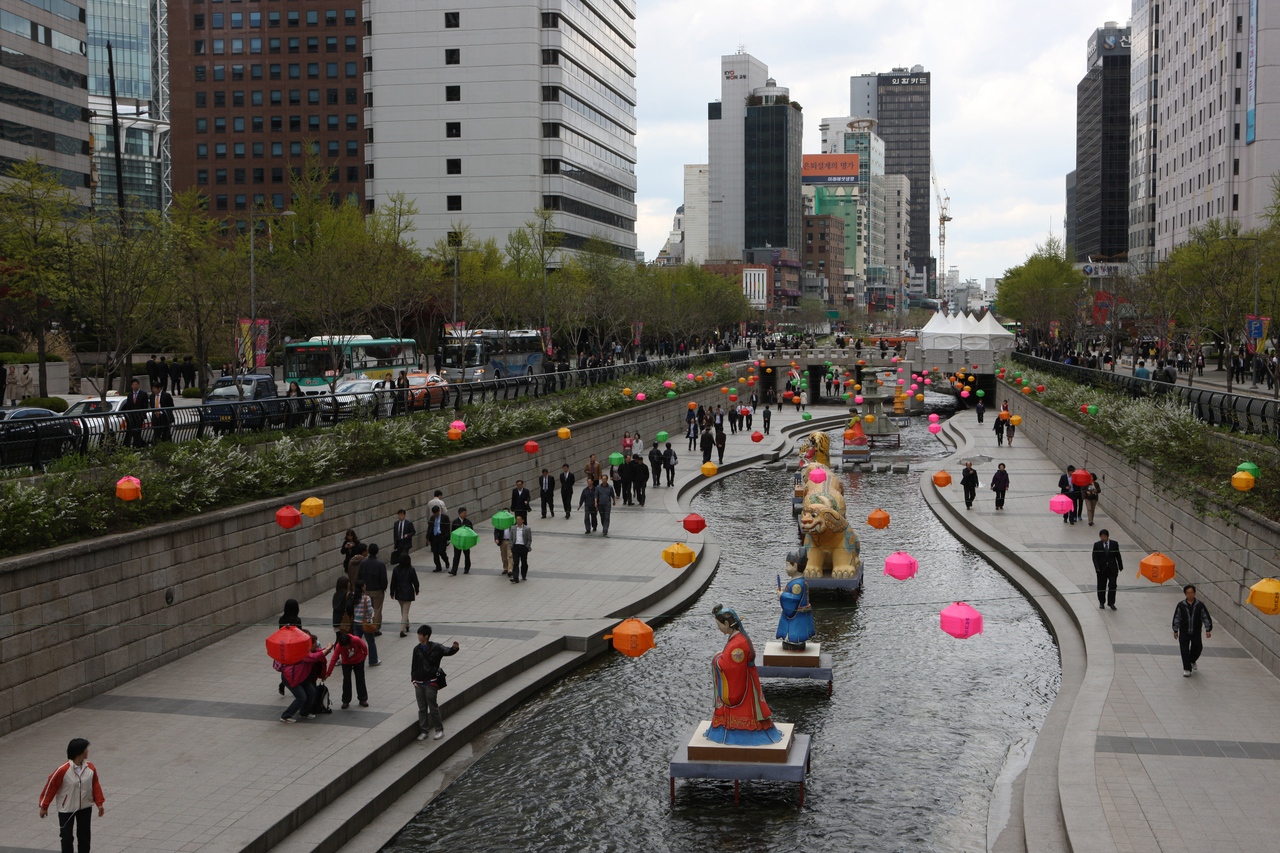
The whole stream is about 11 km, but don't try to walk all of it. The rewarding, sight-dense part is roughly the first 2 km east from Cheonggye Plaza, where the bridges, murals, sculptures, and stepping stones are concentrated. Here are four ways to do it:
| Route | Good for | Roughly |
|---|---|---|
| 1. Cheonggye Plaza → Jonggak | A first visit, a quick taste | 30 to 45 min |
| 2. Cheonggye Plaza → Gwangjang Market | A walk that ends in market food | ~1 to 1.5 hr + food |
| 3. Jongno / Euljiro evening loop | Retro streets and dinner | An evening |
| 4. Toward Dongdaemun / DDP | Shopping and night lights | Half a day |
Start at Cheonggye Plaza, the plaza with the tall spiral sculpture and a small waterfall at the stream's head. For the evening loop, note that Euljiro's back alleys get quiet and unfamiliar late at night: stick to lit, busier stretches after dark, and it's not only about bars.
What to do along the stream
- Just walk. The sunken path, the water, and the sequence of bridges and stepping stones are the main event. Watch your footing: wet stepping stones and steps are slippery, and don't step into the water.
- Photograph the bridges and reflections, especially in the evening when the under-bridge lighting comes on. Don't block the narrow stepping-stone crossings for a photo.
- Spot the wildlife. Herons, mallards, and carp live in the stream, a small, unexpected pleasure in the middle of the city.
- Connect it to food. The walk pairs naturally with nearby eating (see below).
- Seasonal displays. In some years the stream hosts lantern or flower installations, lovely, but they come and go, so check what's currently on rather than assuming.
- The Cheonggyecheon Museum. Near the upper stream, a museum tells the covering-and-restoration story , a good stop for history fans and a rainy-day backup. Confirm its hours, closing days, and admission officially.
Visitor info
| Detail | Info |
|---|---|
| Cost | Free |
| Hours | Officially open 24/7, year-round |
| Weather note | Access can be restricted in heavy rain for safety: obey closure signs |
| Start point | Cheonggye Plaza |
| Nearest station | City Hall Station, Exit 4 (~5 min); also Gwanghwamun, Jonggak, Euljiro 1-ga |
| Popular stretch | About 2 km east from the plaza |
Important: because this is a real stream, water levels can rise fast. During heavy rain, downpours, or typhoons, do not enter: the walkway may be closed, and closure signs and staff instructions are there for your safety. It's designed with flood management, but that's exactly why access is limited when the weather turns.
How to get there
| Where on the walk | Nearest station (confirm exits officially) |
|---|---|
| Start (Cheonggye Plaza) | City Hall, Gwanghwamun, or Euljiro 1-ga |
| Middle | Jonggak or Euljiro 3-ga |
| Toward Gwangjang Market | Jongno 5-ga |
| Eastern end (DDP) | Dongdaemun or Dongdaemun History & Culture Park |
By taxi, the Korean name 청계천 / 청계광장 helps. Sort out your card with the T-money card guide if you haven't yet.
What food is near Cheonggyecheon?
One of the stream's best features is what surrounds it. We won't name specific restaurants (areas, not ads) and you should always check ingredients if you have dietary needs.
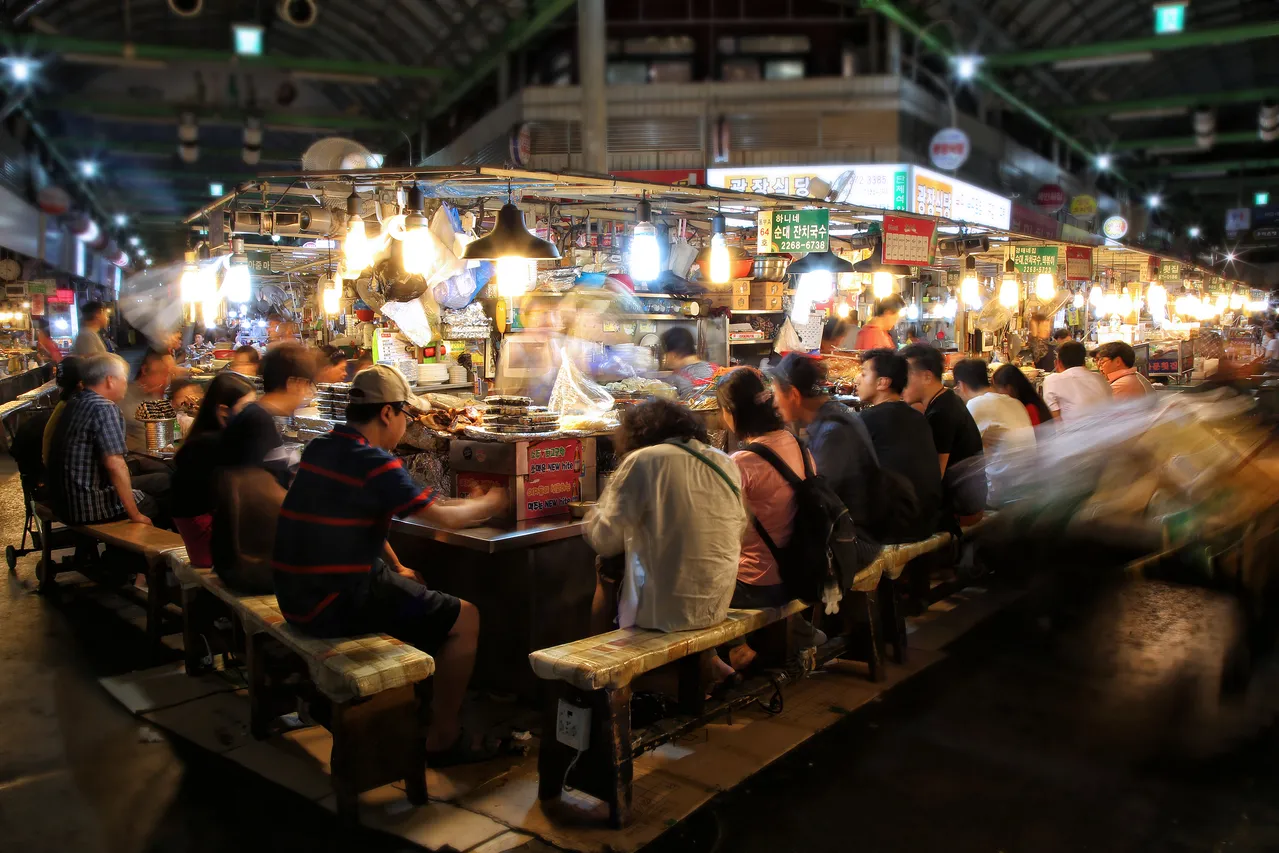
- Gwangjang Market: a famous market a short walk east: bindaetteok (mung-bean pancakes), mayak gimbap, kalguksu, and more. It gets crowded and prices vary, so agree on what you're ordering and check cash/card. Note that yukhoe is raw beef, sundae and tteokbokki broth can contain seafood or other ingredients: see the Gwangjang Market tourist price guide before you dive in.
- Jongno: old-school baekban (set meals), grilled meat, and long-running eateries; a few sit in the top 5 Jongno restaurants guide.
- Euljiro: retro cafés and evening spots; atmospheric, but mind the quiet late-night alleys.
- Insadong: tea houses and souvenirs.
- Ikseon-dong: hanok cafés (busy on weekends).
- Myeongdong: shopping and street food; see the Myeongdong shopping guide.
- Dongdaemun: DDP and late-night shopping at the eastern end.
Dietary note: none of this is automatically halal, vegetarian, or allergy-safe: broths, pork, and seafood are common. The Korea food guide for Muslim travelers explains how to check.
Easy itineraries
- 30 minutes: Cheonggye Plaza and the first few bridges, then back up to street level.
- 1 hour: Plaza to Jonggak, taking in the sculptures and stepping stones.
- 2 hours + food: Plaza east to Gwangjang Market for a market lunch or dinner.
- Half day: Add Jongno or Insadong, or continue toward Dongdaemun/DDP for evening shopping.
Don't overdo it, the stream rewards a relaxed pace more than a route-march to the end.
Best time to visit
| When | Why |
|---|---|
| Summer | It's reported to be up to ~3.6°C cooler than the streets above, a genuine downtown cool-off, best in the evening |
| Year-end | The annual Seoul Lantern Festival is officially held around the stream: dates change yearly, expect crowds, check the schedule |
| Spring / autumn | Mild walking weather; some years bring flower or seasonal installations (check current) |
| Evening | Under-bridge lighting and reflections; livelier and photogenic |
Who should visit
| You are | Why it fits |
|---|---|
| A budget traveler | It's free, central, and flexible |
| A first-timer with a spare hour | Easy to slot between other sights |
| A couple | Scenic, especially in the evening |
| A food lover | It leads straight to Gwangjang Market |
| A history-curious visitor | The restoration story (and the museum) |
Safety and etiquette

- Heavy rain = stay out. Water can rise quickly; follow closure signs and don't enter during downpours or typhoons.
- Watch your footing on wet stepping stones and steps, and don't go into the water.
- Keep kids close near the water's edge.
- Don't block narrow stepping-stone crossings or photo spots.
- At night, favor lit, busier stretches, especially away from the central sections.
- Take your trash with you: bins can be scarce.
Food restrictions
Street and market food near the stream is not automatically halal, vegetarian, vegan, or allergy-safe. Check for pork, seafood broth, egg, dairy, nuts, and wheat: for example, sundae (blood sausage) and some tteokbokki broths can contain ingredients you may want to avoid, and yukhoe is raw beef. Ask, or carry a translation app.
Rainy-day alternatives
If the weather closes the stream, stay dry nearby:
| Instead | Try |
|---|---|
| The walk | Cheonggyecheon Museum (the restoration story) |
| Outdoor sights | The National Museum of Korea |
| A stroll | Myeongdong's covered shopping and street food |
| A café break | Euljiro or Ikseon-dong hanok cafés |
Common mistakes
- Trying to walk all 11 km instead of the 2 km that matter.
- Ignoring heavy-rain closures: the water rises fast.
- Confusing it with the Han River: this is a small downtown stream, not the big riverside parks.
- Blocking the stepping stones for a photo.
- Assuming the lantern festival is always on: it's a year-end event; check dates.
- Wandering Euljiro's quiet alleys alone late at night.
- Expecting the stepping stones to be dry: they're often slick.
FAQ
Is Cheonggyecheon free? Yes. It's free to walk, any time of day.
Where should I start? At Cheonggye Plaza, near City Hall and Gwanghwamun stations. Walk east; the best stretch is about the first 2 km.
Is it open at night? Yes, it's officially open 24/7, but access can be restricted in heavy rain, so check conditions.
Is it near Gwangjang Market? Yes. It's an easy walk east to the market's famous food.
How long should I spend there? Anywhere from 30 minutes to a half-day. It's very flexible.
Do I need a ticket or reservation? No, just show up and walk.
When is the Seoul Lantern Festival? It's an annual year-end event held around the stream, but dates and layout change every year. Check the official schedule.
Is it really cooler than the streets? Studies have reported it runs a few degrees cooler in summer, thanks to the water and the sunken design.
Can I swim or wade in it? No. Stay out of the water; it's for looking, not swimming.
Is it good in the rain? Not in heavy rain. It can close for safety.
Light drizzle is manageable, but check for closures.
Is it stroller- or wheelchair-friendly? There are ramps and access points along the route, but it's a sunken path with steps in places. Check access points and take it slowly.
What's the walking surface like? Paved paths plus stepping stones across the water, which are slippery when wet.
Is there anything to do besides walk? Photos, wildlife spotting, the Cheonggyecheon Museum, seasonal displays, and the food areas nearby.
How do I get there? City Hall Station Exit 4 is about 5 minutes from Cheonggye Plaza; Gwanghwamun, Jonggak, and Euljiro stations also work.
The bottom line
Cheonggyecheon is among the easier wins in central Seoul: free, flexible, and genuinely pleasant: a cool downtown escape in summer, a lantern-lit walk at year-end, and a five-minute detour or a half-day outing depending on your mood. Don't walk the whole thing. Pick the stretch that fits your day, end it with market food if you can, and keep an eye on the weather.
Confirm current hours, festival dates, and closures before you go, and enjoy the rare feeling of walking beside water in the middle of the city.
Sources
- Visit Seoul, Seoul Tourism Organization (official)Official tourism site
- Seoul Metropolitan Government (english.seoul.go.kr)Official government site
- Visit KoreaOfficial tourism site
Information is compiled from official sources. Details such as prices, hours, and schedules can change. Confirm time-sensitive facts before you travel.
Last verified on
Related guides
Free Things to Do in Seoul: Truly Free, Free With Conditions, and Low-Cost
Many “free Seoul” lists mix free entry, free with conditions, and merely cheap activities. This guide separates them. Truly free options include restored stream walks, Hangang parks, and many outdoor trails. Palaces and some museums can be free only on certain days or under dress rules. Markets and food are low-cost, not free. Confirm current admission on official pages before you go.
Gwangjang Market Tourist Price Guide: What to Watch Out For and Better Seoul Market Alternatives
Gwangjang Market is one of Seoul's most famous food markets and still worth a visit, but reported price disputes (2023 to 2026) mean it pays to check before you order. This is a balanced, practical guide, not a "don't go" piece: what to watch for, the price-display and monitoring measures now being rolled out, how to avoid overpaying, and better-fit alternative markets (Tongin, Mangwon, Gyeongdong, Namdaemun) by travel style. Prices and hours change, so confirm current details before you go.