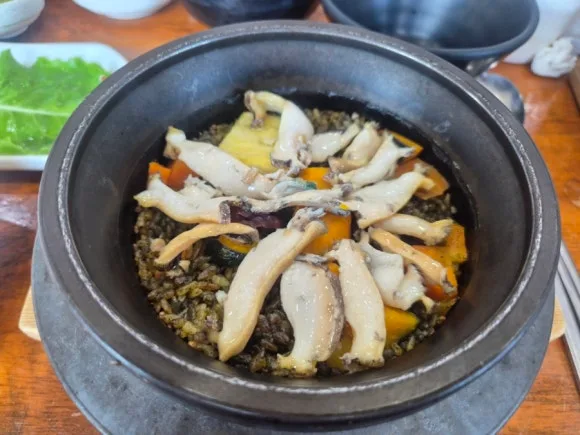
Myeongjin Jeonbok is worth a planned stop if you want a short, abalone-only menu eaten by the sea, and you have a car. It is a weaker fit if you want variety, a spicy meal, or an easy bus connection.
The dish most visitors build the meal around is the abalone stone pot rice, listed at ₩16,000 on both Kakao Map and Naver Place. Everything below is checked against those listings and Korea's two tourism boards as of October 15, 2026.
Quick answer
| Question | Answer |
|---|---|
| Known for | Abalone dishes, with stone pot rice as the main order. Visit Jeju's Korean listing says it was featured on the TV program Wednesday Foodie Talk (수요미식회). |
| Best first order | Abalone stone pot rice (전복돌솥밥), ₩16,000 |
| Price to expect | ₩13,000 for porridge up to about ₩21,000 for stone pot rice plus mackerel, per person, before drinks |
| Hours | 09:30 to 20:30 on Kakao Map and Naver Place, last order 20:00. Current listings disagree on closing time; verify before visiting. |
| Closed | Every Tuesday |
| Waiting | No official wait time is published. Reviewers report both walk-in seating and weekend lunch queues. |
| Reservation | No online booking was found on Kakao Map or Naver Place. Phone: +82-64-782-9944 |
| Eating alone | No minimum-order rule was found; a solo order of one bowl is plausible, but the restaurant does not state it |
| Parking | On-site parking is listed by Kakao Map and Naver Place. Fee and capacity are not published. |
| Best route | By car along the northeast coast, as a lunch stop after Woljeongri or Gimnyeong |
| Biggest caveat | The menu is almost entirely abalone. Shellfish allergies, vegetarians and anyone who wants variety should plan another meal. |
Is Myeongjin Jeonbok worth visiting?
It depends on what you want from one meal. The restaurant does a narrow thing, abalone cooked a few ways, and the listings and recent visitor reports agree on that much.
A good fit if you:
- want to try Jeju abalone in a casual restaurant rather than a banquet setting
- are driving the northeast coast and need a lunch or early dinner stop
- like mild, savory food and are curious about rice cooked with abalone innards
- are happy to eat at an off-peak hour to avoid a queue
A weaker fit if you:
- are traveling without a car
- have a shellfish, fish, egg or dairy allergy
- want a spicy, grilled-meat or multi-dish meal
- dislike the slightly bitter, nutty taste of abalone innards
Recent reviews are not unanimous. One 2026 reviewer who had visited several times found the mackerel sweeter and the innard flavor lighter than before, while another called the stone pot rice good enough to return for. Treat the place as a solid single-dish stop, not a sure highlight.
Where it is and which listing to use
The address is 1282 Haemajihaean-ro, Gujwa-eup, Jeju-si (제주시 구좌읍 해맞이해안로 1282), in Pyeongdae-ri on the northeast coast. Kakao Map, Naver Place, Visit Jeju and VISITKOREA all give the same address and the same phone number.
| Korean name | 명진전복 |
| English name on tourism listings | Myeongjin Jeonbok |
| Road address | 제주특별자치도 제주시 구좌읍 해맞이해안로 1282 |
| Lot address | 구좌읍 평대리 515-28 |
| Phone | +82-64-782-9944 |
| Category on Kakao Map | Abalone and oyster restaurant (굴,전복) |
Search the Korean name 명진전복 in Kakao Map or Naver Map. Kakao Map also shows a separate entry called "명진전복 주차장" (Myeongjin Jeonbok parking lot) at the same address, which is the lot, not a second restaurant.
A different restaurant, Galchi Factory (갈치공장), is a few doors along at number 1296. It also serves abalone dishes, according to a July 2026 visitor report, so check the name on the sign before you queue.
Before you go
Hours and the Tuesday closure
Kakao Map and Naver Place both list 09:30 to 20:30 with last order at 20:00, and neither shows a midday break. Visit Jeju lists "closed every Tuesday, last order 20:00" without a closing time. VISITKOREA lists 09:30 to 21:30.
Current listings disagree; verify before visiting. Planning around the 20:00 last order is the safe reading.
The Tuesday closure is the one point every source agrees on, including both tourism boards. Holiday closures such as Lunar New Year and Chuseok are not published on the listings I checked, so call ahead if you are visiting around a national holiday.
Reservations and waiting
Neither Kakao Map nor Naver Place has booking enabled for this restaurant, and I found no queue app. A phone number is listed, but whether staff take phone reservations is not stated.
No official wait time exists, so I give none. Recent visitors describe sitting down immediately on a weekday morning or afternoon, and expecting a wait at weekend lunch. Kakao Map's hourly traffic chart for the listing peaks around midday, rises again around 17:00 to 18:00, and is quietest around 15:00.
Visit Jeju's own listing says a wait is common. That listing is undated, so use it as a prompt to avoid peak hours, not as a number.
Parking
Kakao Map and Naver Place both list parking, and Kakao Map describes a dedicated lot in front of the restaurant. Recent visitors report parking in front of the building.
Whether parking is free, and how many cars it holds at lunch, is not published. Do not assume either.
Eating alone
No minimum-order rule was found on any listing. Stone pot rice and porridge are priced as single dishes, so ordering one bowl for yourself is the normal reading of the menu.
The restaurant does not state a solo policy. As at most casual Korean restaurants, plan on ordering one dish per person.
Paying
Naver Place lists Jeju local currency, Zero Pay and simple-pay apps as accepted methods. A 2026 English-language reviewer reports that cards are accepted.
Whether a foreign-issued card works is not stated. Carry a backup payment method.
What is jeonbok (abalone)?
Jeonbok (전복) is abalone, a sea snail with a single shell that clings to rocks. In Korean cooking it is treated as a premium seafood, which is why it is priced above most rice dishes.
Abalone is a mollusk. That matters for allergies, and it is the reason this restaurant is not a general-purpose lunch choice.
VISITKOREA says Myeongjin Jeonbok uses abalone from an adjoining farm. Visit Jeju's Korean listing names the stone pot rice and grilled abalone as the representative dishes.
Menu and current prices
The menu is short. Kakao Map's menu was last updated on September 21, 2026, and Naver Place and a June 2026 reviewer agree on the prices of the stone pot rice, porridge and mackerel.
| Dish | Korean | What it is | Best for | Current price | Notes |
|---|---|---|---|---|---|
| Abalone stone pot rice | 전복돌솥밥 | Rice cooked with abalone innards, topped with sliced abalone, pumpkin, sweet potato and carrot | A first order | ₩16,000 | Served in a hot stone pot |
| Abalone porridge | 전복죽 | Rice porridge with abalone | A softer, milder choice | ₩13,000 | Reviewers describe a lighter abalone flavor than the stone pot rice |
| Butter-grilled abalone, small | 전복버터구이 (소) | Kakao Map describes five abalone with butter and cheese | Sharing | ₩15,000 | Contains dairy |
| Sliced raw abalone, small | 전복회 (소) | Raw abalone slices | Raw seafood fans | ₩15,000 | Raw |
| Butter-grilled abalone, large, with mackerel | 전복버터구이(대)+고등어구이 | Larger grill portion plus a grilled mackerel | Groups of three or more | ₩30,000 | Check what the large set includes |
| Sliced raw abalone, large, with mackerel | 전복회(대)+고등어구이 | Larger raw portion plus a grilled mackerel | Groups | ₩30,000 | Check what the large set includes |
| Grilled mackerel | 고등어구이 | A grilled mackerel | Adding to rice | ₩5,000 | Sold separately |
Naver Place lists the large grilled and large raw abalone at ₩30,000 without naming the mackerel. Check the current menu for exactly what the large sets include.
Older reviews often say the mackerel comes free with the side dishes. A June 2026 reviewer and a 2026 English-language reviewer both report a notice that it is now charged separately at ₩5,000, which matches the Kakao Map and Naver Place price. Dishes mentioned in older reviews, such as abalone stew, are not on the current listings.
What a meal costs
These totals are arithmetic on the listed prices, not a bill. Drinks are not priced on the listings.
- One person, porridge: ₩13,000
- One person, stone pot rice: ₩16,000
- One person, stone pot rice plus mackerel: ₩21,000
- Two people, two stone pot rice plus one small butter-grilled abalone: ₩47,000
- Two people, the same order plus one mackerel: ₩52,000
I make no value judgment here. Abalone costs more than most Korean rice dishes, and these prices reflect that.
How abalone stone pot rice works
What dolsotbap is
Dolsotbap (돌솥밥) is rice cooked in a heavy stone bowl called a dolsot. The pot is heated, so the rice keeps cooking at the table and a golden crust of rice forms on the bottom. That crust is called nurungji (누룽지).
How the pot is usually eaten
This is general Korean practice, not a Myeongjin rule.
- Mix the toppings into the rice while it is hot.
- Scoop the rice into your bowl, leaving the crust in the pot.
- Pour hot water into the pot and put the lid on.
- Wait a few minutes for the crust to soften.
- Eat the nurungji and its water as a warm, toasty finish.
What recent visitors report at Myeongjin
A September 2026 English-language visitor says a card on the table explains the nurungji step in English and Korean, with a kettle of hot water provided. Visitors also report butter on the tables.
This comes from visitors, not from the restaurant, and it may change. If the setup is different when you arrive, ask staff.
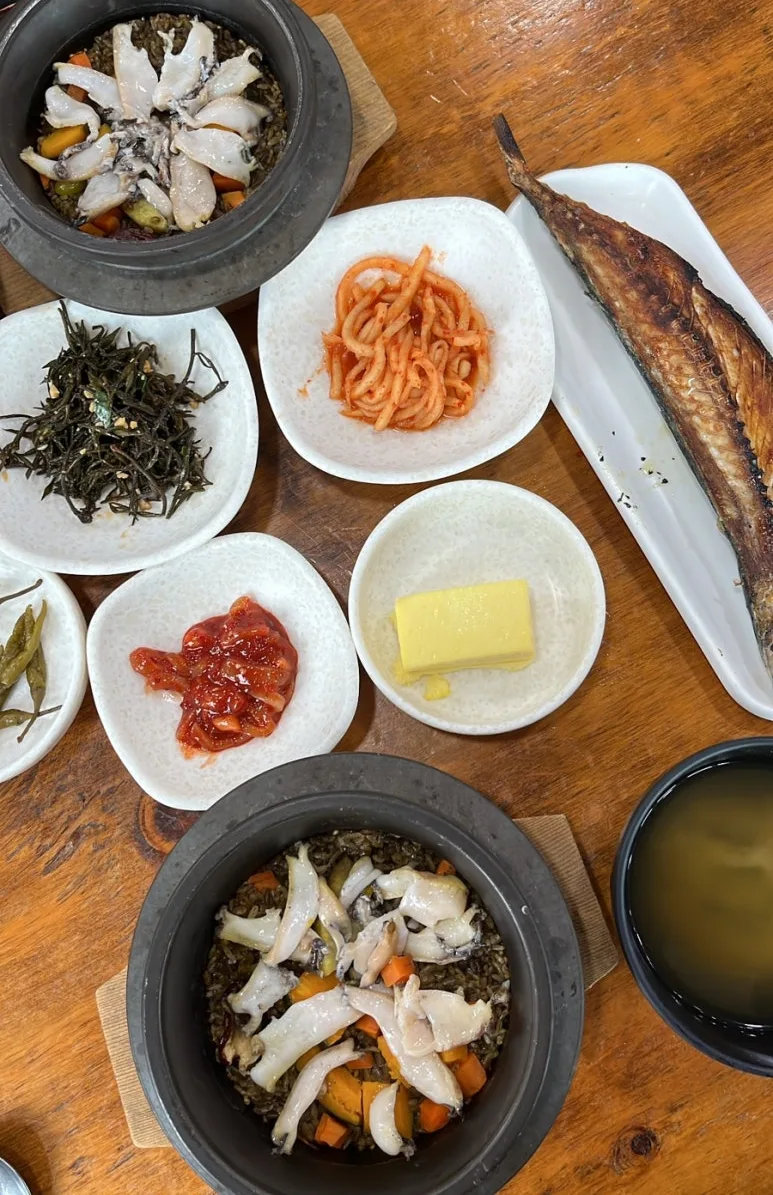
Visit Jeju's Korean listing says the rice is mixed with abalone innards and topped with sweet pumpkin, sweet potato and carrot. Expect a savory, slightly bitter note from the innards against the sweet vegetables, which is my reading of that description, not a restaurant claim. The stone pot is very hot, so keep children back from it.
For foreign travelers
English and ordering
A 2026 English-language visitor reports English names under the dishes on the menu board. Visit Jeju's listing shows no foreign-language service entry, so treat English support as traveler-reported and not confirmed by the restaurant.
With a menu this short, you can order by pointing or by saying the dish name.
The first order most visitors start with.
Polite전복돌솥밥 하나 주세요
jeon-bok-dol-sot-bap ha-na ju-se-yo
One abalone stone pot rice, please.
Korean audio isn't available on this device or browser. Use the romanization above to say it.
Add the mackerel, which is now ordered separately.
Polite고등어구이도 하나 주세요
go-deung-eo-gu-i-do ha-na ju-se-yo
One grilled mackerel too, please.
Korean audio isn't available on this device or browser. Use the romanization above to say it.
Spice and flavor
The abalone dishes are not built around chili. Kimchi is among the reported side dishes, so a little heat is available if you want it.
Side dishes may change. Recent visitors report seaweed salad, hijiki, seaweed soup, salted squid, kimchi, steamed egg and a green salad.
Allergies, halal and vegetarian
Shellfish and mollusks. Every main dish is built on abalone, which is a mollusk. If you have a shellfish or mollusk allergy, this is not a safe restaurant to experiment in.
Other allergens reported. Visitors report fish (mackerel), egg (steamed egg), dairy (butter and cheese on the grilled abalone), soy-based seasonings and salted squid among the sides. This list comes from reviews, not an official allergen sheet, and the sides rotate. Ask staff about your specific allergy before ordering.
Muslim travelers. TripKopia could not verify halal certification. For wider Jeju guidance, see the Muslim-friendly Jeju guide.
Vegetarian and vegan. TripKopia could not verify a vegetarian or vegan option. The rice is cooked with abalone innards and the other mains are seafood.
Gluten. No gluten-free claim is made. Soy-based seasonings are common in this style of cooking.
Raw abalone. The sliced raw abalone carries the usual cautions that apply to raw seafood. If you are pregnant or have a weakened immune system, ask your doctor before ordering raw dishes.
How to add Myeongjin Jeonbok to an East Jeju day
The restaurant is on the northeast coast, between the Woljeongri and Gimnyeong beaches and Seongsan. All distances below are straight-line geography, not driving distances, and no travel times are given.
From Woljeongri or Gimnyeong
Woljeongri is about 6 km west and Gimnyeong about 9 km west in a straight line, all along the same coast. A beach morning followed by a late-morning or mid-afternoon meal is the cleanest pairing. See the Woljeongri Beach guide and the Gimnyeong Beach guide.
From Seongsan Ilchulbong
Seongsan Ilchulbong is about 12 km southeast of the restaurant in a straight line, so this is a detour, not a stop on the way. A Seongsan morning followed by lunch here works if you drop Seopjikoji and Udo from that day. The Seongsan Ilchulbong guide covers the climb and its timing.
From Jeju City
Jeju City hall is about 30 km west of the restaurant in a straight line, along the north coast. The coastal road, Haemajihaean-ro, is named in the address.
No bus route has been verified for this restaurant. A 2026 English-language visitor reports a long walk from the nearest bus stop, so plan to drive. The Jeju car rental guide covers the practical side.
A realistic East Jeju day
Do not stack Udo, Seongsan, Seopjikoji, Woljeongri, Gimnyeong and this restaurant into one day. The East Jeju one-day itinerary already fills a day around Seongsan, and this restaurant sits in the opposite direction.
A workable day is a north-coast one: Woljeongri or Gimnyeong in the morning, this restaurant for lunch, then a slow return along the coast. Whichever stop you pick, check the Tuesday closure first. The Jeju destination hub shows how the regions fit together. For a Jeju City meal near the airport, see the Jamae Guksu guide.
Who will like it and who should skip it
You will probably like it if you want a focused abalone meal, you are comfortable with mild flavors, and you can visit outside peak hours.
Skip it if you do not eat shellfish, you want a spicy or meat-based meal, you are visiting on a Tuesday, or you do not have a way to drive there.
Common mistakes
- Arriving on a Tuesday. It is closed every week.
- Trusting one closing time. Listings disagree between 20:30 and 21:30, so aim to order before the 20:00 last order.
- Expecting free mackerel. Older reviews say it is included; current listings charge ₩5,000.
- Ordering the large sets without checking. Confirm what the ₩30,000 sets include.
- Assuming a bus will do. No bus route is verified, and a visitor reports a long walk from the nearest stop.
- Going at peak hours without a plan. Midday and early evening are when the listing's traffic peaks.
- Pouring the pot's water too early. Eat the mixed rice first, then make the nurungji.
- Touching the stone pot. It stays very hot.
- Assuming a shellfish-free choice. Every main is abalone-based.
- Confusing neighboring restaurants. Galchi Factory is a separate business at number 1296.
- Treating old prices as current. Check the menu board on arrival; prices change.
Frequently asked questions
Is Myeongjin Jeonbok worth visiting?
It is worth a stop if you want abalone and have a car. It is a weaker fit if you want variety or avoid shellfish.
What should I order first?
The abalone stone pot rice (전복돌솥밥), ₩16,000. Both tourism boards name it as the signature dish.
How much is the abalone stone pot rice?
₩16,000 on Kakao Map and Naver Place. Check the current menu on arrival.
What are the opening hours?
09:30 to 20:30 with last order at 20:00 on Kakao Map and Naver Place. VISITKOREA lists 09:30 to 21:30, so listings disagree; verify before visiting.
Which day is it closed?
Every Tuesday.
Do I need a reservation?
No online booking was found. The phone number is +82-64-782-9944 if you want to ask.
Is there a wait?
No official wait time is published. Visitors report both immediate seating and weekend lunch queues.
Can I eat alone?
No minimum order was found, and one bowl of stone pot rice or porridge is priced as a single dish. The restaurant does not state a solo policy.
Is there a minimum order?
None was found on the listings checked.
Is there parking?
Kakao Map and Naver Place list parking. Fee and capacity are not published.
Can I get there without a car?
No bus route is verified here, and a visitor reports a long walk from the nearest stop. Driving is the practical option.
Is the menu in English?
A 2026 visitor reports English names on the menu board. The restaurant does not confirm it.
Is it spicy?
The abalone dishes are not built around chili. Kimchi is among the reported sides.
Is it halal?
TripKopia could not verify halal certification.
Is it vegetarian or vegan?
TripKopia could not verify a vegetarian or vegan option.
Is it safe with a shellfish allergy?
No. Every main is abalone, a mollusk, and cross-contact is possible. Ask staff, and treat an unconfirmed answer as unverified.
Is the mackerel included?
Not according to the current listings. It is ₩5,000 separately, and some larger sets bundle it.
Is it suitable for children?
The porridge is the softer dish, and Kakao Map lists baby chairs. The stone pot is very hot, so keep children back from it.
What is nurungji?
The toasted rice crust at the bottom of a stone pot. Add hot water to make a warm, nutty soup.
Can I combine it with Seongsan Ilchulbong?
Yes, as a detour of roughly 12 km in a straight line. Skip Seopjikoji and Udo on that day.
Sources
- Visit Jeju: Myeongjin Jeonbok (restaurant listing)Official tourism site
- VISITKOREA: Myeongjin Jeonbok (restaurant listing)Official tourism site
- Kakao Map: Myeongjin Jeonbok (place listing with hours and menu)official_service_site
- Naver Place: Myeongjin Jeonbok (place listing with hours, menu and payment methods)official_service_site
Information is compiled from official sources. Details such as prices, hours, and schedules can change. Confirm time-sensitive facts before you travel.
Hours, menu, prices and policies were checked on October 15, 2026 and can change without notice. Statements about English signage, side dishes, queues and how the pot is served come from recent visitor reports, not from the restaurant.
Last verified on
Related guides
Woljeongri Beach Guide: Swimming, Cafes, Parking & East Jeju Travel Tips
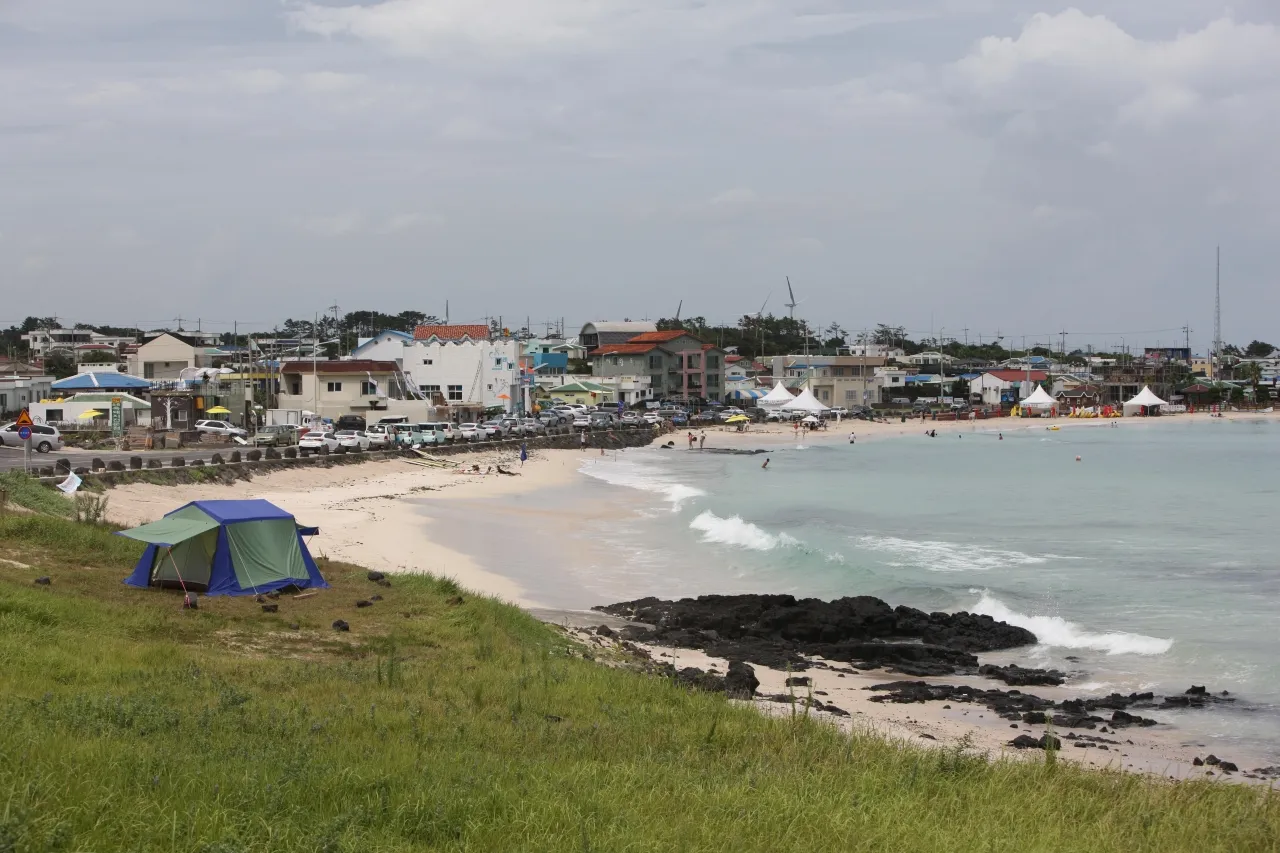
Woljeongri is a beach and cafe village on Jeju's northeast coast, about 17 km from Seongsan Ilchulbong in a straight line. You can walk on the beach at any time, but swimming belongs to the official summer season: in 2026 the province ran it from June 24 to September 6, and other years need a check. VisitKorea lists on-site parking, but I could not confirm a fee, so read the signs.
East Jeju 1-Day Itinerary: Seongsan Ilchulbong, Seopjikoji, Udo & the Best Routes
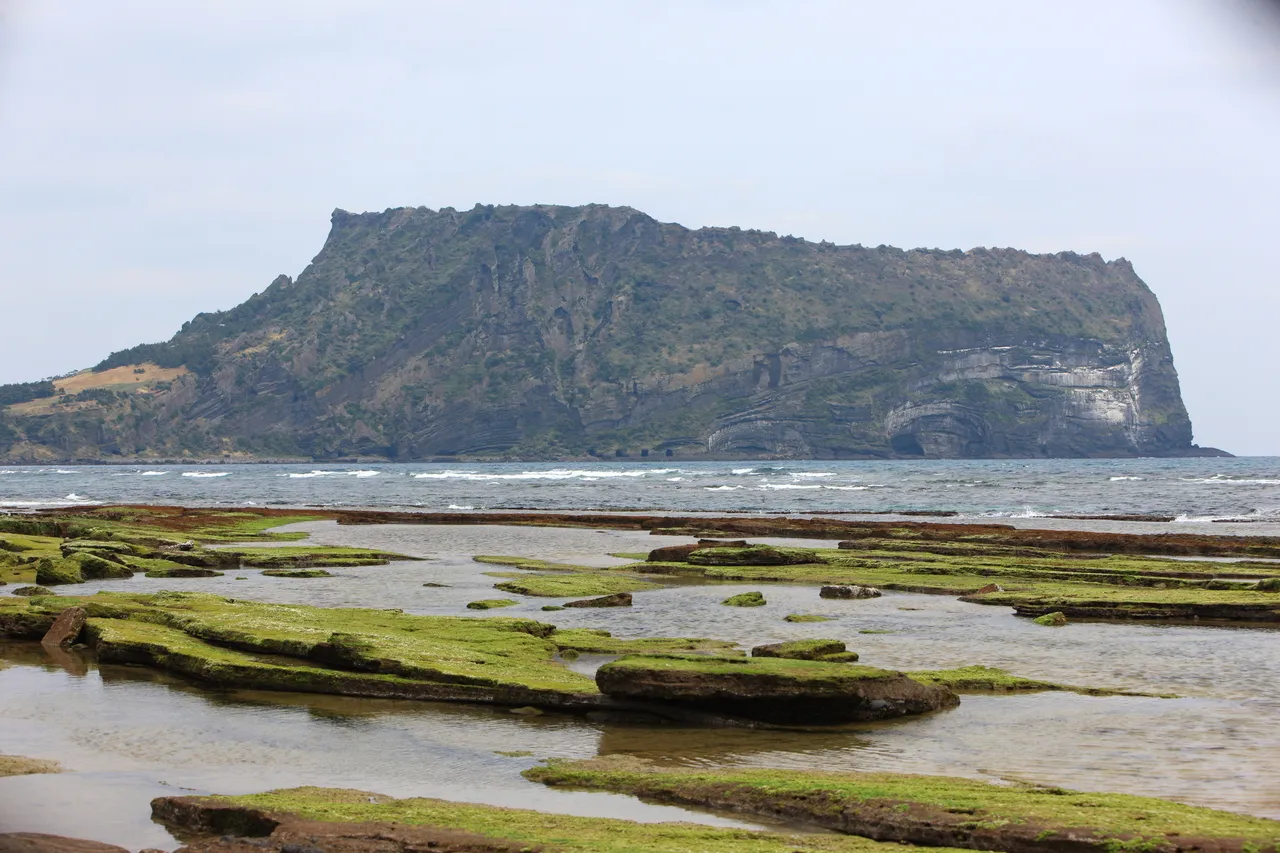
For one day in East Jeju, pick two anchors. Route A pairs Seongsan Ilchulbong with Seopjikoji on the main island, and Route B pairs Udo with Seongsan around the ferry. Doing all three in a day is not the default, and the place guides own the hours, ferry rules and parking.