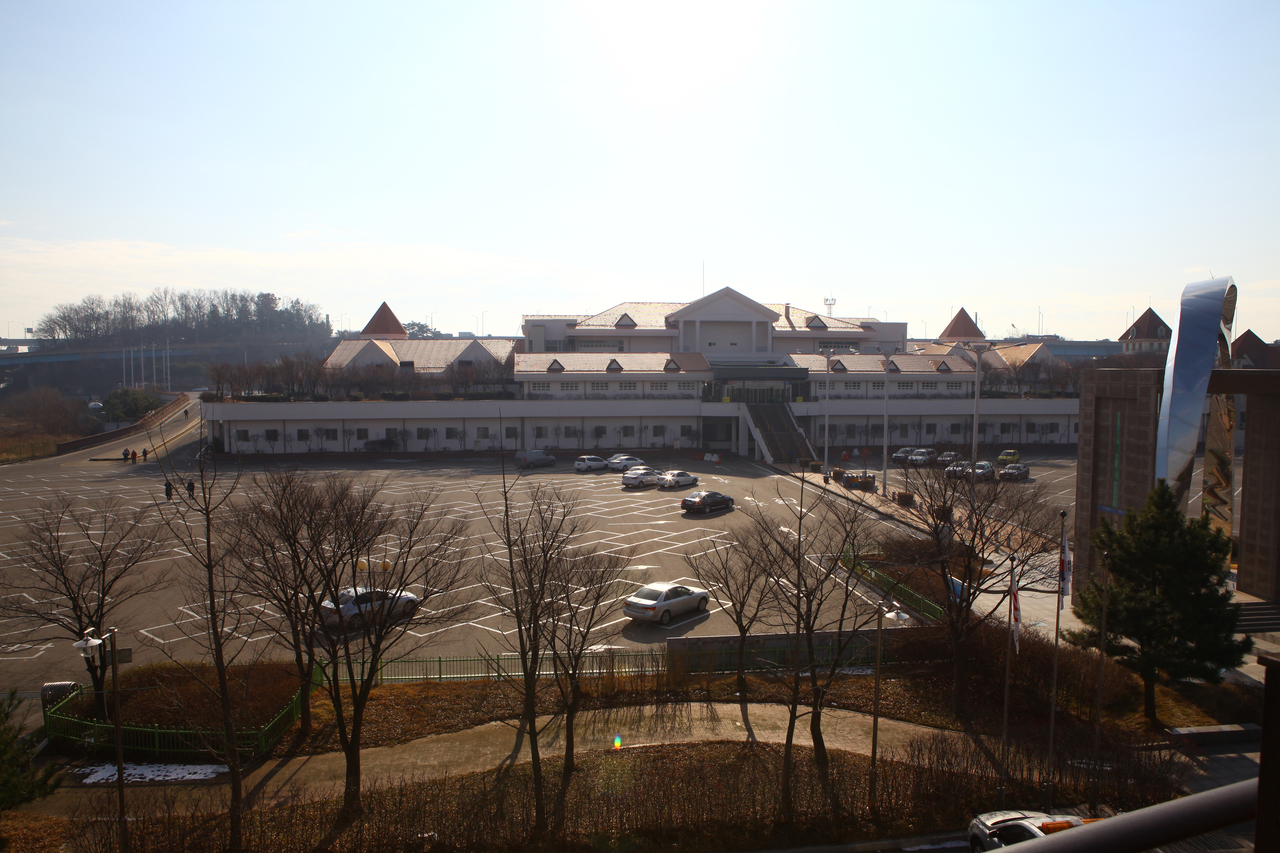
The first time you pull into a Korean expressway rest area, the scale is the surprise. Two hundred parking spaces, a food court with a dozen counters, a bakery, a convenience store, and a queue for walnut cakes.
Koreans treat these stops as part of the journey rather than an interruption. Knowing how they work removes the two things that reliably confuse first-time visitors: how to order, and which side of the road you are on.
What a Korean rest area actually is
A 휴게소 (hyugeso) is a service area on an expressway, reached from the carriageway itself and returning you to the same road. You do not exit onto local streets and you do not pay to enter.
Korea Expressway Corporation publishes a national dataset describing every one of them. Reading its structure tells you more about what to expect than any list of favorites, because of what it records per site.
Each rest area entry carries its own yes-or-no flags for a gas station, an EV charger, restrooms, a restaurant, a shop, a nursing room, and light vehicle maintenance. It also carries its own opening and closing time, its own road direction, and a field for the food that stop is known for.
That structure is the practical lesson. Facilities are recorded site by site, not guaranteed nationwide. A large stop on a busy corridor and a small one on a quiet route are both 휴게소, and they are not the same experience.
Why direction matters more than you expect
This is the mistake that costs visitors the most time.
In the official dataset, road direction is an attribute of the rest area itself, not of the road it sits beside. A stop on the Seoul-bound side and a stop on the Busan-bound side can be separate facilities with separate buildings, separate food counters, and separate parking.
So if you read that a particular rest area has something you want, check which direction that description refers to before you plan around it. Some locations do let both directions share one set of facilities, and some do not. Treat shared access as something to verify for that specific stop rather than the normal case.
How ordering works
Most rest area food courts do not take your order at the counter. You order and pay first, then collect.
The usual sequence:
- Read the menu boards above the counters, which normally carry photographs and prices.
- Go to the ticket machine, often labeled 무인식권기 (unattended ticket machine), and pay there.
- Take the printed ticket, called a 식권, to the counter that sells that dish and hand it over.
- Watch the screen for your order number, then collect your tray yourself.
- Return the tray to the 퇴식구 when you finish.
Counters commonly post two notices worth knowing. One says that if your number does not appear on the screen, tell the counter staff directly. The other says food may be served out of sequence because cooking times differ, so a later order can arrive before yours.
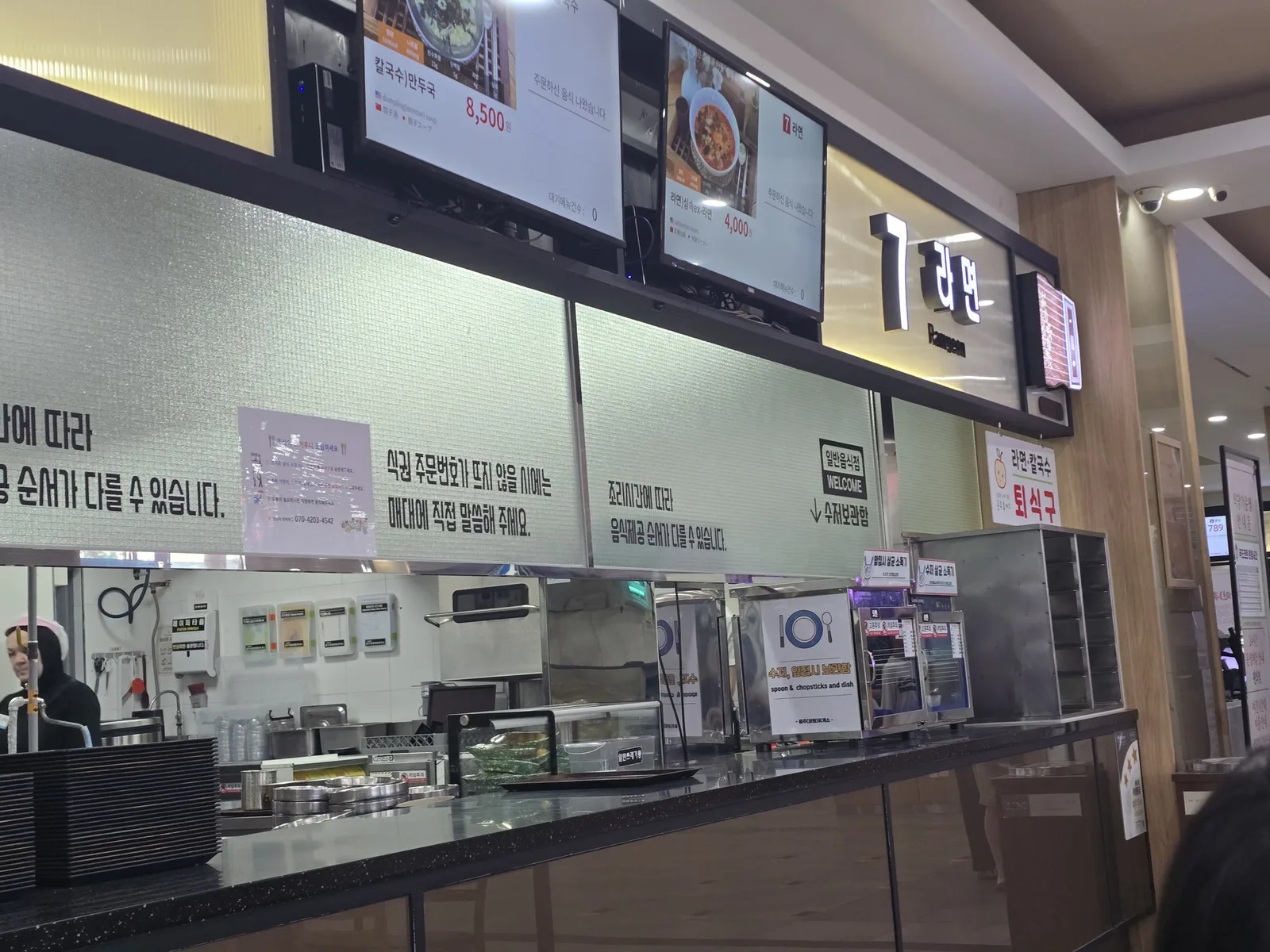
Machines often have an English option, and menu boards frequently carry English and sometimes Japanese or Chinese names alongside a photograph. Pointing at the photograph works when the wording does not.
What there is to eat
Rest area food splits into two habits: something hot in a few minutes, or a proper sit-down meal.
Quick snacks
The snack counters are the part travelers remember. Common items include:
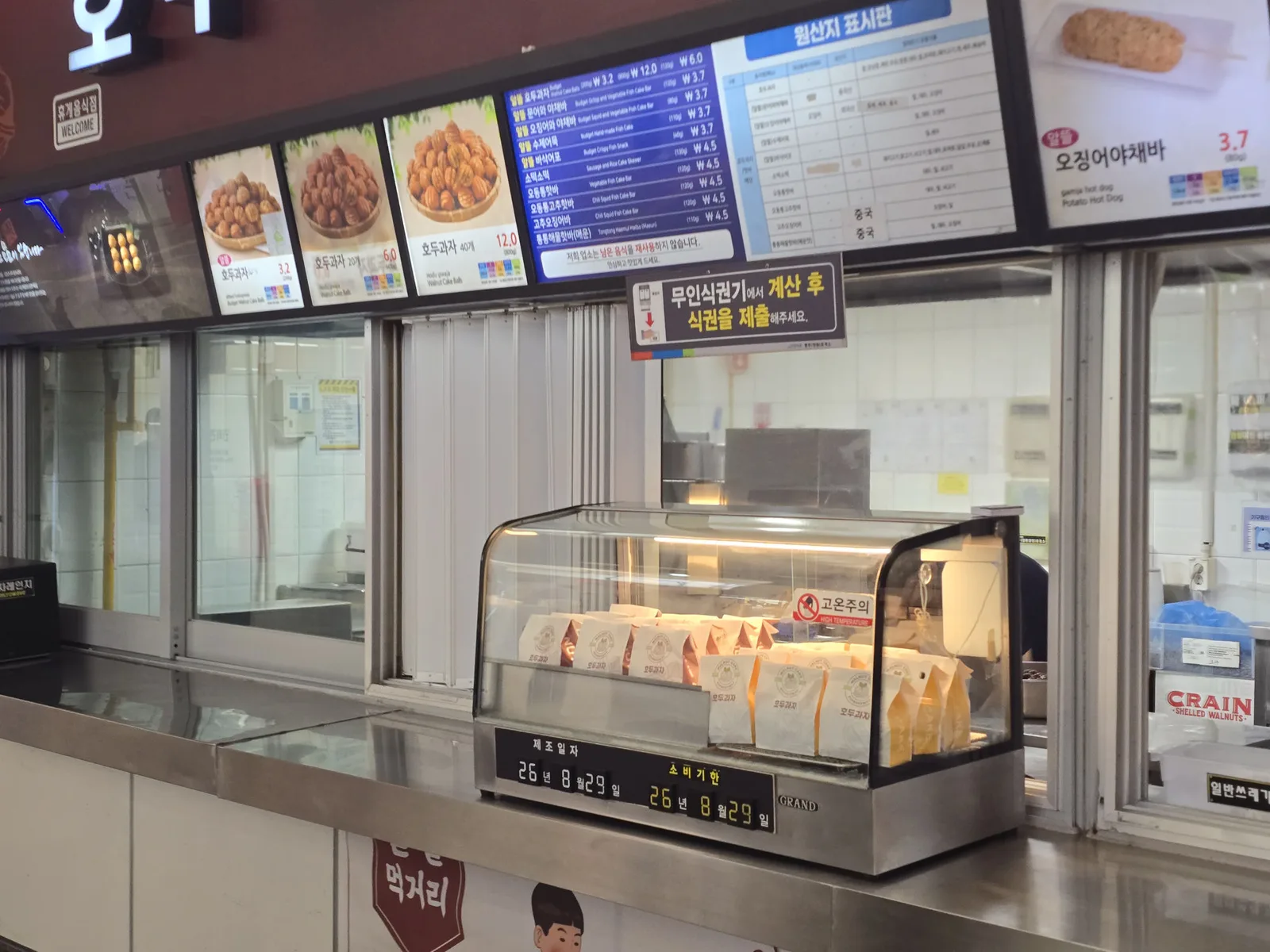
- 호두과자 (hodu-gwaja), small walnut-shaped cakes filled with red bean paste and walnut, usually sold warm in paper bags
- 어묵 (eomuk), fish cake on a skewer, served with hot broth
- 떡볶이 (tteokbokki), rice cakes in a sweet chili sauce
- Corn dogs and sausages on sticks, including cheese-filled versions
- Roasted or steamed sweet potatoes and whole potatoes, more common in colder months
- Coffee, both from chains and from machines
Snack counters usually display an origin board listing where the main ingredients came from. If you have dietary restrictions this board is the most reliable thing on the wall, though it is normally written in Korean only.
Full meals
The food court handles proper meals. What you find varies by stop, but the recurring names are:
- 라면 (ramyeon), instant noodle soup, the cheapest hot dish at most stops
- 칼국수 (kalguksu), hand-cut wheat noodles in broth, often sold with dumplings
- 국밥 (gukbap), rice in a hot soup, usually pork or beef based
- 돈까스 (donkatsu), breaded pork cutlet with rice
- 비빔밥 (bibimbap), rice with vegetables and chili paste
- Udon, kimchi stew, and bulgogi rice bowls at larger sites
Regional specialties
The national dataset includes a field for each rest area's representative food, which reflects a real habit: stops promote something tied to the region they sit in, or to a dish that particular site became known for.
This is genuinely worth a few minutes of your break. It is also the part of the experience that changes most, so treat any specific recommendation as a starting point rather than a promise.
Two reasons for that caution. Tenants at rest areas are re-contracted periodically, and the Ministry of Land, Infrastructure and Transport announced a restructuring of rest area operating contracts in 2026, with pilot sites moving to a new model. A stall that was there last season may not be there now.
The practical approach: look at what the stop actually promotes when you arrive, rather than arriving with one dish in mind.
Rest areas you may actually be routed through
Rather than a popularity list, here are stops with a documented role, which makes them the ones a visitor is most likely to encounter by design rather than by chance.
Five rest areas are official transfer points in the express bus network, meaning some itineraries are booked as two legs that meet there.
| Rest area | Corridor | Why you may end up there | Check before relying on it |
|---|---|---|---|
| Seonsan (선산) | Gyeongbu | Express bus transfer point | Transfer booking is unavailable during major holiday periods |
| Jeong-an (정안) | Honam | Express bus transfer point | Same holiday restriction |
| Seomjingang (섬진강) | Honam | Express bus transfer point | Same holiday restriction |
| Hwangseong (황성) | Yeongdong | Express bus transfer point | Same holiday restriction |
| Insamland (인삼랜드) | Jungbu | Express bus transfer point | Same holiday restriction |
| Deokpyeong (덕평) | Yeongdong | Large site with dedicated dog facilities | Confirm which direction the facilities are on |
| Haengdam-do (행담도) | West Coast | Built on an island between the spans of a long sea bridge | Confirm current facilities before planning a stop around it |
The transfer service runs within set daily hours and is suspended during major holiday travel periods, so it is booked through the express bus reservation system rather than arranged on the day.
The last two rows are exceptions to that pattern. Deokpyeong is listed because it is documented on Korea's official tourism site and is one of the better known stops for travelers driving with a dog. Haengdam-do sits on an island reached from the expressway itself, which makes it unusual enough that people plan around it.
Driving in and out
The flow is simple once you have done it once.
You will see signs for the next 휴게소 in advance, usually with the distance. The slip road leaves from the right, widens into parking, and rejoins the same carriageway afterwards. Trucks and buses normally park in a separate area from cars, so follow the car symbols.
Note where you parked before you walk off. Large sites look similar in every direction once you are inside, and the building often has entrances on more than one side.
If your bus stops at one
Long-distance express and intercity buses often take a break at a rest area, but not every service does and there is no single official rule fixing how long a break lasts. The driver announces the departure time, and that announcement is the only figure that matters.
What to do in practice:
- Listen for the departure time when the driver announces it. If you did not catch it, ask the driver directly before you get off.
- Look at where the bus is parked and at the bus itself. Note the company name and the number on the side, since several similar coaches may be parked in a row.
- Note which building entrance you came in through.
- Stay near the main building. A large rest area is big enough that a walk to the far end and back can use most of the break.
- Be back early. Buses leave on the announced time and your luggage is usually in the hold.
If you are travelling with children or with anyone slower on their feet, treat the announced time as tighter than it sounds and use the nearest restrooms rather than the quietest ones.
Paying
Card payment is normal at staffed food and shop counters, and the ticket machines are built around card payment too.
Where it gets less predictable is the individual machine. Unattended kiosks vary in what they accept, and a foreign-issued card is more likely to be refused at a machine than at a staffed till. Contactless behavior also varies by terminal.
The sensible approach is not to rely on any single payment method:
- Keep a modest amount of cash for machines and small stalls.
- Carry more than one card if you have one, since acceptance is not uniform.
- If a machine rejects your card, go to a staffed counter and ask there rather than retrying repeatedly.
A Korean transit card can be useful for small purchases in some shops, though this is not something to count on at every rest area. If you already carry one for buses and subways, see the T-money card guide for how it works.
Restrooms, fuel, and charging
Restrooms are the reason most people stop, and they are free.
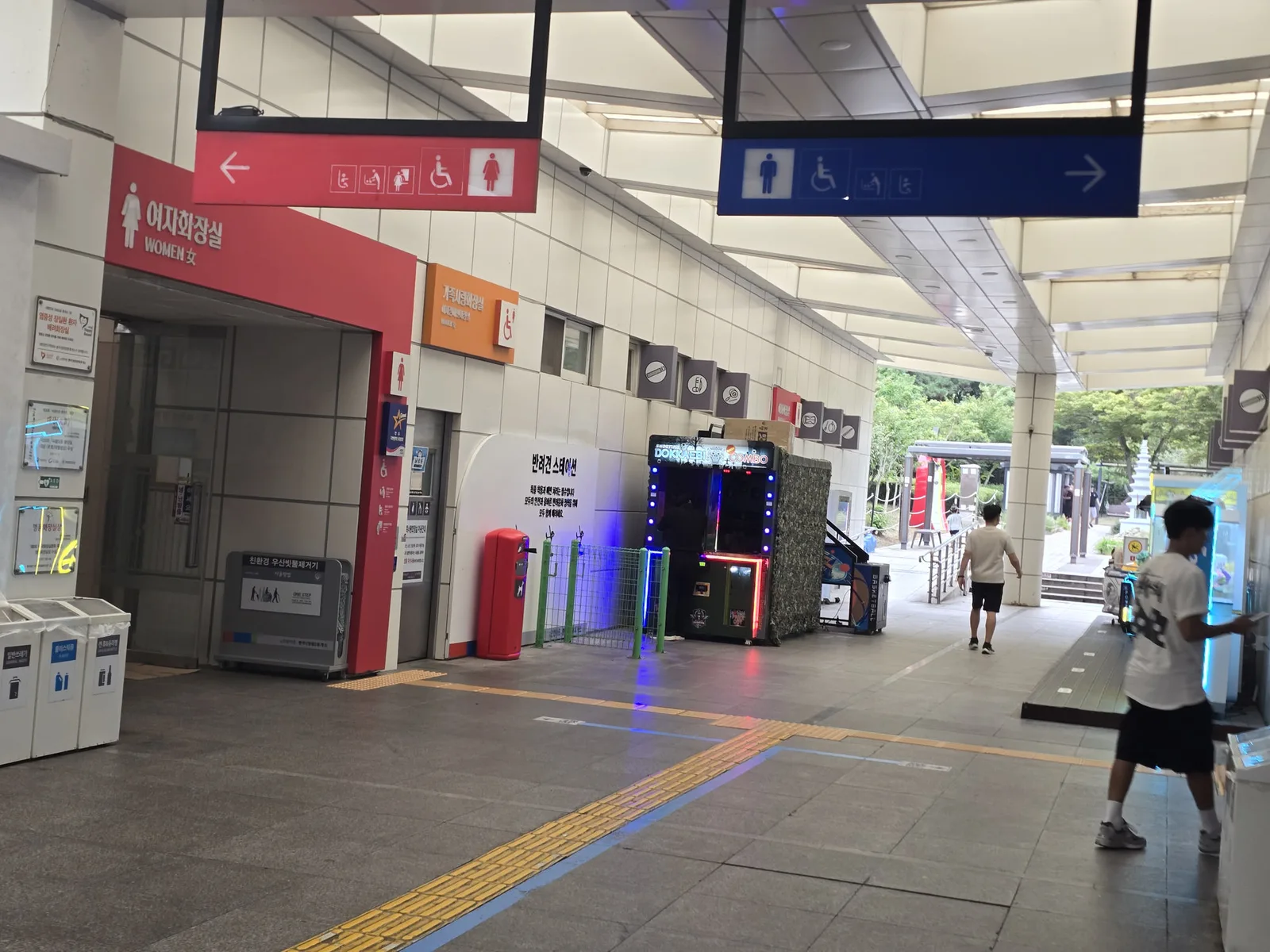
The official dataset records restrooms as a per-site attribute alongside a separate flag for a nursing room, which is a fair signal that family facilities exist at some locations rather than all. Larger stops on busy corridors generally have more of everything, including accessible stalls. Standards differ by site and by how recently the building was renovated, so treat a major stop and a small one as different propositions.
Fuel and EV charging are also recorded per site rather than assumed. Many rest areas have a gas station, and EV charging has been rolled out across the network, but neither is universal and charger availability at a specific stop can change.
Korean words worth recognizing
You do not need to read Korean to use a rest area, but these words appear on signage and screens.
| Korean | Reading | Meaning |
|---|---|---|
| 휴게소 | hyugeso | Highway rest area |
| 화장실 | hwajangsil | Restroom |
| 주유소 | juyuso | Gas station |
| 편의점 | pyeonuijeom | Convenience store |
| 식권 | sikgwon | Meal ticket |
| 무인식권기 | muin-sikgwongi | Unattended ticket machine |
| 퇴식구 | toesikgu | Tray return point |
| 서울방향 | Seoul-banghyang | Seoul-bound |
| 부산방향 | Busan-banghyang | Busan-bound |
The two direction words are the ones to memorise. They appear on road signs, on rest area names, and in any description of which side a facility is on.
Common mistakes
- Assuming both directions share one rest area. Check which side a facility is on before planning around it.
- Deciding too late and swerving for the exit. Take the next one instead.
- Arriving with one specific dish in mind. Tenants change, and a stall you read about may be gone.
- Lining up at the counter before buying a ticket. Find the machine first.
- Leaving a bus without noting where it parked. Coaches look alike in a row.
- Wandering to the far end of a large site during a bus break. Distance costs more time than you think.
- Expecting every stop to have the same facilities. Fuel, chargers, and nursing rooms are recorded per site.
- Depending on one card. Machines are less forgiving than staffed counters.
Is it worth stopping if you are not hungry?
For a short drive, a rest area is a restroom and nothing more, and that is a fine reason to use one.
On a longer trip it earns the stop for a different reason. Korean expressways run long stretches without exits, traffic on holiday weekends can turn a three hour drive into six, and the stops are where you reset. Snacks that only really exist in this setting are part of why Koreans look forward to them.
If you are on a bus, you get the break whether you want it or not. You may as well know what is inside.
Frequently asked questions
Are Korean highway rest areas open 24 hours? Not uniformly. The official dataset records an opening and a closing time for each rest area individually, which means hours are a per-site fact. Restrooms and parking at large stops on busy corridors are the most likely to be available around the clock, while individual food counters keep their own hours.
Can foreign visitors use them? Yes. There is no entry fee, no membership, and no requirement to buy anything. Menu boards usually carry photographs, and ticket machines often have an English option.
Can I visit one without driving? Not easily as a destination in itself, since they are reached from the expressway. The realistic way to see one without a car is to take a long-distance express or intercity bus that breaks at one.
Do express buses always stop at a rest area? No. Longer routes commonly do, but it depends on the service and the distance, and there is no single published rule fixing the length of a break. Listen for the driver's announcement.
Can I pay with a foreign credit card? Often, but not everywhere. Staffed counters are more reliable than unattended machines, and acceptance varies by terminal. Carry some cash as a fallback.
What should I try first? Walnut cakes and fish cake skewers are the two things most associated with the setting, and both are cheap and quick. If you want a meal rather than a snack, ramyeon and kalguksu are the safe defaults.
Are the restrooms free? Yes. Restrooms at rest areas are public and free to use.
Are there EV chargers? At many rest areas but not all, and the dataset records charger presence per site. Check current availability through your car or a charging app before you rely on a specific stop.
Can I cross to the rest area on the other side of the highway? Usually no. Some locations are built so both directions share facilities, but many are not, and there is generally no pedestrian or vehicle crossing on an expressway. Verify for the specific stop rather than assuming.
Sources
- Korea Expressway Corporation, nationwide rest area standard datasetOfficial transport site
- KOBUS (Express Bus Integrated Reservation)Official transport site
- Visit KoreaOfficial tourism site
Information is compiled from official sources. Details such as prices, hours, and schedules can change. Confirm time-sensitive facts before you travel.
Last verified on
Related guides
Renting a Car in Korea Guide for Foreigners: IDP, Insurance, Traffic Rules, and Driving Tips
Renting a car in Korea can be the best way to see Jeju, Gangwon, and the countryside, but it's not the move for a first trip to Seoul, where transit is easier. This is a preparation guide, not legal advice: the documents you need (and the International Driving Permit trap that gets German, French, and Thai visitors turned away at the counter), how car insurance really works, Korea's very strict 0.03% drink-driving limit, the traffic rules that matter most, and what to do after an accident. Prices, fees, fines, and coverage vary by company and change, so always confirm current official info and your rental contract.

Getting Around Korea: Transportation Guide
Korea is easy to get around with public transport. Take the Airport Railroad into the city, ride subways and buses with a T-money card, cover long distances on the KTX high-speed train, and use taxis for short hops. A Korean map app ties it together.