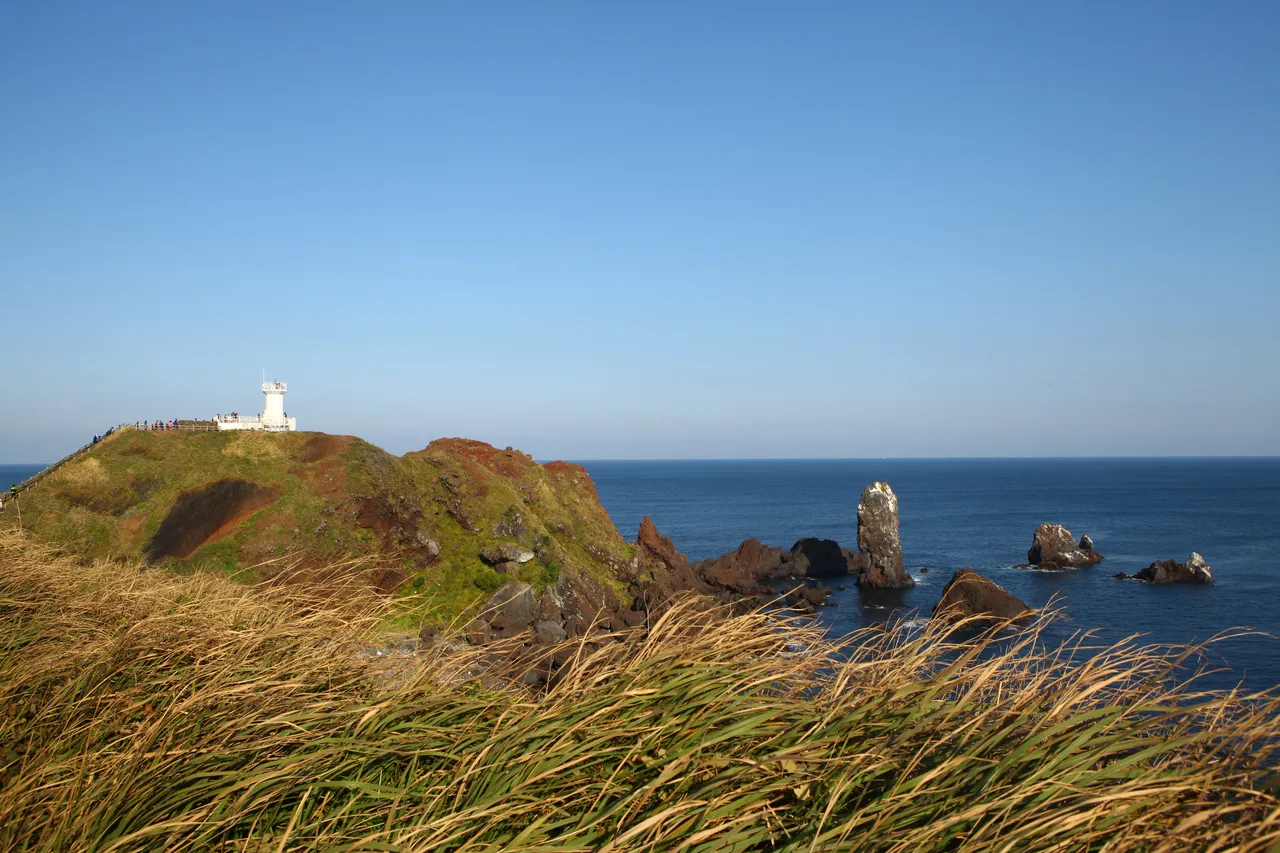
Seopjikoji is a free-to-enter coastal headland on Jeju's east coast, and it is worth an hour or two if you are already near Seongsan. The draw is the sea, the grass and cliffs, and a lighthouse on a small red hill, not any single attraction.
Three questions decide the stop: what is free and what is a separate business, how much walking you want, and what the wind is doing. This page keeps those apart, because "Seopjikoji" on a map covers a public cape and a resort complex with different rules.
Quick answer
| Question | Short answer |
|---|---|
| What is it? | A headland on Jeju's east coast, in Seongsan-eup, Seogwipo |
| Is it the same place as Seongsan Ilchulbong? | No. They are separate sites about 4 km apart in a straight line (my estimate from map coordinates) |
| Is there a fee? | No admission fee is listed on the official page. Parking is paid |
| Opening hours? | Listed as open year-round. Nearby shops, museums and resort buildings keep their own hours |
| How long to allow? | About 30 minutes for a quick look, 1.5 to 2 hours for a relaxed walk (my estimates) |
| Is the walk hard? | Not a serious hike, but it has slopes and steps and is open to wind |
| Wheelchair or stroller? | I am not claiming either. Accessibility features are listed as unavailable |
| Can I see Seongsan from here? | The official page describes Seongsan Ilchulbong in the background, but the view depends on where you stand and on haze |
What Seopjikoji is
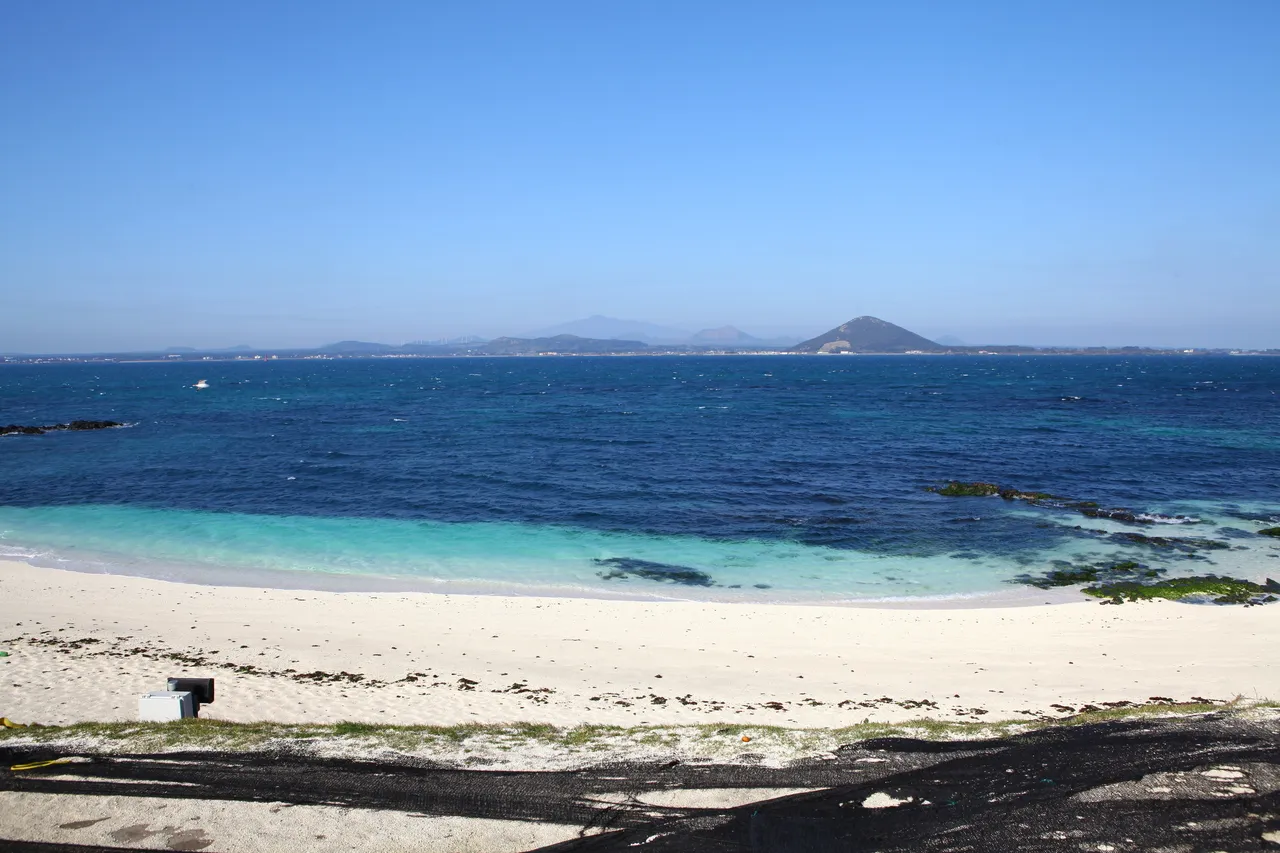
Seopjikoji is a cape that juts out into the sea on the southeast side of Jeju's Seongsan area. The Visit Jeju page describes grassland, coastal cliffs, a rock called Seondolbawi, a red volcanic hill called Bulgeun Oreum, and Seongsan Ilchulbong in the background.
The name is a place name and the walk is the main activity. There is no single ticketed attraction at the cape itself, which is why the official page can list it as open year-round.
The cape is also next to Sinyang Beach, a separate stretch of sand on its northwest side. I did not verify beach facilities, so treat it as a look, not a plan.
Is it worth a visit?
Yes, if you are on the east side and want a scenic walk that costs little and does not need a booking. It suits a short stop or a slower coastal stroll.
| You are | Verdict |
|---|---|
| On an east-coast day near Seongsan | Good fit, an easy second stop |
| Short on time | A 30 minute look from the main path is enough to see the cape |
| Coming for spring canola | Possible, but flowering depends on the year, so do not build the trip on it |
| Using a wheelchair or stroller | Not recommended as a plan. Accessibility features are listed as unavailable |
| Hoping for a sunrise from Seongsan | This is a different place. See the Seongsan guide |
Access, hours and fees
The Visit Jeju page, checked on 2026-10-13, lists Seopjikoji as open year-round and shows no admission fee. That describes the outdoor public area. It does not describe the shops, museums or resort buildings nearby, which are separate businesses.
I am not giving a whole-site opening time, because I could not confirm one that applies to the entire area. If a facility inside the cape matters to your plan, check that facility's own hours before you go.
The address on the official page is 262 Seopjikoji-ro, Seongsan-eup, Seogwipo-si, and the listed phone number is 064-784-2810. Weather closures and any one-off restriction are not described on that page, so look for notices on the day.
Parking
Parking is the one cost most visitors will meet. The Visit Jeju page, checked on 2026-10-13, lists two lots for a standard small vehicle.
| Lot | Listed fee |
|---|---|
| Seopjikoji parking lot | ₩1,000 for the first 30 minutes, ₩500 for each extra 15 minutes, ₩3,000 daily maximum |
| Phoenix Island parking lot | ₩5,000 per day |
These are volatile figures. A Ministry of Oceans and Fisheries walking-route page lists different per-vehicle fees, so older figures online may not match the current ones. Confirm the rate on the sign at the entrance.
The Seopjikoji lot is charged by time with a daily cap, while the Phoenix Island lot is a flat day rate. Check the signs on arrival to see which lot suits your plan.
The coastal walk
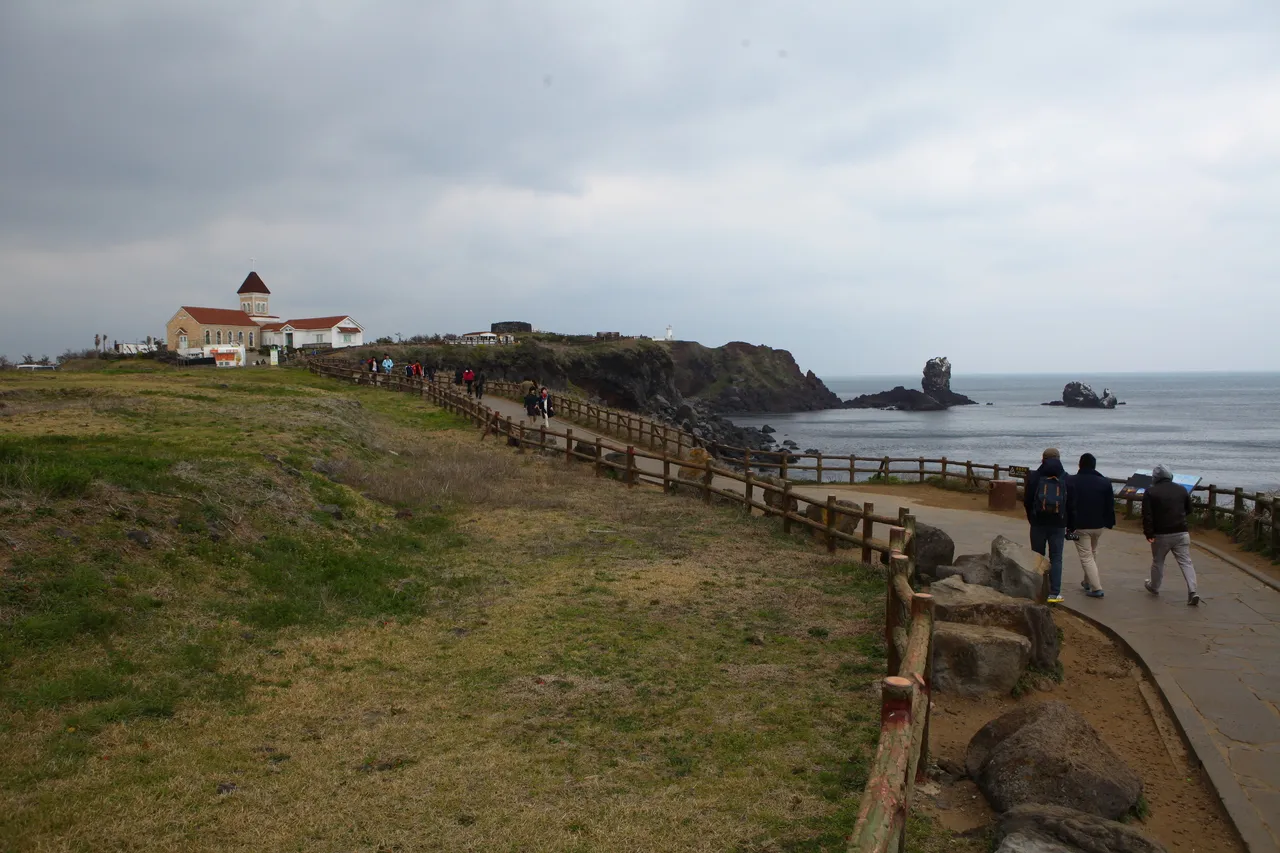
The walk follows paths along the headland, with grass and sea on both sides and rails in places. A government walking-route page describes a north coast route of about 1.5 km and a south coast route of about 2.5 km, and about 1.5 hours for a walking tour. I treat these as rough guides, since I could not confirm them against an official signed map.
How hard is it?
It is a walk on paths with slopes and some steps, not a serious hike. It is not easy for everyone either, because the cape is open to wind and parts of the route are uneven or sloped.
Wear shoes with grip and bring a windproof layer. Stay on the marked path and keep behind the rails near cliff edges.
Accessibility
The VisitKorea listing shows accessible toilets, elevators and dedicated parking as unavailable. The lighthouse approach uses iron stairs, and the rest of the path has slopes.
I am not claiming the route works for wheelchairs or strollers. If you need level access, call the listed number and ask about the specific path before you go.
How much time to allow
These are my planning estimates, not official figures.
| Plan | Time to allow |
|---|---|
| Quick viewpoint stop | About 30 minutes |
| Standard coastal walk | About 1.5 to 2 hours, with photo stops |
| Seongsan plus Seopjikoji block | A half day to most of a day, depending on whether you climb the cone |
The lighthouse hill and Hyeopja Yeondae
The red hill, Bulgeun Oreum, has a white lighthouse on top. VisitKorea says iron stairs lead up to it and describes the climb as easy, and a Ministry of Oceans and Fisheries page names it the Bangdupo Lighthouse.
Walking up to the lighthouse is not the same as entering it. I found no hours, ticket or entry information for the lighthouse building itself, so I am describing the stairs and the view, not an interior visit.
On the broad hilltop is Hyeopja Yeondae, a stone beacon tower that the Heritage Administration lists as a Jeju provincial monument designated in 1973. A beacon like this was used to signal danger by smoke or fire. It is an outdoor structure you can look at from the path.
Views of Seongsan Ilchulbong
The Visit Jeju page describes Seopjikoji with Seongsan Ilchulbong in the background. The cone sits to the north of the cape.
I will not say the view is clear from everywhere. Which stretch of path gives the best angle, and whether haze or cloud hides the cone, depends on where you stand and on the day.
Gwangchigi Beach, west of the cone, is a different place with its own view of Seongsan. It is not part of Seopjikoji, and I have not written a separate guide for it.
Spring canola and other seasons
The Visit Jeju page lists spring canola flowers as part of the scenery. The flowering usually falls in spring, but I am not giving dates, because bloom depends on the weather and on what is planted that year.
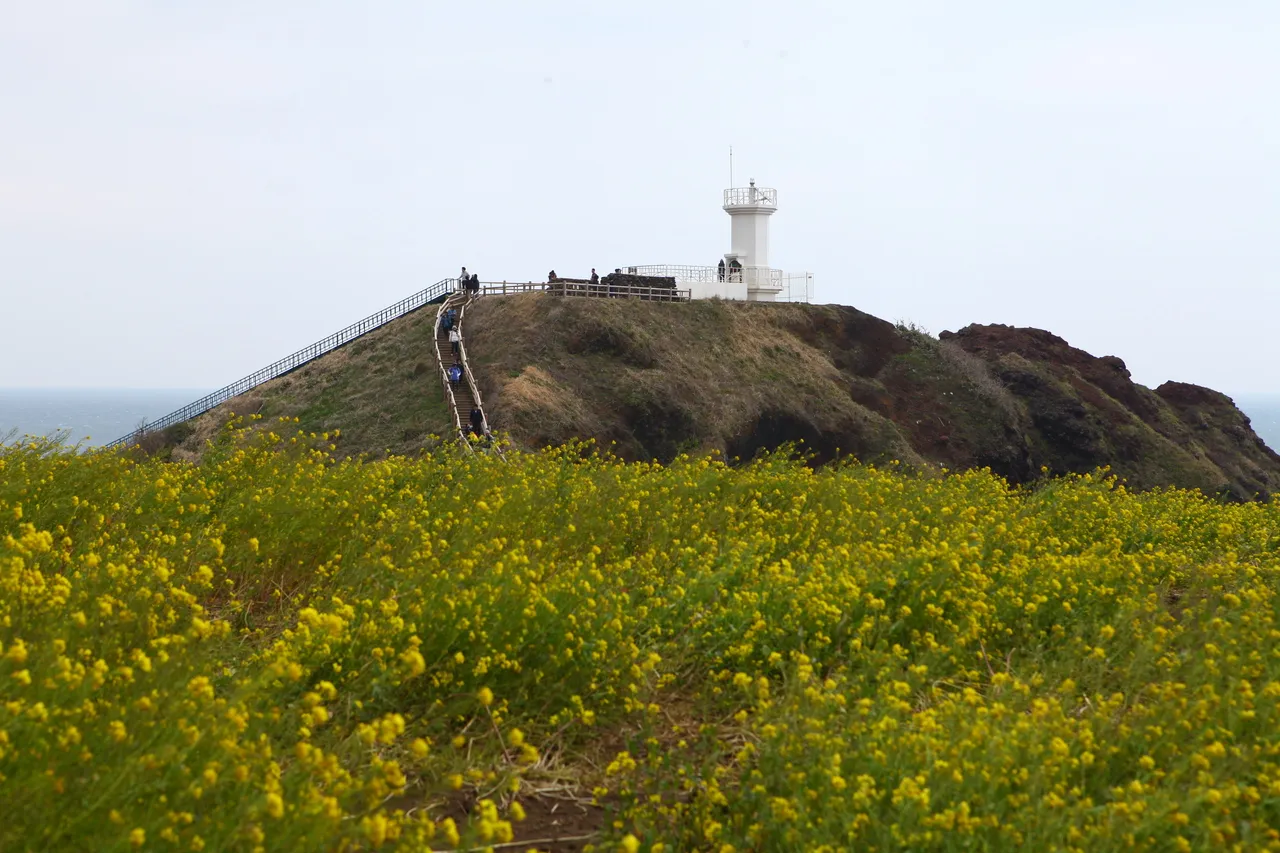
If you come for canola, treat it as a bonus and not the plan. Stay on the paths and out of the fields, since land around the cape may be managed or privately held.
Outside spring the cape is still grassland, sea and cliffs. I do not name a single best month, because summer green, autumn grass and winter light each look different and wind and cloud matter more than the calendar.
Wind and weather
A headland is exposed, so it can feel colder and windier than the car park. Bring a layer even on a mild day.
I am not giving a wind speed at which to skip the walk. Use the day's forecast and posted notices, and turn back from exposed sections if the wind makes walking uncomfortable.
What is not here: the drama set and nearby buildings
A former drama set called All In House stood on the cape and was long used as a museum. A November 2021 Jeju Ilbo report described it as abandoned, with a demolition dispute between a village council and the owner still in court.
I could not confirm its current status, so I classify it as historical and unclear, and I do not recommend planning a visit around it. Older blogs and photos may show a building that is no longer open or no longer there.
The same goes for cafes, museums and other buildings in the area. They are separate businesses with their own hours and fees, and I have not verified any of them, so check each one yourself.
Getting there
Seopjikoji is on the east coast, south of Seongsan Ilchulbong. I measure about 4 km between the two in a straight line from map coordinates, which is not a road distance or a travel time.
A rental car is the simplest way to link the two, and the Jeju car rental guide covers the basics. Public bus routes and frequencies change often, and I did not verify current routes, so check a navigation app or Visit Jeju on the day.
Search for 섭지코지 or the address above in your map app. Make sure you select the cape and not a resort or a similarly named business.
Combining Seopjikoji with other stops
With Seongsan Ilchulbong
Seongsan plus Seopjikoji is a realistic east-coast day. Do the cone first if you want the summit, because its hours are fixed and the climb takes about 1.5 to 2 hours per my estimate in the Seongsan guide.
Seopjikoji is flexible, so it works well as the second stop.
With Udo
Udo is a separate ferry trip, so combining it with Seopjikoji in one day is tight and I would not make it a default plan. For the ferry, ID and timing, use the Udo Island guide.
I would not stack Udo, the Seongsan summit and Seopjikoji in one day. Pick two at most unless you are comfortable with a rushed schedule.
Planning all of East Jeju? See the East Jeju one-day itinerary for how to choose between the routes.
Sunrise, sunset and photography
Seopjikoji is a photography stop, not a timed attraction. I am not giving sunrise or sunset times here, because they change by date and the numbers belong on a source such as the Korea Astronomy and Space Science Institute.
For sunrise from the Seongsan summit, see the Seongsan guide, which covers that question separately. Respect fences and signs, and do not walk into fields or onto private land for a photo.
Food and facilities
The area has cafes and restaurants, and a government walking-route page lists restrooms. I do not recommend specific businesses, and hours differ by place.
If you have Muslim, vegetarian or allergy needs, ask staff directly and do not rely on a menu description. I did not verify any certification.
Common mistakes
- Assuming it is the same place as Seongsan Ilchulbong. They are separate sites with separate rules.
- Quoting one opening time for the whole area. The public cape and the commercial buildings differ.
- Using an old parking price. Fees change, and blog figures are often stale.
- Planning around the drama set. Its status is unclear and it is not a reason to visit.
- Promising yourself canola. Bloom depends on the year.
- Underestimating the wind. The cape is exposed, so bring a layer.
- Stacking Udo, the Seongsan summit and Seopjikoji in one day. It is rushed.
FAQ
Is Seopjikoji free?
The Visit Jeju page lists no admission fee, but parking is paid. Check the sign on arrival, because fees change.
What are the opening hours?
The page lists it as open year-round. Nearby shops, museums and resort buildings keep their own hours, so check each one.
How much is parking?
On 2026-10-13 the Seopjikoji lot was listed at ₩1,000 for 30 minutes, ₩500 per extra 15 minutes and ₩3,000 per day, and the Phoenix Island lot at ₩5,000 per day. These are volatile.
How long should I stay?
About 30 minutes for a look, 1.5 to 2 hours for a relaxed walk. These are my estimates.
Can I go inside the lighthouse?
I found no entry or hours information for the building. You can walk up the stairs to the hill and see it from outside.
Can I see Seongsan Ilchulbong from Seopjikoji?
The official page describes it in the background, but the view varies by spot and by haze. I do not promise a clear view.
When do the canola flowers bloom?
Usually in spring, but it depends on the year and I am not giving dates. Treat it as a bonus.
Is it suitable for wheelchairs or strollers?
I am not claiming it is. Accessibility features are listed as unavailable and the path has slopes and stairs.
Is All In House still open?
I could not confirm its current status, so do not plan around it.
Can I do Udo and Seopjikoji in one day?
It is tight. Use the Udo Island guide and treat the return ferry as the fixed deadline.
The bottom line
Treat Seopjikoji as a free coastal walk with paid parking, not as a ticketed attraction. Allow an hour or two, bring a windproof layer, and keep your expectations for canola and the Seongsan view flexible.
Sources
- Visit Jeju: Seopjikoji (hours, parking, description)Official tourism site
- VisitKorea: Seopjikoji (lighthouse, accessibility listing)Official tourism site
- Heritage Administration: Hyeopja Yeondae (Jeju Monument, designated 1973)Official government site
- Badaon (Ministry of Oceans and Fisheries): Seopjikoji walking route notesOfficial government site
- Jeju Ilbo: All In House left abandoned, demolition stalled (Nov 2021)news_report
- Visit Jeju: Seongsan IlchulbongOfficial tourism site
- Visit Jeju: Udo Island (Maritime Park)Official tourism site
Information is compiled from official sources. Details such as prices, hours, and schedules can change. Confirm time-sensitive facts before you travel.
Last verified on
Related guides
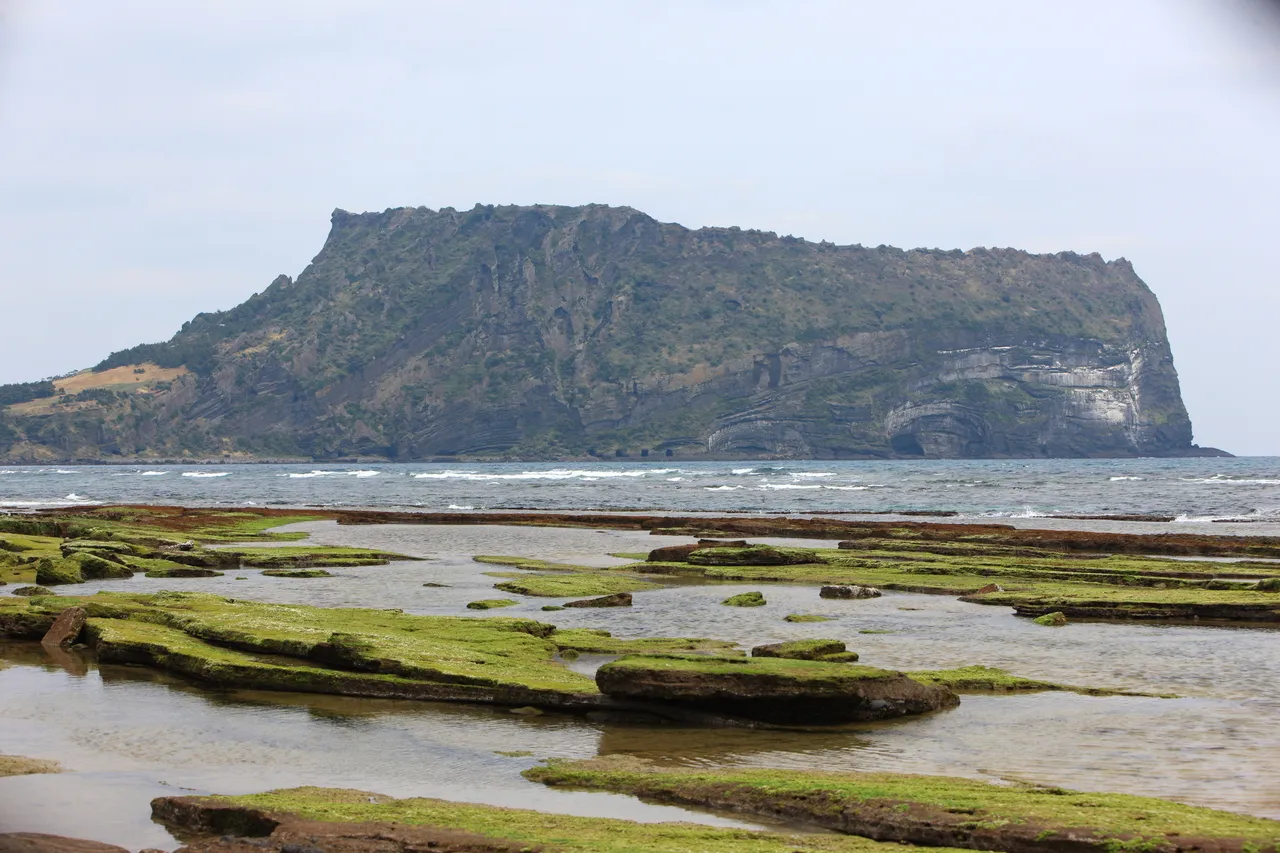
Seongsan Ilchulbong Guide: Sunrise, Hike, Tickets & How to Get There
Seongsan Ilchulbong is a volcanic cone on Jeju's east coast, part of the island's UNESCO World Natural Heritage property. The summit trail is paid and steep, takes roughly 30 to 40 minutes up, and opens before sunrise on every date under the current official hours. Hours and fees change, so confirm them on the official page and look up the sunrise time for your own date.
Udo Island Guide: Ferry, Beaches, Getting Around & a Day Trip Plan
Udo is a small island just off Jeju's east coast, reached by a short ferry from Seongsan Port or Jongdal Port. Most visitors go as foot passengers, bring a passport for the boarding ID check, and get around by bicycle, pedal-assist e-bike, a permitted electric vehicle or on foot. Vehicle rules are strict and change, so confirm them before you rely on a rental car or a two-wheeler.