
Seoul's Hangang parks open outdoor swimming pools and water playgrounds each summer. They are cheap, local heat-wave options, and they are not swimming in the Han River itself.
These are constructed, chlorinated, lifeguarded facilities on riverside parkland. River swimming is not permitted.
For 2026, two sites are real swimming pools (Ttukseom, Yeouido) and four are water playgrounds (Jamsil, Gwangnaru, Nanji, Yanghwa). Turning up at a playground expecting laps is the usual disappointment.
Seasonal notice. 2026 schedule: June 19 to August 30. Prices, hours, and which sites open change by year, and weather can close a site the same day. Check the current Hangang Park notice before you go.
Quick answer
| Question | Short answer |
|---|---|
| Swim in the river? | No. Only the park pools and playgrounds. |
| 2026 season | June 19 to August 30 (confirm official notice) |
| How many sites? | Six: 2 pools + 4 water playgrounds (Jamwon not open in 2026) |
| Want real swimming | Ttukseom or Yeouido |
| Families with young kids | A water playground (check depth and guardian rules) |
| Easiest by subway | Ttukseom (but not Ttukseom Station on Line 2: see station note below) |
| Night hours | Four sites until 22:00 from July 3; Gwangnaru and Yanghwa close 18:00 |
| Adult pool admission (2026) | About KRW 5,000 pool / KRW 3,000 playground (see price table) |
| Biggest same-day risk | Weather suspension: have an indoor backup |
Swimming pool vs water playground
This distinction drives every other decision, so it's worth being explicit.
| Type | Main purpose | Typical users | What to expect |
|---|---|---|---|
| Swimming pool | Swimming and deeper-water activity | Adults, teenagers, families with older children | Separate pools split by age and depth, stricter swimwear rules, larger facilities |
| Water playground | Cooling off and family water play | Families, younger children | Shallower water, fountains and channels, play-oriented layout |
| Natural-style water playground | Landscape-integrated water play | Families, casual visitors | Shallow pools and water channels designed into the park's greenery |
A few points that matter in practice:
- A water playground is not suitable for lap swimming, even if it's called a "pool" colloquially.
- A swimming pool still includes children's and toddler sections: it isn't adults-only.
- Maximum depth isn't the only factor. Age rules and guardian requirements differ by pool section, and children entering youth or adult pools are generally required to wear a flotation device and be accompanied by a guardian.
- Adults without children will usually be happier at a full swimming pool.
- Families with toddlers will usually be happier at a shallow water playground.
The six 2026 locations, and when they run
The 2026 season runs June 19 to August 30, with no regular closed days. Everything here is summer only: outside those dates there is nothing to visit.
Two swimming pools, four water playgrounds. Jamwon is not on the 2026 list, so ignore older guides that still include it. It is closed for construction, and no reopening date is worth planning around.
| Facility | Type | Best for | Closing time (2026) | Night opening |
|---|---|---|---|---|
| Ttukseom | Swimming pool | Swimming, families, easiest subway access | Until 22:00 | Yes, from July 3 |
| Yeouido | Swimming pool | Full pool experience, central Seoul | Until 22:00 | Yes, from July 3 |
| Jamsil | Water playground | Families, natural-style water play | Until 22:00 | Yes, from July 3 |
| Gwangnaru | Water playground | Families, younger children, quieter daytime | 18:00 | No |
| Nanji | Water playground | River views, relaxed family atmosphere | Until 22:00 | Yes, from July 3 |
| Yanghwa | Water playground | Children, relaxed family play | 18:00 | No |
Daytime operation runs from 09:00 to 18:00. From July 3 the four night-opening sites stay open until 22:00; Gwangnaru and Yanghwa never do, and close at 18:00.
No regular closed days is not the same as always open. Weather suspensions can hit any day, which is its own section below.
Rest periods, when nobody is allowed in the water, are normal at Korean public pools. The times are posted at the facility, so read the board on arrival rather than planning a swim down to the hour.
Which facility should you choose?
| Traveler | Recommended option |
|---|---|
| Adult who wants actual swimming | Ttukseom or Yeouido |
| Couple wanting a summer Hangang experience | Ttukseom, Yeouido, or Nanji during night operation |
| Family with toddlers | A water playground: check depth and guardian rules first |
| Family with children of different ages | Ttukseom or Yeouido, for the range of depths |
| Visitor without a car | Ttukseom has the simplest verified subway walk |
| Budget traveler | A water playground |
| Night visitor | Only Ttukseom, Yeouido, Jamsil, or Nanji: and only from July 3 in 2026 |
| Quiet daytime visitor | A weekday morning at Gwangnaru or Yanghwa |
| Serious swimmer | A full swimming pool, never a water playground |
| Rainy-day traveler | Don't rely on these at all: have an indoor backup |
"Best" here depends entirely on what you want, not on a ranking.
Admission prices (2026)
| Facility type | Child | Teenager | Adult |
|---|---|---|---|
| Swimming pool (Ttukseom, Yeouido) | KRW 3,000 | KRW 4,000 | KRW 5,000 |
| Water playground (Jamsil, Gwangnaru, Nanji, Yanghwa) | KRW 1,000 | KRW 2,000 | KRW 3,000 |
Children under 6 enter free. Bring something that shows the child's age.
A 50% discount applies to multi-child card holders and their registered family, visitors aged 65 and over, disabled visitors with one companion, and national merit recipients. It is claimed by showing the supporting document, so it is an on-site transaction rather than something you select when booking online.
These are 2026 rates and they are set per season, so a later year needs re-checking.
Ttukseom Hangang Park Swimming Pool
The most practical pick for most foreign visitors: it's a genuine swimming pool with sections for adults, children, and toddlers, it runs night hours, and it's the easiest of the six to reach on foot from a subway station.
⚠️ The station name trap. Read this one. The pool is not at Ttukseom Station (뚝섬역) on Line 2.
It's at Jayang (Ttukseom Hangang Park) Station on Line 7, roughly a 5-minute walk from Exit 2 or 3. That station was actually renamed in 2024, it used to be Ttukseom Resort Station (뚝섬유원지역), and the rename happened specifically because people kept confusing it with Line 2's Ttukseom Station. If your map app sends you to Ttukseom Station, you're at the wrong place.
Search for the park name, not the word "Ttukseom" alone.

Good for: first-time visitors, adults who actually want to swim, families needing multiple depths, and anyone relying on public transport.
Watch out for: weekend and holiday crowds, ticket queues at peak times, swim-cap enforcement, limited shade, and busier evenings once night opening starts.
Best for: travelers who want the clearest combination of real swimming facilities and subway convenience. Not ideal for: anyone hoping for a quiet, uncrowded pool on a peak summer weekend.
Yeouido Hangang Park Swimming Pool
The other full swimming pool, with youth/adult, children's, and toddler sections, sitting inside Yeouido Hangang Park in central-western Seoul. It pairs naturally with a Yeouido riverside evening.
Getting there: Yeouinaru Station (Line 5), Exit 2 is the usual approach, roughly a 5-minute walk. Line 9's National Assembly Station is a further alternative but a noticeably longer walk. Confirm the current route to the pool ticket office rather than just to the park: Hangang parks are long, and the walk inside the park can add more time than the map suggests.
Good for: adults and teenagers, families needing different depths, visitors staying in western or central Seoul, and a riverside evening atmosphere.
Watch out for: weekend crowding, long walks inside the park itself, and the fact that any evening program or event here is weather-dependent and needs same-day confirmation.
Jamsil Hangang Park Water Playground
A water playground, not a traditional deep pool, built as a natural-style, shallow, play-focused space rather than somewhere to swim lengths. It runs night hours, which makes it one of the better family options for a hot evening.
Actual pool depths and any age or guardian requirements should be checked officially before you commit, especially if you're bringing a toddler. It fits a Jamsil or Songpa day, though don't assume the Lotte World area is a short walk: check the actual distance on a map first.
Good for: families, young children, and visitors who want to cool off and play rather than swim seriously. Not ideal for: adults after lap swimming, or anyone expecting a deep pool.
Gwangnaru Hangang Park Water Playground
The newest of the six, rebuilt from an older outdoor pool and reopened in April 2026 as a natural-style water playground on the eastern stretch of the Hangang.
It has a family pool, a toddler pool, a shared water-play area, and a stream, and it looks out over the Amsa ecological park rather than over city towers.
The key planning point: it closes at 18:00 and has no night opening. If your plan was an evening swim, this isn't the location.
Good for: families, toddlers, visitors staying in eastern Seoul, and quieter daytime water play.
Watch out for: the earlier closing time, transport that's less intuitive than Ttukseom or Yeouido for a first-time visitor, and confirming it's actually open after any heavy rain.
Nanji Hangang Park Water Playground
A water playground on the western Hangang with a strong riverside-view appeal and a relaxed family atmosphere. It runs night hours, so an early-evening visit works here.
Access is less direct than Ttukseom or Yeouido. Expect a bus, taxi, or a longer walk depending on where you're staying. We're not printing a bus number or exit here because we couldn't verify one against official sources.
Check the park's official "getting here" page plus Naver Map or Kakao Map for the current route.
Good for: families, river-view seekers, relaxed water play, and evening visits while night operation is running.
Watch out for: transport planning in both directions, weather exposure, longer walking distances, and crowds on event days.
Yanghwa Hangang Park Water Playground
A family-oriented water playground with shallow water compared with the full swimming pools: suitable for children subject to guardian rules, and a quieter alternative to the busier central sites.
Like Gwangnaru, it closes at 18:00 with no night opening. Verify the nearest station and the walking route officially; we're not guessing at an exit number.
Good for: families with children, daytime water play, and travelers wanting somewhere calmer. Not ideal for: night swimming, serious adult swimming, or anyone expecting multiple deep pools.
Tickets, reservations, and payment
Both online booking and on-site purchase are generally available, but the details differ by facility and by season, so check the current official reservation route before you rely on either.
| Ticket issue | What foreign visitors should do |
|---|---|
| Online booking | Check whether Korean login or phone verification is required: this blocks many visitors |
| On-site purchase | Arrive early on peak days and confirm availability |
| Discounts | The 50% categories are claimed by showing a document, so plan to buy on site |
| Foreign card | Carry a backup payment method; don't assume your card works |
| Age discount | Bring accepted proof of age |
| Free child admission | Bring the original acceptable supporting document |
| Re-entry | Ask staff before you leave the facility |
| Weather closure | Check before traveling; don't assume any particular refund rule |
An honest limitation: Korean online reservation systems frequently require a Korean phone number or a domestic account for verification, which many short-term visitors don't have. We can't verify from outside whether every booking route works for a foreign traveler on your dates. If online booking fails, on-site purchase is generally the practical fallback, but that means arriving early on a busy weekend.
Refund and cancellation policies should be confirmed officially rather than assumed.
What to wear and bring
Swim-cap enforcement catches a lot of visitors out, so treat this as a real requirement rather than a suggestion.
| Item | Required or recommended | Notes |
|---|---|---|
| Swimsuit | Required | Proper swimwear; check the official definition before assuming shorts qualify |
| Swim cap | Required | A fitted swim cap. A baseball cap over one is fine; instead of one is not |
| Rash guard | Recommended | Useful sun protection for an outdoor pool |
| Goggles | Optional | Worth having at the actual swimming pools |
| Water shoes | Check rules | Useful around the deck, but may be restricted in the water |
| Change of clothes | Recommended | Essential if you're continuing to sightsee afterward |
| Towel | Recommended | Don't assume rentals are available |
| Waterproof pouch | Recommended | For phone and cards |
Don't plan on swimming in ordinary street clothes, and leave valuable jewelry at your accommodation.
Beyond the table: sunscreen, a sun hat, your own shower supplies, a bag for wet clothes, a portable charger, proof of age for a child fare, and a backup payment method.
Bring more water than you expect to drink. On-site shops may not be open or well stocked, and this is an outdoor site in a Seoul summer.
What they will not let in
| Restricted item | Reason |
|---|---|
| Large inflatable tubes | Safety and crowding |
| Fins, snorkels | Pool safety |
| Kickboards, paddles, pull buoys | Training equipment is generally not permitted |
| Water guns | Reportedly restricted |
| Glass containers | Breakage risk |
| Cooking equipment | Fire and facility rules |
| Large tents | Space and sightline restrictions: rules vary by facility |
| Alcohol | Verify the current official rule |
| Expensive valuables | Loss risk |
One important nuance that looks contradictory: large tubes are restricted in general, but children and toddlers entering youth or adult pools are generally required to wear a flotation device, a life jacket or approved ring, and to be accompanied by a guardian. So "no tubes" and "children need a flotation device" are both true, applied to different situations. Check the specific rule at your facility.
Anything not explicitly confirmed on the official notice should be treated as "ask on arrival" rather than assumed either way.
Tents, parasols, and mats vary more than anything else here. A tent allowed at Ttukseom may not be allowed at Nanji, and the pool area does not follow the surrounding park's rules.
What differs by site: whether pop-up and shade tents are allowed at all, maximum size, whether you may stake into the ground, parasol rental, where mats are permitted, and limits that appear on crowded days. Read the notice for the facility you are going to rather than a general Hangang park page.
Food, and eating around a restriction
Check the current outside-food policy for your facility. Packed meals and snacks are often permitted under conditions, while glass containers and cooking equipment are generally not. Eat only in designated areas, never in the water, and clear your own trash.
On-site shops may operate, but selection and prices vary and you shouldn't count on them.
Dietary notes: on-site food is not automatically halal, vegetarian, vegan, or allergy-safe. Check for pork, meat broth, seafood, dairy, nuts, soy, and wheat. Staff at a seasonal pool kiosk generally can't verify every ingredient, so if you have a serious allergy or a religious restriction, bringing a clearly labeled packed meal, where permitted, is the more practical route.
Lockers, showers, changing rooms, and valuables
| Facility need | Traveler tip |
|---|---|
| Locker | Bring small change or a payment backup in case they're paid |
| Shower | Bring your own basic shower products |
| Towel | Bring your own unless rental is officially confirmed |
| Wet clothes | Pack a waterproof or plastic bag |
| Large luggage | Leave it at your accommodation or a station locker: don't arrive with a suitcase |
| Passport | Carry only what you need and keep it away from water |
Use the designated changing and shower areas, store valuables in a locker, and note that the facility may not accept responsibility for lost items. Check the closing time for lockers and changing rooms specifically. It can be earlier than the pool's own closing time.
Safety rules
- Follow lifeguard instructions: they override anything written here.
- Children must stay with a guardian, and group guardian ratios should be verified with the facility.
- Use only age-appropriate pool sections.
- Approved flotation devices may be required for children in deeper pools.
- Don't run on wet surfaces, and don't dive unless it's explicitly permitted.
- Don't enter the water during official rest periods.
- Shower before entering, as is standard at Korean pools.
- Leave the water immediately during thunder, heavy rain, an evacuation instruction, or a safety closure.
- Don't swim after drinking alcohol.
- Don't block emergency access routes.
- If you can't swim, stay in a suitable shallow area, and don't assume a shallow-looking area has a uniform depth.
Emergency numbers: 112 (police) and 119 (fire and ambulance). The 1330 Korea Travel Hotline can help with interpretation. Confirm current service hours.
In an emergency, get a lifeguard or staff member immediately rather than working it out yourself.
None of this is medical advice; it's basic pool-safety behavior.
Weather, flooding, and same-day closures
This is the section that decides whether your trip happens at all, so don't skip it.
Hangang facilities can suspend operations during heavy rain, flooding or flood risk, typhoons, thunder, poor water conditions, or air-quality alerts. The 2026 season has no regular closed days, but that's a completely separate thing from a weather suspension, which can happen on any day.
The part visitors don't expect: Seoul can close riverside facilities even when it isn't raining where you are. Rain upstream raises Hangang water levels hours later, so a clear morning at your hotel doesn't mean the pool is open.
Same-day checklist:
- Check the official Hangang Park notice for suspensions.
- Check Seoul weather and any heavy-rain or storm warnings.
- Check the facility's reservation page for closure notes.
- Check for transport disruptions.
- Have an indoor backup ready before you leave.
Don't rely on a map app's "open" status, it lags behind official suspension notices. And if operations are suspended, don't travel there hoping for an on-site exception.
If it is closed
| Planned facility | Suggested backup |
|---|---|
| Ttukseom | Seongsu cafés and shops, or an indoor attraction |
| Yeouido | An indoor Yeouido mall or museum route |
| Jamsil | The Jamsil mall area or another indoor route |
| Gwangnaru | An indoor eastern-Seoul attraction |
| Nanji | A Hongdae or western-Seoul indoor route |
| Yanghwa | A Yeongdeungpo or Hongdae indoor route |
For a proper indoor fallback, the National Museum of Korea is the strongest single option in the city, and the Seoul in August guide has a fuller wet-weather swap list.
How to get there
Public transport is the better choice at every location: Hangang park parking lots fill up fast in summer, and walking distances inside the parks are longer than a map suggests. Aim your navigation at the pool's ticket office, not just the park name.
One caveat about the map on this page: those pins are park-level, not the pool entrance, because we could only verify park coordinates rather than facility-specific ones. Use them to see which park is where, then get the exact entrance from the official page or a Korean map app.
Ttukseom
Jayang (Ttukseom Hangang Park) Station, Line 7, Exit 2 or 3: roughly a 5-minute walk. This is not Ttukseom Station on Line 2, which is a different station entirely; the Line 7 station was renamed in 2024 precisely because of that confusion.
Yeouido
Yeouinaru Station, Line 5, Exit 2: roughly a 5-minute walk. National Assembly Station on Line 9 is a longer alternative.
Jamsil, Gwangnaru, Nanji, and Yanghwa
We're deliberately not publishing exit numbers or bus numbers for these four, because we couldn't verify them against official sources at the time of writing, and a wrong exit number in a long riverside park is worse than no exit number. Use the official Hangang Park "getting here" page for your specific facility, cross-checked with Naver Map or Kakao Map, and search the Korean facility name (below) rather than an English transliteration.
Nanji in particular tends to need a bus or taxi leg rather than a short station walk.
Best time of day
- Morning: generally cooler, often shorter queues, and the easiest option with young children.
- Afternoon: the hottest stretch with the strongest sun, and frequently the busiest.
- Evening: cooler and pleasant, but only at the four night-opening locations, and only from July 3 in 2026. Lighting, any programming, and closing procedures differ by site.
Weekends and public holidays are considerably busier than weekdays. Arrive early if you're going on one. That said, a weekday isn't automatically empty during peak summer.

Accessibility and family notes
Stroller access varies by station exit, park path, and facility, and pool edges and changing rooms don't all have the same accessibility. Check the official page for your specific location rather than assuming. Large strollers and wagons are awkward on crowded days.
For families: check pool depth before choosing a site, keep children under supervision at all times, and bring accepted proof of age if free or discounted admission matters. We're only mentioning nursing rooms or family changing areas as things to check. We can't confirm which sites have them.
A practical habit worth adopting: write your accommodation's contact details on something inside a young child's belongings.
Practical notes for foreign visitors
Staff English ability varies, and while some official signage is in English, don't count on full English support at a seasonal facility. A few things that genuinely help:
- Save the Korean facility name and show it to a taxi driver or use it in your map search.
- Use Naver Map or Kakao Map for precise entrances, Google Maps is weaker for Korean park interiors.
- Expect that some online reservations require Korean phone verification.
- Carry a backup payment method.
- Don't take hotel towels unless that's permitted.
- Don't board public transport or enter restaurants in wet swimwear: change and dry off first.
| English | Korean |
|---|---|
| Ttukseom Hangang Park Swimming Pool | 뚝섬한강공원 수영장 |
| Yeouido Hangang Park Swimming Pool | 여의도한강공원 수영장 |
| Jamsil Hangang Park Water Playground | 잠실한강공원 물놀이장 |
| Gwangnaru Hangang Park Water Playground | 광나루한강공원 물놀이장 |
| Nanji Hangang Park Water Playground | 난지한강공원 물놀이장 |
| Yanghwa Hangang Park Water Playground | 양화한강공원 물놀이장 |
Official English spellings and spacing can vary between Seoul city pages, the Korean name is the reliable one to show someone.
Useful Korean phrases
| English | Korean |
|---|---|
| Can I buy a ticket here? | 여기에서 표를 살 수 있나요? |
| Do I need a swim cap? | 수영모가 필요한가요? |
| Where is the changing room? | 탈의실이 어디예요? |
| Where are the lockers? | 사물함이 어디예요? |
| Is this pool open today? | 오늘 수영장 운영하나요? |
| What time does the pool close? | 수영장은 몇 시에 문을 닫아요? |
| Can children use this pool? | 어린이가 이 수영장을 이용할 수 있나요? |
| Is re-entry allowed? | 재입장할 수 있나요? |
At the Hangang pool
The two questions most likely to come up at the entrance.
Worth asking by phone or on arrival, weather closures happen.
Polite오늘 수영장 운영하나요?
o-neul su-yeong-jang un-yeong-ha-na-yo?
Is the pool open today?
Korean audio isn't available on this device or browser. Use the romanization above to say it.
A swim cap is required at the swimming pools; confirm the exact rule.
Polite수영모가 필요한가요?
su-yeong-mo-ga pil-yo-han-ga-yo?
Do I need a swim cap?
Korean audio isn't available on this device or browser. Use the romanization above to say it.
Sources
- Seoul Hangang Park (Future Hangang Headquarters, official)Official government site
- Seoul Metropolitan Government (english.seoul.go.kr)Official government site
- Visit Seoul, Seoul Tourism Organization (official)Official tourism site
- Korea Meteorological AdministrationOfficial weather service
Information is compiled from official sources. Details such as prices, hours, and schedules can change. Confirm time-sensitive facts before you travel.
Last verified on
Related guides
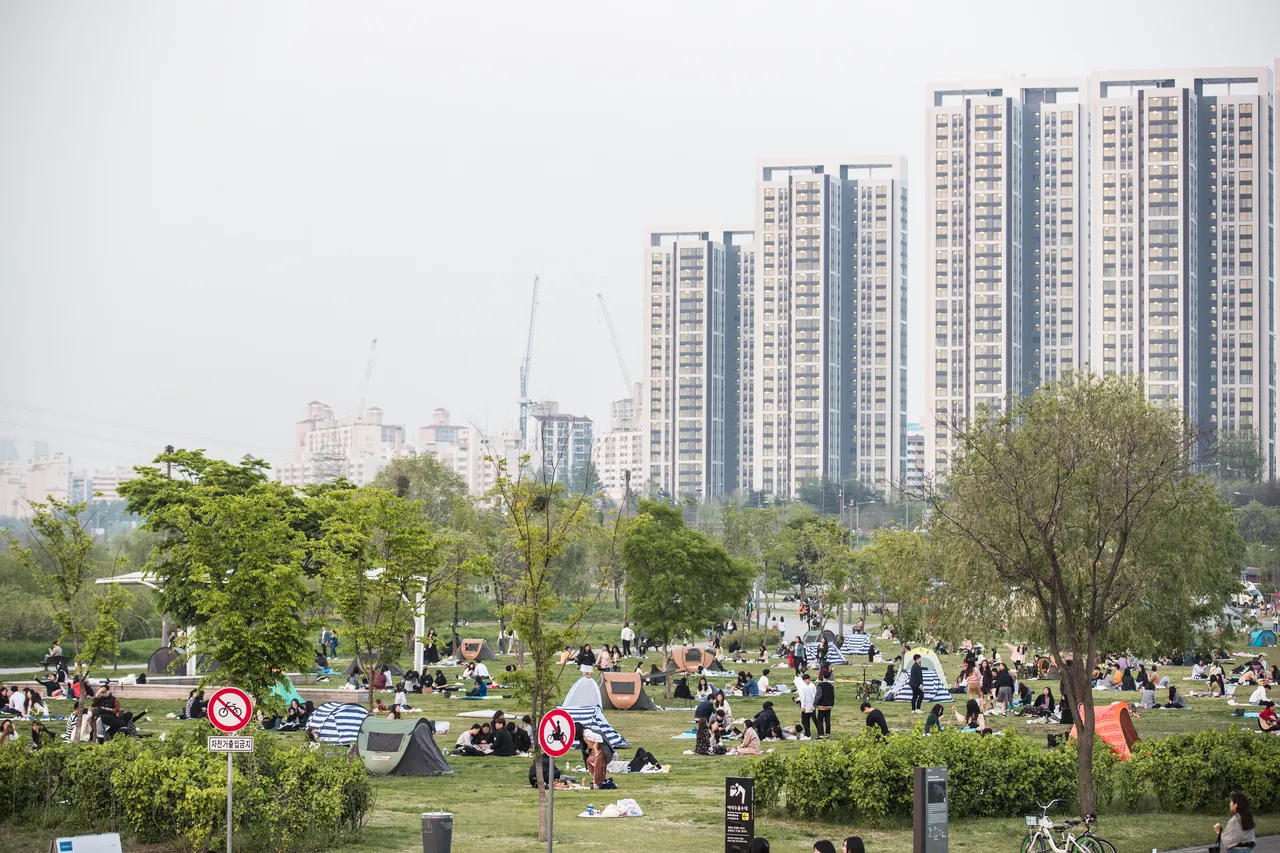
Han River Picnic Guide: Parks, Food, and Etiquette
A Han River (한강) picnic is one of Seoul's easiest, cheapest evenings out: pick a riverside park like Yeouido, Ttukseom, or Banpo, bring a mat and food, and relax by the water. Convenience stores and takeout are the simplest way to eat, and a few drinking and litter rules keep it pleasant for everyone.
Seoul in August Guide: Essential Places, Summer Festivals, Indoor Attractions, and Things to Do
Seoul in August is hot, humid, and sometimes rainy, copying a spring or autumn itinerary here doesn't work. Below: the essential places worth your time, the summer festivals actually confirmed for 2026 (Hangang River Festival, Seoul Summer Beach, Hangang pools, the Seoul International Garden Show), indoor attractions for the hottest hours, Korean summer food, what to wear, heat and rain safety, August 15 considerations, and realistic 3-day, 5-day, and 7-day itineraries built around the heat rather than against it.