Pohang sits on the East Sea, about two and a quarter hours from Seoul by high-speed rail. You arrive at a station, not a beach.
That gap is the whole planning problem. Pohang Station is several kilometers north of the water, and the coast then splits into a near cluster and a far one.
Get the geography right and Pohang is one of the easier coastal cities to add to a Korea trip without renting a car. Get it wrong and you spend the day in taxis.
Is Pohang worth visiting?
It depends on what you want from a coastal day.
Pohang is a working steel city with a beach in the middle of it. The skyline across the bay is a steelworks, not a resort strip, and the city's best-known artwork is a giant steel walkway on a hill.
That combination is unusual in Korea, and it is the reason to come.
What Pohang is good for: an urban beach fifteen minutes from the train, a large seafood market, a distinctive piece of public art, and a sunrise cape at the eastern tip of the peninsula.
What it is not: a compact walkable old town, or a place where the highlights sit next to each other.
How to get to Pohang from Seoul
Both of Seoul's high-speed rail gateways serve Pohang directly. Which one you use depends on where you are staying.
From Seoul Station by KTX
Direct KTX service between Seoul and Pohang opened on March 31, 2015, with the government putting the journey at about 2 hours 15 minutes, down from more than five hours on the old Saemaul train.
Trains branch off the Gyeongbu high-speed line after Dongdaegu and run into Pohang on the Donghae line. Frequency and the exact time on any given train vary by day and by how many intermediate stops it makes, so read the current timetable rather than a fixed figure.
From Suseo by SRT
SR's published Donghae Line runs:
Suseo → Dongtan → Pyeongtaek-Jije → Cheonan-Asan → Osong → Daejeon → Gimcheon (Gumi) → Seodaegu → Dongdaegu → Pohang
That is the operator's own route listing, and Pohang is the terminus. When the service launched, the first train was timed at 2 hours 21 minutes from Suseo.
Suseo is in southeastern Seoul, served by subway line 3 and the Suin-Bundang line. If you are staying in Gangnam, Jamsil, Songpa, or anywhere on that side of the river, Suseo is usually a much shorter start to the day than crossing the city to Seoul Station.
Fares are left out here for the same reason. The fare structure changed with the integration, and a number checked before that change would mislead you rather than help. Use the official booking engine for the current price.
KTX or SRT: which should you take?
There is no winner. The question is where your hotel is.
| KTX | SRT | |
|---|---|---|
| Seoul departure | Seoul Station | Suseo Station |
| Best if you are staying | Jongno, Myeongdong, Seoul Station area, Hongdae, northern Seoul | Gangnam, Jamsil, Songpa, southeastern Seoul |
| Route into Pohang | Gyeongbu high-speed line, then the Donghae line | Same Donghae line, from Suseo |
| Published journey time | About 2h15m at opening | 2h21m on the first service |
| Arrival | Pohang Station | Pohang Station |
| What to check | Current timetable and frequency | Same, plus that your account is converted |
Both land you at the same station. Pick the one whose Seoul-side station you can reach without a long subway trip, then pick the departure time that fits your day.
Pohang Station is not downtown
This is the most common planning mistake here.
Pohang Station sits in the north of the city, away from the waterfront and away from the market. You cannot walk from the platform to Yeongildae Beach, to Jukdo Market, or to Space Walk.
The Korea Tourism Organization gives two ways to cover the gap to the beach:
| From Pohang Station to Yeongildae Beach | Time |
|---|---|
| Express city bus No. 9000 | About 15 minutes |
| Taxi | About 12 minutes |
With luggage, take the taxi. The time difference is small and you skip the transfer entirely. Traveling light, or on a return leg after checkout, the 9000 bus is straightforward.
Do not plan the last five minutes of your return around either number. Both are typical figures, not guarantees, and Pohang traffic varies.
Understand Pohang before planning
Four clusters. The distances between them are the whole story.
A. Pohang Station. Your arrival and departure point in the north. Nothing to see; everything starts with a bus or a taxi from here.
B. Yeongildae and Hwanho Park. The beach, the overwater pavilion, Space Walk, the coastal walk, and most of the cafes and restaurants aimed at visitors. This is the easy cluster.
C. Central Pohang and Jukdo. Jukdo Market, the canal, and the downtown grid, inland of the port and south of the beach.
D. Guryongpo and Homigot. The Homi Peninsula, southeast of the city. Guryongpo is a fishing port; Homigot is the cape at the far eastern tip.
Clusters B and C are close enough to combine in an afternoon. Cluster D is a separate half-day at minimum. The map on this page is drawn to show exactly that, and it is why one night usually beats one long day.
Best things to do in Pohang
Yeongildae Beach
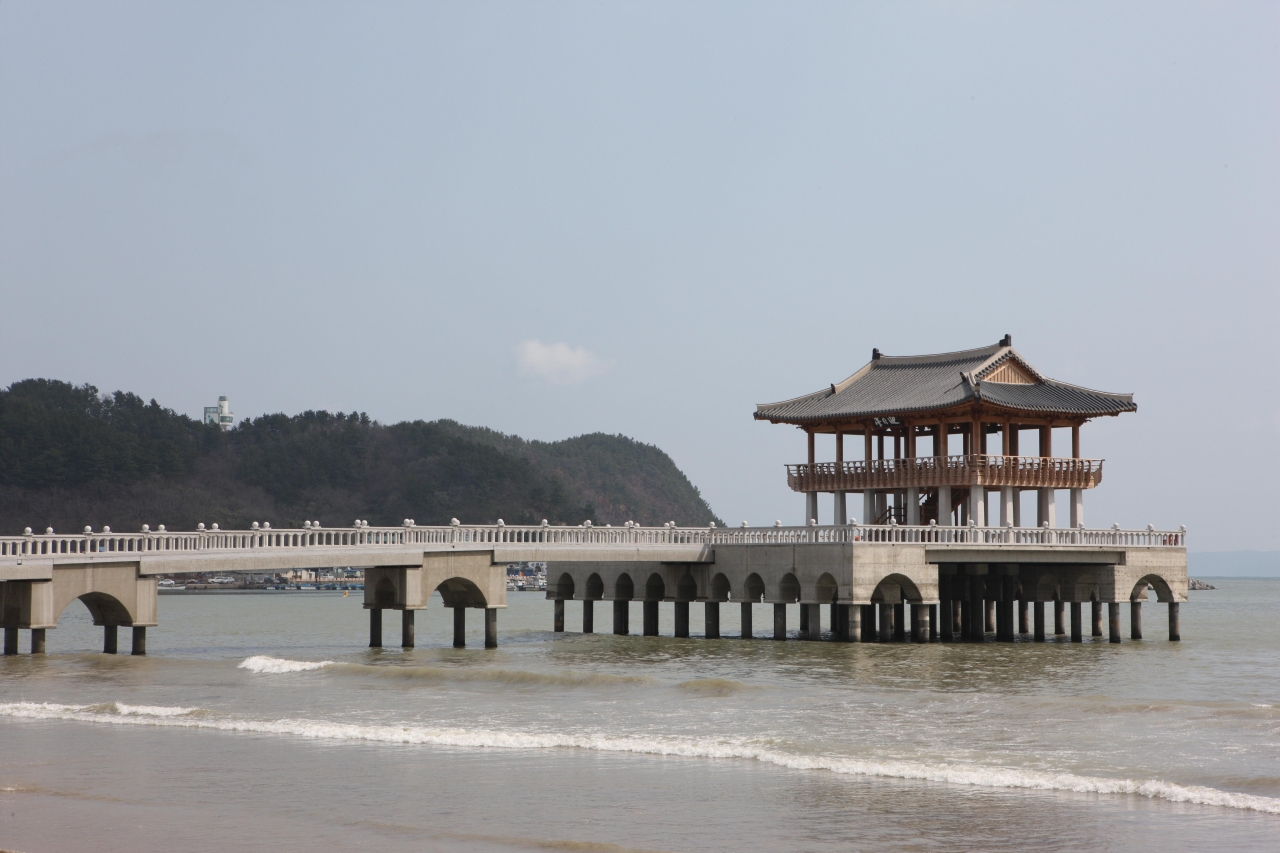
At 1,750 meters long, the KTO calls Yeongildae the largest beach on Korea's east coast. It is an urban beach: apartment blocks and restaurants run along the back of it, and there is a working city behind you rather than a resort.
Two things are worth doing here. Walk out to the pavilion standing over the water, and look across Yeongil Bay at the steelworks on the far shore.
That view divides people, and it should not. A steel plant across the water from a public beach, lit up after dark, is what Pohang looks like. Treating it as something to crop out of the photo misses the city.
Space Walk
The most distinctive thing in Pohang, and the reason many people come.
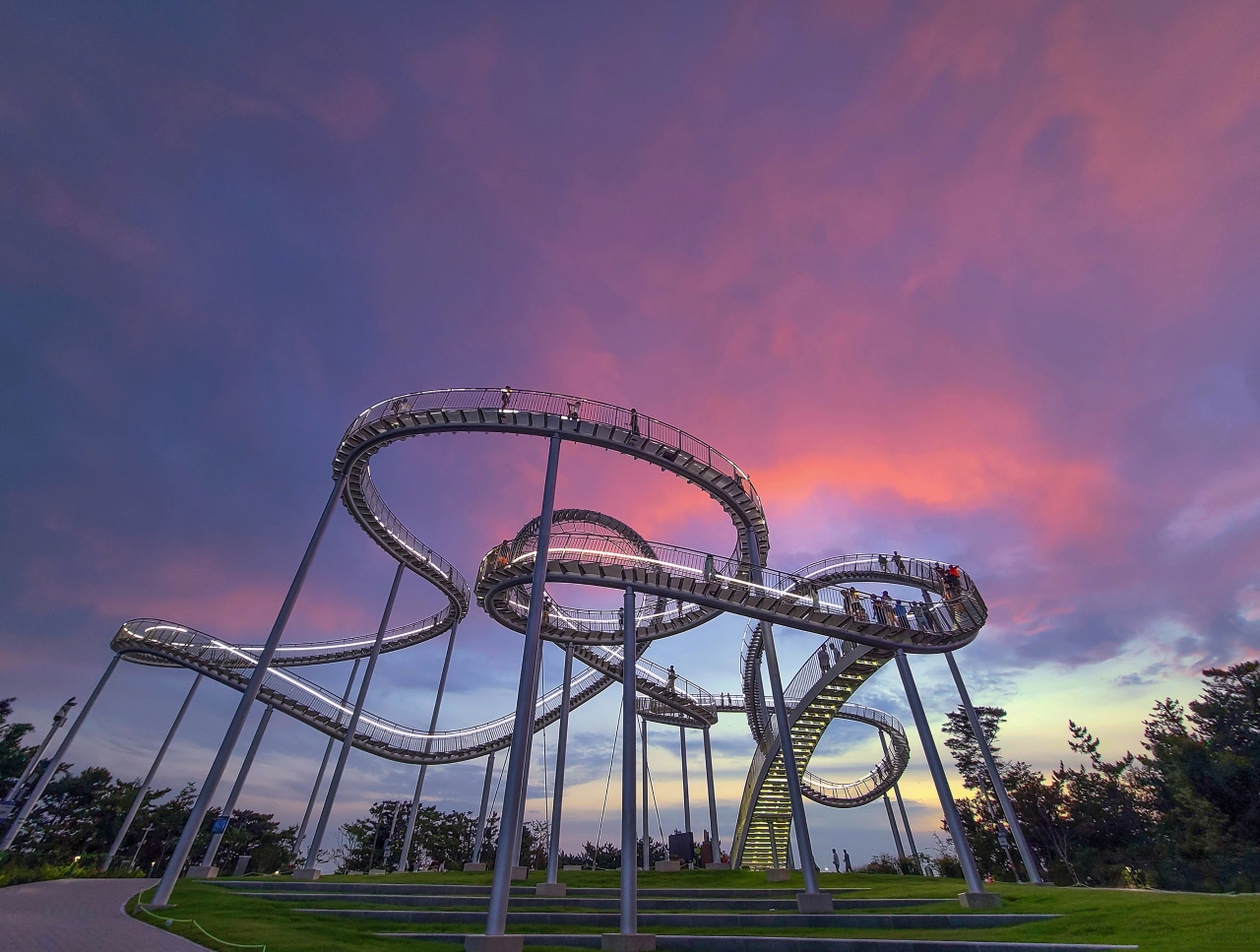
Space Walk is a large steel structure in Hwanho Park, on the hill above the coast. It reads as a roller coaster in photographs. It is not one. It is a staircase you walk on, looping up and over itself, with the bay below.
Pohang City publishes the operating details:
| Admission | Free |
| April to October | Weekdays 10:00 to 20:00; weekends and holidays 10:00 to 21:00 |
| November to March | Weekdays 10:00 to 17:00; weekends and holidays 10:00 to 18:00 |
| Closed | First Monday of each month, or the next day if that Monday is a holiday |
| Capacity | 150 people on the structure at once |
| Height rule | Visitors under 110 cm cannot enter |
| Contact | 054-270-8282, weekdays 09:00 to 18:00 |
Sunrise, sunset, and what you actually see
Pohang faces east. That has a practical consequence people get wrong.
Sunrise comes up over the East Sea. That is the real thing here, and it is why Homigot exists as a destination.
Sunset does not drop into the ocean at Yeongildae. What the evening gives you instead is the bay going blue, the city lights coming on, the steelworks lit across the water, and Space Walk illuminated on its hill. Pohang City runs the Space Walk lighting at varying brightness through the evening.
It is a good evening. It is not a west-coast sunset, and no amount of marketing copy changes which way the coast faces.
Jukdo Market
Pohang's largest traditional market, and a food stop rather than a photo stop.
Pohang City's own figures: about 148,760 square meters, roughly 1,200 shops, and around 200 raw-fish restaurants inside. Daily hours are listed as 08:00 to 22:00. It sells seafood, dried seafood, and live fish for sashimi, then everything else a city market sells, from vegetables and fruit to clothing and household goods, wholesale and retail.
The market grew up on its own. Street traders gathered on marshland by the inner harbor in the 1950s, the merchants' association was formally established in October 1969, and the market received its official opening permit in November 1971.
Practical approach in a market this size:
- Walk the whole seafood section before committing to anything.
- Check displayed prices, and ask what the total will be before you order.
- Where a restaurant cooks fish you picked from a tank, the fish and the table service are often priced separately. Confirm both.
- Seasonal items are seasonal. Snow crab and gwamegi are not equally available all year.
Guryongpo
A fishing port on the Homi Peninsula, southeast of the city, and a genuinely different half-day from the beach cluster.
Most visitors go for the street of Japanese-era wooden houses, and it deserves an accurate description.
After the 1883 trade agreement between Joseon and Japan, Japanese settlers moved into the peninsula. Fishing crews from Kagawa Prefecture followed the fish to Guryongpo and settled there, and under the protection of the Japanese colonial state they accumulated significant wealth while Korean fishing rights were expropriated. At its height the settlement held around 300 Japanese households.
Forty-seven of those wooden buildings survive. In 2010 Pohang City bought and restored them, and the KTO describes the city's purpose plainly: to create a living educational site for remembering that history. The Guryongpo Modern History Museum occupies a two-story Japanese wooden house built in the 1920s by a settler named Hashimoto Zenkichi.
So it is not a charming foreign quarter. It is a preserved colonial-period settlement, presented by the city as a record of an occupation. Visit it as that and it is one of the more interesting stops on this coast.
Guryongpo is also the center of Korea's gwamegi production, and the town has a Gwamegi Culture Museum.
Homigot
Homigot is the cape at the eastern end of the Homi Peninsula. The KTO describes it as the easternmost point of the Korean peninsula, the tail if you picture the country as a tiger, and states that its January 1 sunrise at 7:32 am is the earliest first sunrise in Korea.
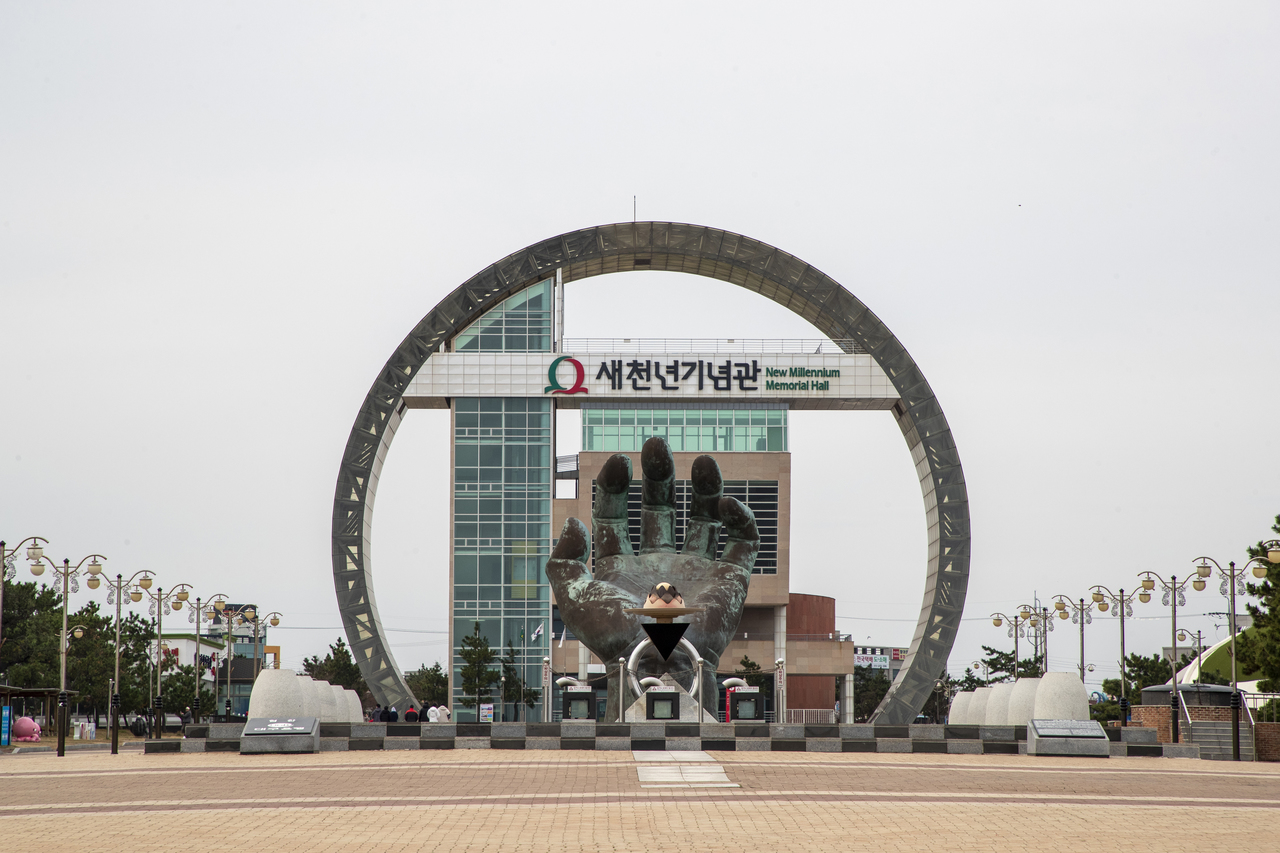
The landmark is a pair of bronze hands called Sangsaeng-ui Son, usually rendered in English as the Hands of Harmony. They were built in 1999 for the millennium and face each other across the shoreline: the left hand stands on the land, the right hand rises out of the sea. The sea-side hand is the larger of the two at 8.5 meters and 18 tons; the land-side hand is 5.5 meters and 13 tons.
The square around them runs to about 48,000 square meters and includes the New Millennium Memorial Hall, a torch and eternal flame, and open performance space. Rapeseed flowers bloom across it in April and May. Admission is free.
What to eat in Pohang
Pohang's food is a seafood-port cuisine, and two of its dishes barely exist elsewhere in the country.
Mulhoe
Mulhoe is the one to try, and "raw fish soup" is a poor translation.
It is sliced raw fish in a cold, sharp, gochujang-based liquid with vegetables, eaten cold. The KTO explains where it came from: fishermen too busy working to stop for a proper meal would slice up what they had just caught, mix it with chili paste and water, and drink it down. It was a working shortcut before it was a regional specialty.
Recipes vary by restaurant and by fish. Some versions lean sweet, others sour, others fiercely spicy. Rice or noodles usually come alongside, to go into the bowl at the end.
Gwamegi
Gwamegi is Pohang's cold-season specialty, and Guryongpo is its home. It is made from Pacific saury, half-dried outdoors in the cold sea wind, then eaten in slices, usually wrapped in seaweed or leafy greens with garlic and a dipping sauce.
The season is the point. Production runs while the sea wind is cold enough to dry the fish, roughly late November through February. Guryongpo gwamegi accounts for more than 90 percent of the national market.
If you are visiting in July, do not build your trip around gwamegi. It is a winter reason to come to this coast, not a year-round one.
Mori-guksu and snow crab
Mori-guksu is a Guryongpo dish, invented by boat crews out of whatever had not sold. A wide pot goes on the heat with monkfish and its innards, sea squirt, crab, mussels, and noodles, plus bean sprouts, scallion and a garlic-chili seasoning, all boiled down thick and hot.
Pohang is also a major snow crab landing point, which is why crab appears throughout Jukdo Market. Crab is seasonal and priced by weight, and prices move.
Can you visit Pohang without a car?
Yes, with one honest caveat about the far cluster.
| Where | Without a car |
|---|---|
| Pohang Station to Yeongildae | Easy. Bus 9000 or a short taxi |
| Yeongildae to Space Walk | Easy. Same coastal cluster |
| Yeongildae to Jukdo Market | Straightforward by bus or taxi |
| Anywhere to Guryongpo | Possible, but slower and needs a checked timetable |
| Anywhere to Homigot | Possible, but the most planning-intensive stop |
| Homigot before sunrise | Not realistic on ordinary city buses |
A car makes Pohang easier. It is not required. What is required is deciding in advance whether the Homi Peninsula is in your plan, because that decision changes everything else.
Pohang Tourist Taxi
This is the option most useful to foreign visitors, and Pohang City publishes its terms:
| 3 hours | 80,000 won |
| 5 hours | 125,000 won |
| Overtime | 25,000 won per hour, or 4,000 won per 10 minutes |
| Passengers | Up to 4 per car; 5 or more means two cars, with a 10 percent discount |
| Booking | At least two days ahead |
| Payment | On the day, by card or cash |
| Routes | Preset city, south, north and market courses, or a route you choose |
Split four ways, five hours at 125,000 won is about 31,000 won each, which for a Pohang Station to Guryongpo to Homigot to Yeongildae loop compares reasonably with a string of one-way taxis.
City tour courses
Pohang City also runs city-tour bus courses, and their routes confirm how the city splits up:
- Theme B: Pohang Station, intercity bus terminal, Jukdo Market, Yeongildae Beach, Space Walk, terminal, Pohang Station. This is the city cluster, and the city lists it as payable on the day at boarding.
- Landmark A: Pohang Station, terminal, Guryongpo Japanese House Street, Homigot Square, a coastal trail, Jukdo Market, Space Walk, terminal, Pohang Station. This is the version that reaches the peninsula.
Departure is confirmed after 13:00 the day before, and the theme A course is for groups of 35 or more. Check current operating days, pricing, and whether any commentary is available in English before you rely on one.
Pohang day trip from Seoul
A day trip works. It works for the city cluster.
Morning. Early train from Seoul Station or Suseo, and you are at Pohang Station roughly two and a quarter hours later.
Late morning. Bus 9000 or a taxi to Yeongildae. Walk the beach and out to the pavilion.
Midday. Up to Hwanho Park for Space Walk, weather permitting. Check conditions before you commit to the walk up.
Lunch. Jukdo Market, or one of the seafood restaurants along the Yeongildae front if you would rather not backtrack.
Afternoon. The central waterfront and the canal, or more of the coastal path.
Late afternoon. Back to Yeongildae for blue hour and the lights across the bay, if your train allows it.
Evening. Taxi or bus to Pohang Station, with buffer.
What does not work as a car-free day trip is Space Walk plus Jukdo plus Guryongpo plus Homigot. Something in that chain gets rushed, and it is usually the train.
Recommended 1-night, 2-day Pohang itinerary
This is the shape most first-time visitors should use, because it matches how the city is laid out.
Day 1: the city.
Arrive by late morning. Jukdo Market for lunch. On to Yeongildae in the afternoon, then Hwanho Park and Space Walk. Stay through blue hour for the bay and the steelworks lights. Sleep near Yeongildae.
Day 2: the peninsula.
Out to Guryongpo in the morning for the port and the Japanese-era street. On to Homigot for the Hands of Harmony and the cape. Back toward Pohang Station in the afternoon with real buffer, and a train home.
Day 2 is the day that needs a transport decision. Tourist taxi, a city-tour course, or a checked bus timetable, chosen before you go rather than on the morning.
Should you stay two nights?
Only for a reason. Two nights suits coastal hikers walking the Homi Peninsula trail, photographers who want both a sunrise and a night, and anyone heading north to Naeyeonsan and Bogyeongsa.
For a first visit built around the sights above, one night is enough and two is slow.
Where to stay in Pohang
Choose an area, not a hotel ranking.
Yeongildae. Our recommendation for most first-time leisure visitors. You are on the coast, the evening view is outside your door, Space Walk is in the same cluster, and the restaurant and cafe density is highest here. Staying out until the lights come on costs you nothing in transport.
Central Pohang and Jukdo. More practical than atmospheric. Best if your trip is short, market-focused, or built around city bus connections. Cheaper on average, quieter in the evening.
Near Pohang Station. Useful only for a very early departure or a very late arrival. It is not where you want to spend an evening, and you pay for that convenience in taxi fares during the day.
Guryongpo. Only if the peninsula is the point of your trip, for example a winter gwamegi visit or a sunrise at Homigot without a pre-dawn drive.
That call is our editorial judgment, not an official designation. If you value market access and short transfers over sea views, central Pohang is the better answer for you.
When to visit
| Season | What it gives you | What to weigh |
|---|---|---|
| Spring | Comfortable coastal walking; rapeseed flowers at Homigot in April and May | Wind on the cape |
| Summer | Beach season at Yeongildae, long evenings | Hot, humid, busiest at weekends |
| Autumn | The best walking weather on this coast | Nothing significant |
| Winter | Gwamegi season and the strongest case for sunrise | Cold and windy, and wind closes Space Walk |
Beach-opening dates are set each year and are not fixed, so check the current season announcement rather than assuming last year's dates.
If you have more time
North Pohang has its own coastline: the Igari Anchor Observatory, Wolpo, the market town of Cheongha, and Naeyeonsan with Bogyeongsa temple inland.
None of it belongs in a first trip built around the sights above. Add it on a second visit, or on a longer stay with a car.
Pohang and Gyeongju are close, roughly an hour apart, and pairing them across several days is reasonable. Squeezing both into one short trip is not, because each deserves more than a rushed half-day. If Silla-era heritage is what you actually want, Gyeongju should be the anchor and Pohang the add-on, not the other way around.
First-time priorities
Ranked by usefulness, not by claimed popularity.
Do these. Yeongildae and its pavilion, Space Walk, Jukdo Market. All three sit in the near cluster, all three are free or cheap, and together they explain what kind of city this is.
Add these with more time. Guryongpo and Homigot. Both are worth the trip; neither fits a rushed day.
Interest-based. The canal and central waterfront, POSCO-related visitor facilities, the northern coast, Naeyeonsan.
The reason for that order is transport, not merit. The first three cost you almost no travel time; the next two cost a half-day each.
Common mistakes
- Assuming Pohang Station is downtown. It is not, and there is no walking route to the sights.
- Trying to walk from the station to the waterfront. Take bus 9000 or a taxi.
- Planning Space Walk without checking the weather. Wind at 8 m/s closes it automatically.
- Arriving on the first Monday of the month and finding Space Walk shut.
- Fitting Homigot into a short downtown layover. Look at the map first.
- Assuming SRT leaves from Seoul Station. It leaves from Suseo.
- Assuming KTX and SRT share a Seoul departure station. They do not.
- Following pre-September 2026 booking advice. The apps and fares changed on September 1, 2026.
- Booking the last train back with no buffer after Homigot. Pohang has few departures.
- Planning a summer trip around gwamegi. It is a late-November to February food.
- Treating the Guryongpo street as a cute photo village. It is a preserved colonial-period settlement.
- Trying to see the whole Pohang coastline in one car-free day. Pick a cluster.
Frequently asked questions
Can I take a KTX directly from Seoul to Pohang? Yes. Direct service opened in March 2015 and runs from Seoul Station to Pohang Station. Check the current timetable for departure times and frequency.
Can I take an SRT directly from Suseo to Pohang? Yes. Pohang is the terminus of SR's Donghae Line, which runs Suseo, Dongtan, Pyeongtaek-Jije, Cheonan-Asan, Osong, Daejeon, Gimcheon (Gumi), Seodaegu, Dongdaegu, Pohang.
Is KTX or SRT better for Pohang? Neither. Use whichever Seoul-side station you can reach faster: Seoul Station for central and northern Seoul, Suseo for Gangnam and the southeast. Both arrive at Pohang Station.
How long does Seoul to Pohang take? Official figures put the KTX at about 2 hours 15 minutes and the first Suseo SRT at 2 hours 21 minutes. Trains with more stops take longer.
How do I book high-speed rail tickets now? Through Korail+ or the Korail website. Integrated KTX-SRT operation began on September 1, 2026, and the separate SRT app no longer covers trains from that date. Confirm the current channel before booking.
Can Pohang be a day trip from Seoul? Yes, for the city cluster: Yeongildae, Space Walk, and Jukdo Market. Not for Guryongpo and Homigot as well.
How far is Pohang Station from Yeongildae Beach? About 15 minutes on express bus No. 9000, or about 12 minutes by taxi, per the Korea Tourism Organization.
Can I visit Space Walk without a car? Yes. It is in Hwanho Park, the same coastal cluster as Yeongildae, reachable by city bus or a short taxi ride. Admission is free.
Why would Space Walk be closed? Rain or wind of 8 meters per second or more closes it automatically, and it also shuts on the first Monday of each month. Visitors under 110 cm cannot enter at any time.
Can I reach Homigot by public transport? It is possible, but it is the most planning-intensive stop covered here. Check the Pohang bus information system first, or use the tourist taxi or a city-tour course. Arriving before sunrise on ordinary city buses is not realistic.
How many days do I need in Pohang? One night and two days for the city plus the peninsula. A single day covers the city cluster only.
What food is Pohang known for? Mulhoe, a cold raw-fish dish; gwamegi, half-dried saury eaten from late November to February; mori-guksu, a Guryongpo seafood noodle pot; and snow crab and sashimi at Jukdo Market.
Where should I stay in Pohang? Yeongildae for most first-time visitors, central Pohang if you want market access and short transfers, near the station only for a very early train.
Is Pohang worth visiting in winter? It is the strongest season for two of its specialties: gwamegi, and sunrise at Homigot. Weigh that against cold, wind, and a higher chance of Space Walk being closed.
Sources
- KORAILOfficial transport site
- SRT (SR Corporation)Official transport site
- Visit KoreaOfficial tourism site
- Pohang City Official TourismOfficial tourism site
Information is compiled from official sources. Details such as prices, hours, and schedules can change. Confirm time-sensitive facts before you travel.
Last verified on
Related guides
How to Book KTX Train Tickets in Korea: KORAIL, SRT, Korail Pass, and Foreigner Tips
Korea's high-speed trains have been one system since 1 September 2026, when KTX and SRT stopped being two companies with two apps. Every high-speed train, including the Suseo departures that used to be SRT, is now booked in the integrated Korail+ app, on the KORAIL site, or at a station. Below: how to book, which Seoul station fits your trip, paying with an overseas card, and what the fare cut does and does not cover.
Gyeongju Travel Guide for First-Time Visitors
Gyeongju is Korea's open-air museum, the thousand-year capital of the Silla kingdom, where royal tomb mounds, a UNESCO temple, and an old observatory sit within easy reach. One full day covers the highlights; arrive by KTX to Gyeongju Station, which sits outside the historic center.