
Olympic Park is a free Songpa campus from the 1988 Seoul Olympics: walking paths, outdoor sculpture, Baekje earthworks, and concert halls share one oversized site.
Station choice is the real planning problem.
World Peace Gate and SOMA sit toward Mongchontoseong and Hanseong Baekje. KSPO DOME sits toward Olympic Park Station.
Do not enter at a random exit and try to walk the whole park. Visit Korea notes the grounds are large enough that a full circuit can take more than three hours.
Hours, exhibitions, and venue names change. Check KSPO, SOMA, and your concert ticket for the date you go.
Olympic Park at a glance
| Item | Detail (verify for your date) |
|---|---|
| Best for | Walking, photos, 1988 Olympic leftover spaces, outdoor art, concert logistics |
| Location | 424 Olympic-ro, Songpa-gu, Seoul |
| Park admission | Free (museums, sports, and concerts are separate) |
| Walking / bike access | About 05:00 to 22:00; square areas until 24:00 (KSPO) |
| After 22:00 | Inner park closed except Peace Square and Meeting Square |
| Recommended time | 60 to 90 minutes for one cluster; half day for heritage plus art |
| Photo stop | Lone Tree (inside the park, not at the subway) |
| History stop | Mongchontoseong plus optional Hanseong Baekje Museum |
| Art stop | SOMA indoor rooms plus free outdoor sculpture paths |
| Concert venues | KSPO DOME, Olympic Hall, and other named halls on your ticket |
| Main caution | The park is too large for one-station, one-loop sightseeing |
Quick facts
- Admission
- Park grounds free; indoor shows extra
- Time
- 60 to 90 min one cluster; half day if combining
- Station
- Pick by destination, not by the park name
- Access
- Walk/bike about 05:00 to 22:00 (squares later)
Is Olympic Park worth visiting?
Yes, if you want a long green walk with 1988 Olympic leftovers, outdoor art, and a Baekje fortress landscape. It is not a compact "one photo and leave" stop.
Good for
- Walkers and photographers who will pick a side of the park
- Repeat Seoul visitors after palaces and markets
- Families who want lawns, restrooms, and a free outdoor afternoon
- Concert-goers who want a short pre-show walk on the same side as the venue
- Autumn and spring outdoor days (weather and bloom still vary)
Less ideal for
- First-timers with only a few Seoul days (spend those on the palace core first)
- Shopping-first itineraries
- Anyone with about 45 minutes and no station plan
- Heavy rain, if your only goal is flowers and hills
Visit Seoul splits the park into arts and culture, recreation and sport, environment, and history.
For a visitor that means south-west art and gate, central fortress hills, and east sports and concert halls. Treat those as separate clusters.
Which subway station should you use?
There is no single best station. Olympic Park Station is named for the park. It is still a long walk from World Peace Gate.
| You want | Best station | Line | Why | Caveat |
|---|---|---|---|---|
| World Peace Gate / Peace Square | Mongchontoseong, Exit 1 | 8 | Official 9-spot notes put the gate by this exit | Not close to KSPO DOME |
| SOMA / outdoor sculptures | Mongchontoseong Exit 1 or Hanseong Baekje Exit 2 | 8 or 9 | Art zone sits on the Peace Gate side | Indoor SOMA is ticketed and often closed Monday |
| Lone Tree / fortress hills | Mongchontoseong, Exit 1 | 8 | Hills start from the west-south landscape | The tree is inside; budget walking time |
| Hanseong Baekje Museum | Hanseong Baekje, Exit 2 | 9 | Namesake station for the museum cluster | Museum closed Mondays and 1 January |
| KSPO DOME | Olympic Park, Exit 3 | 5 and 9 | Official KSPO DOME transit table | Wrong start for a Peace Gate morning |
| Olympic Hall / Rose Plaza side | Olympic Park (confirm exit on the day) | 5 and 9 | Hall and rose garden sit away from Peace Gate | Still check the ticket's exact hall name |
KSPO headquarters directions also list Mongchontoseong Exit 1 and Hanseong Baekje Exit 2 for the Peace Gate / Olympic Hall of Fame side. Visit Seoul's Olympic Park card lists Olympic Park Station Exit 4 at about 1,100 m, which is a warning, not a recommendation for the gate.
Pay with T-money as usual. Fare rules stay on the T-money card guide.
Olympic Park Station (Lines 5 and 9)
Use this for east-side venues, Meeting Square, and KSPO DOME. Official KSPO DOME pages name Exit 3.
Skip it as a default if your only goal is Peace Gate, SOMA, or the Lone Tree.
Mongchontoseong Station (Line 8)
Use Exit 1 for World Peace Gate, the sculpture walk, and the start of the fortress hills. This is the usual first-time park entrance.
Hanseong Baekje Station (Line 9)
Use Exit 2 for the museum and a short walk toward Peace Square / SOMA. It is a strong Line 9 alternative when you are already on that line.
How much time do you need?
| Length | What fits |
|---|---|
| 60 to 90 minutes | One cluster: Peace Gate + nearby sculptures, or Lone Tree from Mongchontoseong, or venue plus a short lawn walk |
| 2 to 3 hours | Peace Gate, SOMA outdoor paths, fortress ridge, Lone Tree, then exit |
| Half day | Add Hanseong Baekje Museum or a slow flower/rose loop. Do not add KSPO as a "while you're here" extra if you started at the gate |
| Concert day | Station → one nearby photo stop → food → venue. No cross-park hike |
KSPO's official 9-spot stamp course from World Peace Gate is about 3.8 km / 2 hours if you collect all nine. A shorter sculpture-and-gate loop is listed around 1.9 km / 40 minutes. Those are planning ranges, not a promise you will match the clock.
Best things to see
World Peace Gate
World Peace Gate (세계평화의문) is the 1988 entrance monument at Peace Square, designed by architect Kim Chung-up. KSPO describes a roughly 24 m high winged gate with Four Spirits paintings under the eaves and rows of mask pillars.
It is the park's easiest orientation landmark. Photograph it, then decide whether you continue into SOMA, the moat, or the fortress hills.
Peace Square itself stays useful later than the inner park: KSPO keeps square areas open until 24:00, while the interior closes at 22:00.

1988 Olympic heritage, in traveler doses
The park was built for the 1986 Asian Games and 1988 Summer Olympics. What you still use as a visitor:
- World Peace Gate and Peace Square
- Sports halls that now host concerts and events (names on the ticket, not "the Olympic stadium" as a generic label)
- Outdoor sculptures collected with the Games-era art program
- Flag / plaza leftover spaces on the Peace Gate side
Skip a full 1988 history essay. You are here to walk the campus that the Games left behind.
SOMA Museum and the sculpture park
SOMA (Seoul Olympic Museum of Art, 소마미술관) is the indoor art stop on the Peace Gate side. Official SOMA hours currently read 10:00 to 18:00. Last entry is earlier than closing. The museum is typically closed Mondays, plus 1 January and Seollal / Chuseok days. Confirm the calendar before you go.
Park grounds are free. SOMA exhibitions are not automatically free. Ticket prices change by show and by building. Do not copy an old ₩3,000 or ₩5,000 figure from a third-party listing.
Outdoor sculptures sit on park paths around SOMA. Visit Seoul describes a large international outdoor collection. Walk them without treating any "top 5 in the world" marketing line as a Tripkopia ranking.
Mongchontoseong Fortress
Mongchontoseong (몽촌토성) is a Baekje-period earthen fortress inside the park, not a Joseon palace wall. Seoul Baekje Museum lists it as Historic Site No. 297, an earthwork on the south bank of Seongnaecheon.
Visit Seoul dates the remains around the 3rd or 4th century. The walk is a grassy ridge with city views, stairs in places, and more wind than the paved Peace Square.
Allow extra time if you are using a stroller or a wheelchair. This is the cluster where "the park is accessible" stops being a blanket claim.
KSPO also closes the fortress interior outside park hours for heritage protection.
Hanseong Baekje Museum
Hanseong Baekje Museum (한성백제박물관) is the indoor history pair for the fortress. Official English hours: 09:00 to 19:00. Closed Mondays, 1 January, and other director-set days.
Permanent admission is free. Special exhibitions may charge. The museum covers Hanseong Baekje, the period when Baekje's capital sat in the Seoul area from 18 BCE to 475 CE, before the move to Ungjin (Gongju).
Use it if you care why these hills exist. Skip it if you only want photos and a walk.
The Lone Tree
The Lone Tree (나홀로나무) is a single tree on a hill inside the park. Visit Seoul notes it survived when nearby houses were cleared for the Olympic landscape, which is why it reads as a solitary landmark.
It is a well-known photo stop. It is not at the subway door, and it is not "Seoul's number one photo spot" as a fact.
Walk in from Mongchontoseong Exit 1 via the fortress landscape. Budget the hill, not just the shutter click.

Rose Plaza and seasonal flowers
Rose Plaza (장미광장) is an official 9-spot stop near the Olympic Hall side. Wildflower Hill (들꽃마루) is the other named seasonal field.
Roses and cosmos follow weather and planting, not a fixed calendar. Do not plan "roses every May 1 to 31" or "cosmos peaks on September 20."
In September, wildflower and cosmos displays are often the reason people come, including around the Lone Tree hillside. Treat that as a check-the-park-this-week note, not a permanent feature.
Best walking routes
Pick an entrance and an exit. Do not criss-cross from KSPO to Peace Gate to the Lone Tree and back.
Route A: First-time highlights (about 2 to 3 hours)
- Mongchontoseong Station, Exit 1
- World Peace Gate and Peace Square
- SOMA outdoor sculpture paths (go inside only if you have ticket time)
- Mongchon moat
- Mongchontoseong ridge
- Lone Tree
- Exit the same station, or keep walking east only if you still have energy
Route B: Photo / nature
- Mongchontoseong Exit 1
- Lone Tree hillside
- Wildflower Hill if it is in bloom
- Rose Plaza if you are already moving toward Olympic Hall
- Do not add KSPO DOME "because it is on the map"
Route C: Concert day (short)
- Read the exact venue name on the ticket
- KSPO DOME: Olympic Park Station Exit 3, then a short park-edge walk
- One nearby square or lawn photo, then food, then the hall
- Skip Peace Gate unless you arrived hours early and accept a long extra walk
Route D: History and art (half day)
- Hanseong Baekje Station, Exit 2
- Hanseong Baekje Museum (closed Monday)
- World Peace Gate
- SOMA indoor or outdoor sculptures
- Fortress ridge if legs remain
- Do not finish at KSPO unless that is your evening event
A useful cross-park pattern: enter Mongchontoseong, exit Olympic Park Station only if you are walking east on purpose (flowers, Rose Plaza, a later east-side event). The reverse works for a concert arrival plus a short east-side stroll.
Best seasons
Spring: milder walking weather; rose timing still depends on planting and weather. Bring a layer.
Summer: shade is uneven and the park is huge. Midday long walks are sweaty. Start early or late.
Autumn: the strongest outdoor season for grass, trees, and (some years) wildflowers. There is no official single peak foliage date.
Winter: the landscape stays open and the gate still photographs well. Flowers drop out. Wind on the fortress ridge is real. The park is still worth a short walk, not an all-day picnic plan.
If you are attending a concert
Olympic Park is several venues, not one building. Confirm the name printed on the ticket.
| Venue | Current official naming | Station cue |
|---|---|---|
| KSPO DOME | KSPO DOME (Olympic Gymnastics Arena / 체조경기장) | Olympic Park Station Exit 3 (official venue page) |
| Olympic Hall | Olympic Hall (올림픽홀) | East / Rose Plaza side; still confirm the day's exit |
| Other halls | Handball arena and art halls keep their own names | Trust the ticket, not a blog that says "Olympic Park concert" |
Event days get crowded at stations, convenience stores, and roads. That is normal. Do not invent a one-hour subway queue.
Doors, bag rules, and lockers are event-specific. Use the promoter page. Station lockers are a separate maybe, not a park promise.
Concerts end at different times. Check last trains on Lines 5, 8, and 9 for your date rather than copying a generic last-train table.
Food, toilets, and practical facilities
The park has restrooms, convenience stores, and cafes on official amenity pages (Meeting Square / Olympic Park Station side, Olympic Hall, swimming-pool area, and KSPO DOME interiors on event days). Hours flex for performances.
Eat a real meal in Jamsil or Bangi-dong if you want more than convenience-store food. This page is not a restaurant list.
KSPO rules that matter for a picnic:
- Cooking is prohibited
- Smoking only in designated spots
- Do not damage lawns, flowers, or trees
- Commercial shoots need prior approval
Dogs: official English etiquette asks for a leash, muzzle, and waste bags. If that does not match how you travel with a pet, skip the inner lawns.
A Hodori park train still has an official reservation page near Peace Square. Treat it as optional. Confirm whether it is running the day you go.
Accessibility
Visit Seoul lists accessible restrooms, parking, pathways, and information-center services. KSPO rents wheelchairs at Peace Square and Meeting Square information desks (ID, time limit; confirm on the day).
Paved squares are the easy part. Mongchontoseong stairs, grass, and seasonal paths are not a full wheelchair loop. Do not assume the entire park is step-free.
Olympic Park plus Jamsil
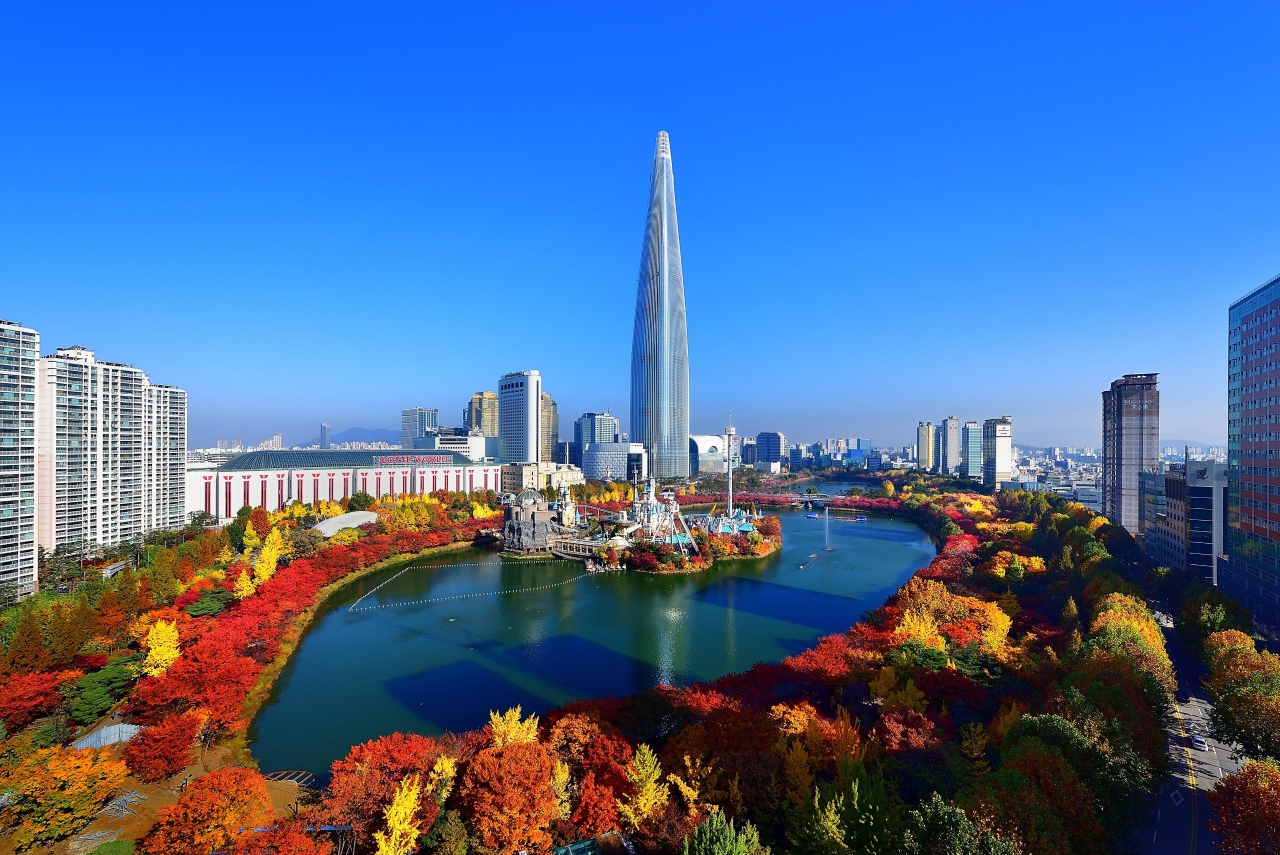
West of the park, Seokchon Lake, Lotte World Tower, and Jamsil Station are a separate afternoon. That pairing works if you finish the park on the west / Mongchontoseong side and still have energy.
Full Jamsil lodging and theme-park planning stays on the Jamsil and Songpa stay guide.
A simple shape: morning Olympic Park (gate + tree) → lunch toward Jamsil → lake walk. Reverse it if you want evening light on Peace Square.
Common mistakes
- Using Olympic Park Station for World Peace Gate "because of the name"
- Thinking the Lone Tree is in front of the ticket gates
- Forcing a cross-park loop: KSPO, then Peace Gate, then the tree, then back
- Assuming everything inside is free because the park is free
- Copying last year's SOMA price or a closed exhibition
- Treating Rose Plaza / cosmos as year-round
- Entering the inner park after 22:00
- Showing up for "the Olympic Park concert" without reading which hall
FAQ
Is Olympic Park free? The grounds are free. SOMA shows, special museum exhibitions, sports programs, bike rental, and concerts charge separately.
Which station should I use? Mongchontoseong Exit 1 for Peace Gate, SOMA, and the Lone Tree. Olympic Park Station Exit 3 for KSPO DOME. Hanseong Baekje Exit 2 for the Baekje museum.
Is the Lone Tree next to the subway? No. It sits on a hill inside the fortress landscape. Plan a walk.
Is Olympic Park worth it if I have no concert ticket? Yes, if you like parks, photos, and a bit of 1988 plus Baekje landscape. No, if you need a dense indoor neighborhood in under an hour.
Can I combine it with Jamsil? Yes as a second cluster, especially from the Mongchontoseong side toward Seokchon Lake. Do not try to "do" Lotte World and the whole park as one casual loop.
Do I need a car? No. Three subway stations cover the useful doors. A car mainly helps if you are carrying concert gear and using paid parking.
Are the flowers out in September? Sometimes, especially wildflower and cosmos plantings. Check current park photos or KSPO notices. Do not lock a trip to a single bloom date.
Final takeaway
Enter Olympic Park on the side that matches your goal. Walk Peace Gate, sculptures, fortress, and Lone Tree from Mongchontoseong, and keep KSPO DOME on the Olympic Park Station side. The park is free and large. Your time goes further when you stop trying to see all of it.
Sources
- Olympic Park (KSPO official)Official tourism site
- Visit Seoul, Seoul Tourism Organization (official)Official tourism site
- Visit KoreaOfficial tourism site
- SOMA Museum of Art (official)Official tourism site
- Seoul Baekje Museum (Hanseong Baekje Museum official)Official government site
Information is compiled from official sources. Details such as prices, hours, and schedules can change. Confirm time-sensitive facts before you travel.
Last verified on
Related guides
Where to Stay in Jamsil and Songpa: Lotte World, Suseo SRT, and Value Hotels
Jamsil and Songpa, in southeastern Seoul, are the area for Lotte World, Lotte World Tower, and the Han River parks, and the handiest base if you're catching the SRT to Busan from nearby Suseo. It's family-friendly and practical rather than central for palaces. The sub-areas, who each one suits, and what to check before booking are below.

T-money Card Guide for Visitors to Korea
A T-money card is a rechargeable transit card that works on subways, buses, and most taxis nationwide. Buy one at any convenience store or station machine for about ₩3,000 to 5,000, load cash onto it, and tap in and out. It is the simplest way for visitors to get around Korea.